More about Hourana, Radio National AM here
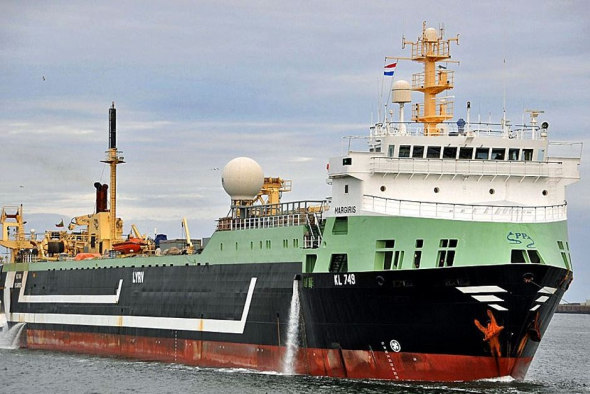
Environment groups have today rejected an offer from Federal Fisheries Minister Joe Ludwig to enter into negotiations with Tasmanian company Seafish as the closed-door negotiations are an attempt to avoid rather than promote public debate on an issue of state and national importance.
The rejection of this process by conservation groups, including Environment Tasmania, Tasmanian Conservation Trust, WWF-Australia, Australian Marine Conservation Society, Greenpeace, Conservation Council of Western Australia, Ocean Planet Tasmania, Australian Conservation Foundation, Humane Society International and The Wilderness Society, came after they had repeatedly raised concerns with the Minister over the proposal to allow the world’s second largest super trawler to fish in Australian waters.
Spokesperson for Tasmanian Conservation Trust Jon Bryan said the Minister’s offer of closed door negotiations would not reduce community concerns about the introduction of this super trawler.
“Closed door negotiations are completely inappropriate. It is the job of the Australian Fisheries Management Authority to do these things properly and they must do them transparently and openly. How can the meeting be expected to do the job of fisheries management and solve in few weeks problems that the Government has not been able to fix over years,” Mr Bryan said.
Environment Tasmania’s Marine Coordinator Rebecca Hubbard said there is deep and widespread opposition to the introduction of this super trawler, reflected by over 22,000 signatures on an online petition, and ongoing rallies and events around Tasmania.
“Instead of backroom negotiations, the Minister must act immediately to address the concerns of the Australian public and conservation groups,” Ms Hubbard said. “This new process does not have any credibility, and seems to replicate processes that have failed in the past.”
“We lack the safeguards to ensure that Australia can sustain a vessel of this size in our waters. We do not want to suffer the same fate as other countries visited by this super trawler that were unprepared for the scale of its fishing operation.”
Background:
Ten environment organisations representing state, national and international concerns wrote to Minister Ludwig regarding the proposed introduction of the FV Margiris on 6 June and again on 4 July, followed by a meeting of representatives with the Minister in Sydney earlier this week.
The petition is hosted by the Australian organisation Community Run and can be viewed on this link:
http://www.communityrun.org/petitions/stop-giant-fishing-trawler-in-tasmania
Rebecca Hubbard, Environment Tasmania
Jon Bryan, Tasmanian Conservation Trust
Tooni Mahto, Australian Marine Conservation Society
Elsa Evers, Communications Officer, Greenpeace Australia Pacific
First published: 2012-07-24 06:25 AM
• LUDWIG MOVE CASTS DOUBT OVER PELAGIC FISHERY DATA
Kim Booth MP
Greens Primary Industries Spokesperson
Wednesday, 25 July 2012
The Tasmanian Greens today said the Federal Fisheries Minister appeared be accepting that the science behind the small pelagic fishery quota was questionable, by seeking to appoint an ad hoc working group to determine additional operating conditions for the super trawler FV Margiris.
Greens Primary Industries spokesperson Kim Booth MP today called on Mr Ludwig to explain whether or not he still had confidence in the AFMA process, and if so, why additional measures were needed to help keep the Margiris in check.
“The Greens have always said that the science behind AFMA’s assessment was out of date and incomplete and that it is inappropriate for a vessel such as this to be fishing in Australian waters,” Mr Booth said.
“Up until now the Minister has been trying to convince Tasmanians there’s nothing to worry about because all the boxes have been ticked by AFMA.”
“Mr Ludwig should know better than trying to silence fishing groups by bringing them behind closed doors in an attempt to massage AFMA’s so-called scientific assessment process.”
“If this is about improving the science behind the management of the fishery, then trying to bring community representatives into closed door discussions with SeaFish Tasmania is the wrong way to go about it.”
• WILKIE URGES OMBUDSMAN PROBE INTO MV MARGIRIS FISH QUOTA
The Independent Member for Denison, Andrew Wilkie, has written to the Commonwealth Ombudsman about apparent irregularities in the AFMA process that determined the fishing quota relevant to the super trawler Margiris.
“The super trawler is heading for Tasmania, but there is a serious question mark over whether AFMA followed proper process when it determined the fishing quota of the operator, Seafish Tasmania,’’ Mr Wilkie said.
“Unless this is cleared up very quickly, there’s the very real possibility the quota should be revoked because the basis for the super trawler coming to Australia is unlawful.’’
The unanswered questions focus on the teleconference of AFMA’s South East Management Advisory Committee on March 26 this year when a recommendation was finalised on the 2012/13 Total Allowable Catch for the small pelagic fishery.
The Fisheries Administration Act 1991 is quite clear where it states that members of the committee with a direct conflict of interest must absent themselves from any meeting, or for the committee to decide deliberately if the member can remain in attendance.
The Act and an associated policy document also require minutes of meetings be kept but there are no minutes for the March meeting publicly available on the AFMA website.
Seafish Tasmania’s Gerry Geen is a member of the advisory committee and it’s noted in the Chair’s Summary of the teleconference that Mr Geen declared a “direct conflict of interest’’ in the setting of the fishing quota.
But due to the lack of minutes there’s no way of knowing if the Act was followed – which would require Mr Geen to either absent himself from the meeting or the committee to authorise him to remain.
“Minutes are required by the Act and their apparent absence for a meeting at which such a controversial recommendation was agreed raises serious questions the Commonwealth Ombudsman is best placed to investigate,’’ Mr Wilkie said.
“In particular did Mr Green absent himself from the meeting in accordance with the Act, or did the committee decide he could stay and why?
“The public needs to be assured proper process was followed when AFMA decided to increase the fishing quota and open an opportunity for the world’s second largest super trawler to operate in Australian waters.’’
• Crikey today: Something fishy going on with supertrawler brawl
Lionel Elmore, Crikey naturalist, writes:
The imminent arrival of one of the world’s largest fishing trawlers in Australian waters has set off howls of protest from conservation groups — but they may only have themselves to blame.
The supertrawler Margiris, at 140 metres the largest fishing vessel ever to work in Australian waters, is expected to arrive in Tasmania within weeks. Opponents warn the factory ship will deplete fish stocks, damage the environment and squeeze out smaller fishing operators (including recreational fishermen).
The public has every right to be concerned that this factory ship will drag an unimaginably huge net across the seafloor, possibly catching and drowning seals and dolphins, while perhaps dumping tonnes of fish for which there is no quota. It’s a type of vessel more suitable for trips of months in remote waters when there is no access to shore-based processing — not for coastal fishing.
But the supertrawler’s arrival is the logical and direct result of 20 years of fisheries reform that has been heartily backed by many of the green groups now protesting so loudly.
Authorities used to conserve fish stocks by “boat management” — restrictions on gear used, and the areas and seasons in which people could fish. The system has been reformed towards “catch management” (also called “quota management”), where total allowable catch is capped and transferable, with operators free to accumulate quotas and fill their quotas however they like. This has encouraged large operators to buy up quotas and dominate the market — and led to one massive supertrawler wending its way towards Tasmanian fish stocks.
The writing was on the wall for smaller fishing operators once this policy reform process was put in place. Economists might like it, and see the dominance of big players and big vessels as more efficient, but it has wreaked significant damage on the industry.
Gerry Geen, the director of SeaFish Tasmania, was a fisheries economist who played a key role in the introduction of quota management in Australian fisheries and is now part of the industry he helped establish. His company is bringing the Margiris to Devonport, Tasmania, in a joint venture with the ship’s Dutch owners, to fish for redbait and jack mackerel.
Setting fishing quotas and strictly limiting catches to prevent overfishing was sold to the Australian public and conservationists by scientists, economists and bureaucrats. For scientists it promised a massive increase in research dollars for a huge variety of species. The management bureaucracy expanded too, with all costs recovered from the industry and passed through to the price of fish.
Recreational fisheries have also been identified for future quota management. Now the recreational fishing sector is leading the protests against trawler.
Improving the economic efficiency in fisheries, replacing small so-called “inefficient” owner-operators with corporate owners and large boats, has been the aim from the outset. But was the small-fry nature of the industry ever really a problem?
Just one trawler can land 5% of the total allocated catch for a given species, but that it is apparently sustainable in the view of SeaFish Tasmania, the Australian Fisheries Management Authority, and marine scientists who have the job of estimating how many fish are in the sea — estimates we “should have faith in” according to Geen.
Extraordinarily, the implementation of quota management does not include habitat associated with the marine environment.
And in a bizarre twist, as the amount of fish caught declines under quota, the actual value of fish increases by more than that decline — making local fish very expensive to the public while also limiting their choice.
The underlying issue for the public, however, is the massive loss of jobs that fisheries reform has caused. It was not long ago that there was a multimillion dollar buyout of hundreds of licences, itself representing many hundreds of jobs lost. But the total quota was not reduced.
Fisheries economists only value the landed catch, not the jobs in crewing, building and maintaining boats or transporting, processing and retailing fish. Then there is the additional value of local fresh-caught fish in retail, so obvious in Hobart. The economic impact and job losses from Australian fisheries management reform has been grossly underestimated.
We the public, especially marine green groups, surely must share some of the blame. We have been quick to demonise the small-boat trawl industry for its apparent unsustainability, while lauding fish farming. Yet the environmental cost of the modification of seabed to make trawl grounds for small boats should be compared to that of factory farming. Even organic farming needs all the native vegetation cleared, while conventional farming uses a wide range of agricultural chemicals and fertilisers — pollutants at sea.
The arrival of this trawler perhaps highlights too the state of Australian fisheries management. Fishermen can neither land nor confess to dumping perfectly good fish, even when dead, that they have no quota for, for fear of being fined, losing their licence or even having their fishery closed.
Crikey here (online has full links)
• Last Friday Tasmanian Times posted this John Hawkins’ analysis with the observation, I suggest that the power of vested interest is here displayed … And the plea, Please respond Mr Geen: All about Seafish Tasmania: Download document: Fishery_Document_(2).docx
• Download The Sustainability Myth: 2006_Longhurst_Fisheries_and_the_sustainability_myth.pdf or Read Online: Here