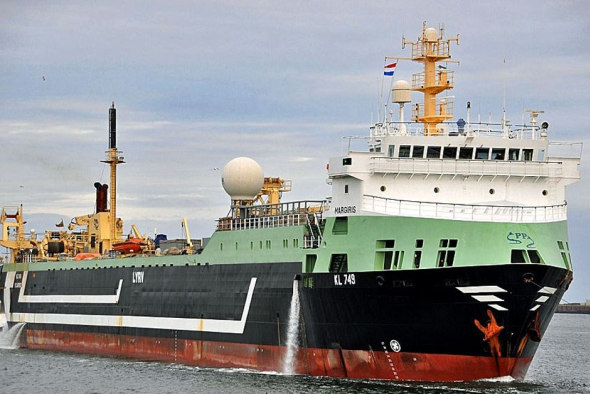
A local fishing company is firming up plans to bring a giant industrial fishing trawler into Australian waters, and government still has not put in place strategies to protect fish stocks. The marine ecosystem, marine mammals, seabirds and other marine life are now at risk.
I wrote an article for the August 2010 Tasmanian Conservationist about the renewed push to bring a large freezer trawler into Australian waters, and the threats posed by this type of factory ship to fish stocks, other marine life and the marine ecosystem. This industry proposal is now well advanced and appears to have the support of the Australian Fisheries Management Authority (AFMA).
The risks and problems I outlined in the 2010 article remain and have simply not been addressed by industry, or the government’s Commonwealth Fisheries Manager, AFMA.
Small pelagic fishing around Tasmania already has a bad record. The huge surface schools of jack mackerel that were once common off south-east Tasmania still have not returned more than 20 years after the fishery that targeted them collapsed due to a lack of fish. The industry was reanimated about 10 years ago and targeted a new species, redbait. These schools also disappeared in the Tasmanian region just a few years after industrial fishing started up again.
Before we even consider allowing factory trawlers into Australian waters, the small pelagic fishing industry and the federal government must prove that the fishery will be sustainable, that marine mammals and seabirds will not be killed as bycatch, and that localised overfishing will not occur. There needs to be a long-term commitment to undertaking proper regular assessments of the pelagic stocks. These must be based on annual fishery independent daily egg production method (DEPM) assessments, so that we can get a reliable estimate.
One of the difficulties associated with managing any small pelagic fishery is that numbers can vary greatly, and unpredictably, from year to year as a result of environmental conditions. This means that fishing pressure can crash a fish stock if it is maintained at previous levels when poor environmental conditions (which may not be apparent to the human observer) reduce stock to critical levels. Many small pelagic fisheries around the world have collapsed due to poor management, and it would be unforgivable to allow that to happen again in our local fishery.
The latest industry proposal is to bring a Lithuanian-flagged ship called the Margiris into Australia. This factory ship will process its catch at sea and produce a low-value product for export. The company indicates that it will be reflagged as an Australian vessel, although I believe that ultimate ownership of the ship will remain European. All officers will be foreign, but the proposal includes sourcing crew from Australia, no doubt as a way to reduce controversy over the Labor government allowing yet more foreign workers into Australia. It is unclear how many Australians will gain long-term employment as crew on this ship. There will be relatively little economic benefit to Australia, with much of the profit going to foreign shipowners. Australia’s marine environment will be put at risk for little reward
The Margiris is a huge factory trawler, 142m long with a gross tonnage of 9499 tons, and makes most Australian fishing boats look like bath toys. This ship poses a direct threat to marine mammals such as seals and dolphins, and seabirds. It is an ocean-going vacuum cleaner, able to deploy enormous trawl nets that are up to 600m long with an opening 100m by 200m across.
The Margiris is owned by a member of the European Association of pelagic freezer trawlers (PFA). This association is responsible for some of the worst fishing practices on the planet. It grew out of the devastation of North Sea herring fisheries. When these collapsed due to overfishing, the companies and boats moved on to new fishing grounds. In 1995, PFA trawlers started fishing off West Africa and later extended their activities into the south-east Pacific, where they participated in an ongoing fishery disaster.
I understand that the South Pacific jack mackerel fishery has been targeted by the Margiris itself. The PFA has certainly targeted this fishery, which made headlines this year when it was revealed that fish populations had crashed by 90 per cent. Almost all the PFA’s target species are now fully exploited or overexploited off West Africa, to the point where the Senegalese government has moved to expel all PFA vessels from their waters. The Margiris itself has even been the subject of a Greenpeace protest action off West Africa. It is unbelievable that the Australian Government would allow such a vessel to operate in Australian waters, at least without some very stringent safeguards in place to protect our fish stocks and marine environment.
The small pelagic fish that this huge trawler will kill are a vital to the ecosystem, forming an important part of the diet of marine mammals such as dolphins and seals, game fish such as tuna, seabirds and other marine life. We can’t afford to put this element of our marine environment at risk.
Other small pelagic fish, such as lantern fish, may be too small to be caught by industrial trawl nets, but may still be injured and killed on contact with the gear. These species are also important to ecosystem processes, but there has been no assessment of fishery impacts on them.
Recently, claims were made during a TV interview with a Tasmanian Department of Primary Industry, Parks, Water and Environment spokesperson that the proposed factory ship will only operate in the Great Australian Bight or off Flinders Island. The implication was that it was not going to operate in Tasmania’s backyard so we should not be too concerned. Apart from this being a rather selfish and narrow-minded approach to fisheries management (we are part of the same country, after all,) the claims were nonsense as there are no regulations that would limit fishing to areas far from Tasmania. We can expect this ship to be able to fish from northern New South Wales to Tasmania in the south and across to the Great Australian Bight in the west. Once Australian quotas are caught, it may even continue to fish in international waters in our region. Fish do not recognise lines on charts.
The AFMA harvest strategy for small pelagic fish has recently been watered down so that there is no longer a requirement for regular science-based stock assessments, which are needed to ensure that fishing is sustainable. The AFMA and industry seem incapable of making a commitment to the necessary ongoing fishery assessments. Existing data is old and the current proposal will look at only two of the three main target species this year. I have no confidence that industry or AFMA will carry out any further DEPM-based assessments beyond that point.
One of the big problems associated with this type of freezer trawler is that, because of its size, it can be expected to concentrate effort and increase the risk of depleting local fish stocks. There is almost no information about the movements of these fish and AFMA has not even begun to collect useful data or look at ways to prevent long-term localised depletions such as appear to have occurred with jack mackerel and redbait off eastern Tasmania.
There also needs to be more research into the movement patterns of the small pelagic fish species that are targeted, so that a management strategy can be developed, to prevent localised overfishing. This work has not even been started.
In addition to regular and thorough stock assessments, and the development of a mechanism to prevent localised depletions, there needs to be 100 per cent on-board observer coverage on this type of vessel, to ensure that seals, dolphins and seabirds are not killed during fishing operations.
These significant concerns are widely shared, including by commercial and recreational fishers who see this ship and this fishery as a direct threat to their own activities.
The TCT has recently coordinated a letter from local and national environmental groups* outlining these concerns to the Federal Minister for Fisheries, Joe Ludwig, and asking how he would deal with them. We are still waiting for a response.
Jon Bryan
Marine Campaigner
Tasmanian Conservation Trust
For more articles from The Tasmanian Conservationist go online to our website www.tct.org.au
* As well as the Tasmanian Conservation Trust, signatories were the Australian Marine Conservation Society, Environment Tasmania, Greenpeace Australia Pacific, Humane Society International, Ocean Planet Tasmania, The Wilderness Society Inc and World Wide Fund for Nature – Australia.
• Earlier on Tasmanian Times: Supertrawling the spirit of Tasmania. Why is she going round in circles?
• LUDWIG MUST TURN BACK TRAWLER
As Community Angst Intensifies
Kim Booth MP
Greens Primary Industries spokesperson
Saturday, 14 July 2012
The Tasmanian Greens today called for the Federal Fisheries Minister, Joe Ludwig, to rule out the FV Margiris being granted a licence to operate in Australian waters, as community opposition intensifies.
Greens Primary Industries spokesperson Kim Booth MP said that the announcement by commercial and recreational fishing groups to hold rallies in three locations around the state next weekend should send a strong message to Canberra that people will not back down on this matter.
“Federal Minister Ludwig could put an end to all this community disquiet and angst by simply ruling out this supertrawler being granted a licence to operate in Australian waters,” Mr Booth said.
“Greens Member for Braddon Paul O’Halloran wrote to Minister Ludwig last week drawing to his attention the motion passed by our public forum calling for the operating licence to be denied.”
“It is incredible arrogance to have this monster trawler steaming over the horizon towards our fisheries when it doesn’t even have an operating licence. Is that how acquiescent Australia’s reputation is, that our decision-makers are considered to be just rubber-stamps?”
“Well, the Tasmanian community has stood up and is saying loud and clear that it will not be treated like a rubber-stamp.”
“They stood up last weekend at a public forum calling for the trawler to be turned back, and they will be rallying next weekend to protect local fisheries.”
“Across the community and from many different walks of life, there is growing concern over the out-dated science underpinning the decision to double the quota to 18, 000 tonnes each year, and a growing awareness that it is only because of the increased quota that this operation is financially viable for the trawler operation.”
“There is also mounting concern over the impact this operation will have not only on the target pelagic fish stocks, but also on the other fish species, seals, dolphins which depend on them for their food source.”
“These concerns will not go away, not until the threat of this supertrawler goes away. And that ball is in Minister Ludwig’s court,” Mr Booth said.
The Greens support people’s democratic right to peaceful, non-violent protest.
Text of motion passed by the Turn Back the Trawler public forum, Devonport, 8th July 2012:
That this meeting (Turn Back the Trawler) held at Devonport on 8 July 2012:
(1) expresses grave concern about the proposal to deploy the FV Margiris to fish Australian waters and AFMA’s management of the small pelagic fishery, and
(2) commits to continued lobbying of Government to stop the FV Margiris from fishing Australian waters and for AFMA to better manage the small pelagic fishery.
• George Monbiot: One of the purposes of government is to protect public goods threatened by the self-interest of unscrupulous people or corporations. But what happens when governments fail? When they are either unwilling or unable to protect something valued by the many from the depredations of the few? What do you do, for example, to defend the bluefin tuna? Read the full article, with full links here
Subject: (FV Margiris super trawler) Funding needed please for Super Trawler campaign!
• Anne: Hi Everyone,
Once again please excuse borrowing the pulp mill info list to highlight this super trawler issue that has arisen over the past couple of weeks. There could well be more emails from me in coming weeks encouraging support to stop this trawler so I hope you’ll bear with me until, (or if) it becomes necessary to create a dedicated list for those wishing to be kept informed about what’s happening with this monster. The hope is this factory fishing boat can be stopped before that point is reached.
As you can see a group has formed to lead the campaign to prevent this boat plundering our oceans. If you’re in a position to help with a donation to assist the efforts to do this, please consider helping. Details are at the end of the email.
Thanks,
Anne
To: [email protected]
Subject: Funding needed for Super Trawler campaign!!!
Dear Supporters,
As you may be aware, there is a super trawler arriving in Tasmanian waters in the next month. We are looking for funding to help us stop the trawler. The FV Margiris, a 142m, 10 000 Tonne Dutch factory ship, is set to trawl for redbait and jack mackerel, devastating the fragile marine ecology and diversity in Tasmania. The trawling nets are said to be 600m long, with an opening measuring 200m by 100m. This has already aroused massive dissent from all sectors including the fishing community, the Greens, the public and other marine and environmental conservation groups.
Stop the Trawler Action Group (STAG) is a grassroots community based organisation set up to stop the trawler from fishing in Tasmanian and Commonwealth waters. STAG is committed to non-violent direct action. The FV Margiris has plundered ocean fish stocks worldwide, leaving collapsed communities in its wake, and now it is on its way here. STAG will campaign against its arrival, following Greenpeace Holland’s efforts to stall the ship from leaving Europe.
We are organising to get people involved, raise awareness, pressure the relevant politicians and ministers, and ultimately ensure that this ship is not able to trawl in Tasmania. We will be co-ordinating public events including protest actions, demonstrations, Peaceful Direct Action Workshops, theatrical vigils, banner painting days and film screenings.
We are collecting money to buy resources and make these events happen.
To donate money to STAG:
Account name: STAG
Account number: 146383310
BSB: 633-000
Please forward this email to your contact lists and to anybody else who might be interested in helping us out.
We look forward to hearing from you.
Kind regards for your time in considering this request,
Erik
(on behalf of Stop the Trawler Action Group)
To follow what is going on, keep informed and find out about our events join us on Facebook…..
http://www.facebook.com/StoptheTrawlerActionGroup
For more info please have a read of this sheet…..
http://www.et.org.au/system/files/userfiles/Super%20Trawler%20fact%20Sheet_July%202012_0.pdf
And add yourselves to the petition to stop the trawler….
http://www.communityrun.org/petitions/stop-giant-fishing-trawler-in-tasmania
• IGNORING TRAWLER CONCERNS ARROGANT
As Fishing Groups Ramp Up Protest Action
Paul O’Halloran MP
Greens Member for Braddon
Sunday, 15 July 2012
The Tasmanian Greens today urged the Federal government to heed the escalating outrage over the imminent arrival of the supertrawler FV Margiris, as game and commercial fishing groups began to detail their protest plans.
Greens Member for Braddon, Paul O’Halloran MP, said it is incredible arrogance for either Federal Minister Ludwig or Seafish Tasmania to just hope that by ignoring community concerns, the issue will just go away.
“The Greens share the recreational and commercial fishing groups’ concerns over the negative impact this huge supertrawler will have on our local fish stock, local fishing industries and communities,” Mr O’Halloran said.
“Minister Ludwig must face up to the fact that these concerns are real. There is serious disquiet over the science being out of date and not stacking up, and there are real-life examples of ecological disasters in other international fisheries.”
“This is not about more so-called consultation with bureaucrats. There have been briefings between representatives of the Australian Fisheries Management Authority and recreational fishing groups, and the simple fact remains that they are not convinced.”
“There are too many unanswered questions, from how one Commonwealth observer can monitor a 24 hour, seven day a week operation without sleep, to the impact on fish stocks of doubling the quota to 18, 000 tonnes per year based on egg production data that is at least ten years old.”
“It is not good enough for Joe Ludwig to say he has no role in intervening with granting this ocean vacuum-cleaner an operating licence in Commonwealth waters. If he refuses to accept responsibility for turning back the trawler, than he must accept responsibility for the potential decimation of local fish stocks and ongoing community anger.”
“These Australian waters belong to all, they cannot be allowed to be plundered to benefit just one company’s profit margin.”
The Greens support people’s democratic right to peaceful, non-violent protest.
First published: 2012-07-13 04:33 pM
• Whish-Wilson calls on Ludwig for Super Trawler answers
Allowing a super trawler to operate in Australian waters without addressing all risks to our small pelagic fisheries is a disaster waiting to happen for fish stocks and local industries, Australian Greens Senator, Peter Whish-Wilson said today.
“I have been consulting with many stakeholders in the super trawler debate, and the message is clear: without answers, we cannot allow this super trawler into Australian waters.
“With so many unanswered questions, the risks to letting the super trawler operate under the current AFMA quota system and licensing arrangements are totally unacceptable.
“The trawler should not be granted a license by AFMA until key risks are first addressed, especially a scientific study on how to best manage the small pelagic fishery across the Eastern Seaboard to avoid local fish depletion issues.
“Allowing the trawler to operate without this study is simply a roll of the dice, and is unacceptable to many Tasmanians, including local fisherman and tourism operators who rely on healthy seas and ecosystems.
“How can you put in place an effective ecological and economically efficient spatial fisheries management plan without having collected adequate scientific fisheries data over the past 10 years?
“Stakeholders have been asking for this plan for months, and they want to know why AFMA still have nothing to show. We don’t even know who will administer, enforce and pay for such a plan.
“I have submitted more questions to Minister Ludwig because Tasmania wants detailed information surrounding the potential operation of this controversial vessel in Australian waters.
“It’s worth keeping in mind that over the history of Australian fisheries management, the best science and intentions hasn’t stopped many fisheries from going into decline, and even collapse. This time we must get it right.
“We need to exercise extreme caution in how we approach what is likely to be a significant turning point in the management of the Australian small pelagic fisheries”.
SENATE
QUESTION ON NOTICE
Date: 13/07/2012
Senator: Peter Whish-Wilson
To ask the Minister for Agriculture, Fisheries and Forestry – In regard to the
company Seafish Tasmania Pty Ltd (Seafish) bringing the ‘super trawler’ FV
Margiris to Tasmania, to be docked at Devonport in order to fish in the
Commonwealth Small Pelagic Fishery:
1) Does AFMA have an industry strategy to deal with localised depletion
within fisheries? If so, please provide detail. If there is no strategy, what
attempts has AFMA made to address this issue?
2) Does AFMA have modelling which shows the length of time it takes for
small pelagic fish to repopulate an area following localised depletion? If
so, please provide. If not, what data is AFMA relying upon to ensure
recovery from localised depletion events?
3) Is there a spatial management plan for the small pelagic fishery to
ensure localised depletion events cannot occur? If so, please provide.
If not, how will the fishery be managed to guard against localised
depletions?
4) How would any new or adjusted spatial management plans or spatial
management conditions be arrived at, by whom, and funded in what
manner?
5) As modelling indicates that Tier 2 exploitation rates may pose a greater
threat to fish stocks than Tier 1 levels, even though Tier 1 levels of
exploitation may be at a higher rate, given Tier 2 does not require
ongoing validation by the daily egg production method (DEPM)
assessments of fish stocks, what is the justification for not requiring
ongoing DEPM for Tier 2 to ensure stocks are protected?
6) Have assessments been done on the fishing induced mortality of
Lanternfish or the related ecosystem based impacts? If so, please
provide. If not, what data is AFMA relying upon to determine the
impact of activities on Lanternfish or related ecosystem based
impacts? Please provide.
7) Why was the Harvest Strategy general meta-rule used to increase Jack
Mackerel (east) recommended biological catch (RBC) from 5,000
tonnes to 10,600 tonnes when the research meta-rule presents a better
fit within the Harvest Strategy for such a situation?
8) Is it true that the review of the SPF Harvest Strategy is many months, if
not a year, overdue and that if it was completed it would better consider
issues critical to this debate and the sustainability of Australian fish
stocks such as localised depletion?
9) What safeguards and protocols exist within the AFMA Small Pelagic
Fishery Total Allowable Catch setting process to remove any conflicts
of interest regarding financial advantage? If there are any, when were
these last reviewed?
10) What effort has been undertaken to test the ability of Seal Exclusion
Devices, (SEDs) to work on a trawler the size of FV Margiris given the
net size, shape, and construction materials to be used?
11) Given that Seafish Tasmania has only used the SEDs on trawlers
around one-third the size of the FV Margiris what evidence is there to
support a view that a SED will lesson or eradicate mammalian bycatch?
12) Is there the potential for the SEDs to act as a method of removing dead
mammalian by-catch before such occurrences can be observed and
recorded?
13) Does standing AFMA policy block public access, transparency, or
scrutiny of any compliance data that would be collected on a single
‘super trawler’ like the FV Margiris?
Senator Whish-Wilson: To ask the Minister for Agriculture, Fisheries and
Forestry – In regard to the claim being made that there will be 100% observer
coverage on the ‘super trawler’ Margiris being brought to Tasmania by
company Seafish Tasmania Pty Ltd (Seafish):
1) How many Commonwealth fisheries officials would be aboard the FV
Margiris, or ship of similar size and capability to observe the operation?
2) If only one observer would be aboard the FV Margiris, or ship of similar
size and capability, how would that person be able to provide 100%
coverage on a ship where fishing operations can continue for 24 hours
per day? Please provide detail?
3) How many observers would be required to provide 100% coverage of
the FV Margiris, or ship of similar size and capability?
4) How much funding has been allocated to video or e-monitoring as a
method of reducing observer costs? What research has been done on
the accuracy of this method of observation?
Senator Whish-Wilson: To ask the Minister for Agriculture, Fisheries and
Forestry – In regard to the company Seafish Tasmania Pty Ltd (Seafish)
bringing the ‘super trawler’ FV Margiris to Tasmania:
1) Can the Federal Government or your Department provide guarantees
the Margiris won’t fish the high-seas – outside Australia’s 200 mile
nautical boundary where it can operate without prudent controls –
before, after, or during the time the boat is flagged in Australia?
2) Is the Federal Government or your Department aware of any subsidies,
direct or indirect, that the FV Margiris’s owners may be receiving from
the European Union to help fund the operations of the boat while it is
fishing in or transiting through Australian waters?