Environment Tasmania, the Australian Conservation Foundation and the Wilderness Society today welcomed the release of the comprehensive verification report under the Tasmanian Forests Intergovernmental Agreement process.
“We welcome this comprehensive and rigorous report. This will form a sound factual basis for the signatories to work together to reach a lasting agreement that delivers for conservation, industry
and the community” said Denise Boyd Campaigns Director of the Australian Conservation Foundation.
“Independent scientists have confirmed that the proposed forest reserves are unique and important on a national and global scale. We believe they deserve protection,” said Vica Bayley, Tasmanian Campaign Manager for the Wilderness Society.
“These areas provide important habitats for the Tasmanian devil and other threatened species and contain a range of other special values. The report shows the proposed reserves comprise the best of the remaining state native forests, are globally significant and critical for maintaining Tasmania’s unique natural heritage,” he added.
The report also presents some very sobering facts highlighting real challenges for conservation, industry and communities.
“We remain committed to finalising the forests agreement” concluded Dr Phill Pullinger, Director of Environment Tasmania. “It presents the best chance to achieve an outcome that protects the most important areas of Tasmania’s remaining public native forests, to boost Tasmania’s brand and to provide economic gains for Tasmania through a vibrant forestry industry and new opportunities such as carbon storage, tourism and new regional businesses.”
The groups thank Professor West and the team of experts for the thorough work they undertook in producing these reports.
Images and footage of proposed forest reserves and wildlife can be downloaded here:
http://bit.ly/GSWCNS
Josh Meadows, Australian Conservation Foundation, Phill Pullinger, Environment Tasmania, Vica Bayley, The Wilderness Society
Findings on the importance of the proposed forest reserves.
The proposed forest reserve areas have been confirmed to be unique, important and deserving of protection because:
o Of the presence of a substantial proportion of the remaining old growth and ecologically mature forests in Tasmania in the area;
o The forests along the eastern boundary of the existing World Heritage Area are a globally significant functional and connected area of tall eucalypt forests;
o A large number of Tasmania’s 510 giant trees are located in the area;
o It protects important areas of both wet and dry forest ecosystems, which both contain large numbers of unique, and threatened species including endemic flora and fauna;
o Core, known and potential ranges of most major groups of priority threatened fauna including the grey goshawk, azure kingfisher, forty spotted pardalote, swift parrot, masked owl, Tasmanian devil, spotted-tailed quoll, eastern quoll, skemps snail, blind velvet worm, Marrawah skipper, Bornemissza stag beetle, Simpson stag beetle, broad toothed stag beetle, giant freshwater crayfish, Australian grayling, Scottsdale burrowing crayfish, Mt Arthur burrowing crayfish, and fish including the Clarence galaxias are found in the reserve area;
o Half of the reserve area is part of a globally significant large and intact habitat for marsupial carnivores, the Tasmanian devil, spotted-tailed quolls and eastern quolls;
o The forests provide ecosystem services, including carbon storage and water catchments;
o The forests of the north-east of Tasmania have demonstrated differences in biodiversity and genetics when compared to western Tasmania. This shows a long-term separation between the two parts of Tasmania;
o Macro fungi in wet forests which are in the proposed forest reserves have amongst the highest recorded diversity in the world;
o It will protect and help to maintain eucalypt phylogenetic and genetic diversity including the northern and southern races of Eucalyptus globulus (blue gum); western, eastern and Tasman peninsular populations of Eucalyptus oblique (stringybark), and the north-eastern and south-eastern Eucalyptus Regnans (mountain ash);
o It includes the Wielangta forests, the area with the highest level of eucalypt species richness in Tasmania, disjunct eucalypt populations, variants and natural hybrids;
o It includes forest areas that span an elevation range of 400 metres that will provide refugia for species that may migrate in response to the impacts of climate change;
o The complex topography of Tasmania provides a diversity of micro-climatic conditions and thus habitat conditions that contribute to very high biodiversity and the resiliencies of species and ecosystems, this includes the unique area of cloud forests that includes sea to mountain corridors, a haven for endemic species at South Sister, Mt Elephant and the Blue Tier.
Download Initial notes on IVG Conservation Assessment Reports
23 March 2012
Key Facts:
Initial_Notes_on_Conservation_Assessment.pdf
• File is huge but this link will take you to the individual components: here
• Use the TT News Dropdown for breaking news on this announcement
Earlier on Tasmanian Times:
• The Rogue Agency
• ‘The garbage media component to what happens around here in Tasmania’
• Biomass rejection is flawed policy
• Bob Brown: World Heritage next step in forest protection
The Gillard and Giddings governments should move to extend the Tasmanian Wilderness World Heritage Area to include forests in the Tarkine, Styx, Weld, upper Florentine and Great Western Tiers, Australian Greens Leader Bob Brown said today.
“The report by Professor Jonathan West and his team of experts has backed what the Greens have been saying for 20 years – that Tasmania’s giant eucalypts and rainforests are of World Heritage value,” Senator Bob Brown said.
“The report says that this could be our ’last chance’ to protect the heritage values of these forests.
The report found that 94% of the 572,000 hectares of forest nominated by environment groups had high conservation values, including rare and threatened species; old growth forests; Aboriginal heritage; cave systems and formations; giant trees; and rainforests.
“The West Report has also highlighted the importance of protecting these forests as a significant and quick contribution to reducing Australia’s greenhouse gas emissions,” Greens Deputy Leader Senator Christine Milne said.
“It is clear that the way forward is for immediate protection of these areas, as was agreed in the Statement of Principles at the outset of this process,” Senator Milne said.
Significant findings in the report include:
• World heritage listing of the Tarkine would protect the largest area of cool temperate rainforest in the southern hemisphere.
• Tasmania’s tall eucalypt forests satisfy at least three and possibly all four of the criteria for natural World Heritage Areas.
• Certain forests within the 572,000 ha are crucial habitats for rare, threatened or endangered species such as the grey goshawk, the Tasmanian devil, the spotted-tailed quoll, the swift parrot, the masked owl, the forty-spotted pardalote, azure kingfisher, and invertebrates such as the giant freshwater crayfish, the Mt Arthur burrowing crayfish, and several species of stag beetle.
Key Quotes from Capstone Report
• In general, the ENGO report’s claims regarding the conservation values of their proposed new forest reserves (i.e. the ENGO forest) are largely substantiated. (Page 15, Capstone Report)
• The majority of ENGO proposed reserves meet one or more National or World Heritage criteria, and formal national or international heritage assessment is warranted for most of the ENGO clusters. (Page 18, Capstone Report)
• It is apparent that beyond the ENGO proposed reserves, state forest land in Tasmania has been extensively logged and/or converted to plantation with the result that much of their natural heritage values have been destroyed or severely degraded. The ENGO proposed reserves have been found to mainly encapsulate most of the remaining intact forest. It follows that the ENGO proposed reserves represent the last chance to address and protect many natural heritage values on forested public land. Emphasis added. (Page 18, Capstone Report)
World Heritage – Tarkine and tall-eucalypt forests (Styx, Weld, Florentine etc)
• The area known as the Tarkine was assessed to have values that meet National Heritage criteria and are very likely to meet World Heritage criteria. It would, if included in the existing Tasmanian Wilderness World Heritage Area, add a major new component to that inscribed property, by recognizing and protecting the largest area of cool temperate rainforest in the southern hemisphere. Emphasis added (Page 18, Capstone Report)
• New research and analysis leads to the conclusion that not only do the tall eucalypt forests readily satisfy (World Heritage) criteria (vii), (ix) and (x), it is highly likely that these forests also satisfy criterion (viii). (Page 18, Capstone Report)
• Southern Forests (Cockle Creek to Upper Derwent) – a substantial proportion of the ENGO proposed reserves adjoining and adjacent to the eastern boundary of the Tasmanian Wilderness World Heritage Area (TWWHA) were found to have important conservation values. Many of these values was derive from the area’s tall eucalypt forests but a significant number of areas have other important heritage attributes including karst, caves, Aboriginal sites and glacial features. Given their adjacency, these important attributes would add to the values and integrity of the World Heritage Area. (Page 19, Capstone Report)
• Northern TWWHA (Great Western Tiers, Central Plateau, Mole Creek Karst, Mersey, Cradle Mountain) – Many of the ENGO proposed reserves adjoining or adjacent to the northern boundary of the TWWHA were identified to have significant conservation values with respect to National and World Heritage criteria. Many of the proposed ENGO proposed reserves were assessed to make important contributions to the existing values and/or integrity of the TWWHA and to meet World Heritage criteria. The ENGO proposed reserves in the Mole Creek karst region were also assessed to meet World Heritage criteria. (p. 19, Capstone Report)
Climate Change and Carbon
• Creation of the ENGO reserves has the potential to make a ‘significant and quick’ contribution to reducing Australia’s greenhouse gas emissions. (p. 19, Capstone Report)
http://www.environment.gov.au/land/forests/independent-verification/pubs/ivg_capstone_final1-1.pdf
Map from West Report – indicating World Heritage and National Heritage values
All colours except bright red show National Heritage or World Heritage values.
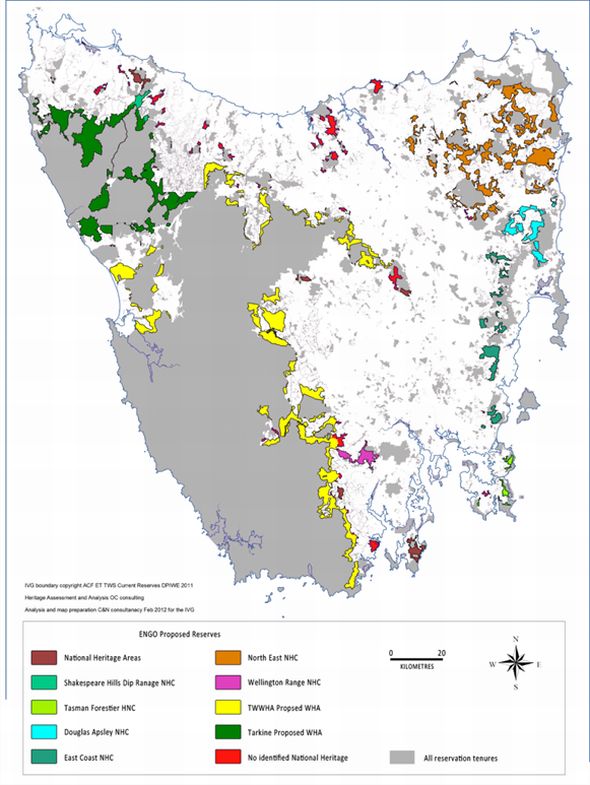
Figure 14. The heritage values of ENGO forest polygons. NHC = cluster of ENGO polygons of national heritage value. WHA = cluster of ENGO polygons of World Heritage value. Also shown are other areas of national heritage value and polygons for which no heritage values were identified. Those with identified values warrant formal assessment for National and/or World Heritage listing.
• SENATOR THE HON RICHARD COLBECK
Senator for Tasmania
Shadow Parliamentary Secretary for Fisheries and Forestry
Shadow Parliamentary Secretary for Innovation, Industry and Science
M E D I A R E L E A S E
23 March 2012
Lock up of forest resources cannot proceed
The position of the Federal Coalition on further lock up of Tasmania’s forest resources has been vindicated by the Independent Verification Group report, Coalition Forestry Spokesman Richard Colbeck said.
“The position of the Federal Coalition has been vindicated by this report and I repeat again that the Federal Coalition will not recognise any lock up that is a product of this failed Intergovernmental Agreement process,” Senator Colbeck said
“The environmental movement might have “claims” on some areas, but the forest industry has contracts.
“Even with the exit of Gunns Ltd, locking up our forest resources will mean existing contracts cannot be met.
“It was clear from looking at the wood supply projections at the very start of the Statement of Principles process that locking up more forest resources would cause supply shortages.
“This report does not tell us much more than we already know, but it does reinforce the quality of Tasmania’s forest management.
“Even coupes previously clear-felled and burned retain conservation value due to the high quality of forest management, confirming that forestry can co-exist with positive environmental outcomes.
“Labor must now decide between Tasmania’s viable forest industry, or the Greens and their demands.
“We know there will be no peace. Bob Brown and Christine Milne have already said they want to end native forest harvesting altogether.
“It is time for Tasmanians to tell the Government, and the Greens, that enough is enough.
“Labor and the Greens must not kill off any more of Tasmania’s forest industry,” Senator Colbeck said.

• Tree sitter reaches one hundred days
Miranda Gibson has been at the top of a tree in Tasmania’s threatened forest for 100 days. Ms Gibson’s extraordinary effort began in mid-december when she climbed to the top of the tree vowing to remain on her tree-top platform until the area was protected, as it should have been according to the Intergovernmental Agreement. Miranda celebrated her 100th day amid snow.
“For 100 days I have sat at the top of this tree, bringing international attention to the ongoing destruction that is occurring every day in Tasmania’s irreplaceable high conservation value forests. It is timely that today Jonathan West’s report has been released, giving clear evidence of the global significance of these forests.” said Ms Gibson.
“Documented evidence has shown that Tasmanian devils are living in this area of forest. The West report has indicated the significance of these endangered species and the importance of these habitat areas” said Ms Gibson.
“I am committed to staying another 100 days if that’s what it takes. However, I hope that Tasmania will not have to wait that long to see these precious forests protected” said Ms Gibson.
“To mark my 100th day in the tree sit we will be posting 100 letters to the corporate customers of Ta Ann. These letters, from community members, will send a strong message that Tasmanians do not want to see our world class forests destroyed to make veneer” said Ms Gibson.
“My 100th day has been a special day so far, with a spectacular show from the forest as it snowed for the first time since I have been up here. Despite the cold weather, I enjoyed the beauty of the forest in the snow. I hope that through my action people all around the world can share the wonder of these forests and help conserve them for future generations” said Ms Gibson.
• RESPONSE TO WEST REPORT
Nick McKim MP
Greens Leader
The Tasmanian Greens today said the release of Jonathan West’s Independent Verification Report backs long-standing calls for protection of Tasmania’s high conservation value forests, and marks a pivotal point in the debate over the future of Tasmania’s forest industry.
Greens Leader Nick McKim said that to get value out of the work that has gone into the report, the signatories to the peace process now need to be given the space to work towards a negotiated outcome.
“The release of the Report marks a pivotal turning point in the debate over Tasmania’s forests, demonstrating that the time has arrived for fundamental change in the forest industry and protection of our globally significant forests,” Mr McKim said.
“We now have a scientific basis for an informed debate about a way forward that includes protection of the identified forests and a managed transition that looks after people and regional communities.”
“Of course 430 000 ha of these forests should be protected by now under the IGA, and we reaffirm our calls for this to occur.”
“The Report confirms the globally significant values of Tasmania’s native forests, an industry in crisis, and that the do-nothing approach is not an option.”
“It also confirms that the carbon value of Tasmania’s forests means that they are worth more standing than chopped and chipped.”
“The signatories have a mammoth task ahead of them to reach the history-making potential of this process, and they need the space to give it their best shot.”
“No-one thought this process would be an easy one, but the discussions are ongoing and still provide us with a historic opportunity to achieve a lasting resolution,” Mr McKim said.
• Tony Burke, Bryan Green …
Tony Burke
Minister for Sustainability, Environment, Water, Population and Communities
Bryan Green, MP
Deputy Premier
Friday, 23 March 2012
Independent Verification Group advice released
The Australian and Tasmanian governments today welcomed the release of the Independent Verification Group assessment of the forestry industry s timber supply requirements and the conservation values of nominated areas of Tasmania s native forests.
Federal Environment Minister Tony Burke said delivery of the advice to the Australian and Tasmanian Governments, and the community, was a significant milestone in the Tasmanian Forests Intergovernmental Agreement (IGA).
The Australian and Tasmanian governments are implementing the IGA in response to rapid change and major challenges in the industry, which had shed thousands of jobs in recent years as a result of changes in the market for forest timber.
The IGA was developed in response to calls from the forestry industry, unions and environment groups that have worked together to develop a constructive way forward to respond to challenges faced by the forestry industry as a result of the major market changes.
Professor Jonathan West led an independent process with forestry and conservation groups to verify the high conservation value of native forests nominated under the IGA, and the timber supplies needed to meet industry needs. The independent verification process was agreed by groups involved in the IGA.
The independent process is not intended to define a single solution, but rather to provide all parties with the information to use in developing agreed options that will achieve the best possible results for industry, timber workers, communities and the environment.
The Tasmanian forestry industry faces huge challenges and that s why we are working hard to support workers and secure a sustainable future without the IGA timber communities would be hit by these market changes without the support they need, Mr Burke said.
For the first time we have an independent view of the current demands for wood supply and the different conservation values of areas within Tasmania.
This independent information provides a foundation for any discussions about jobs, timber communities or conservation. Without the IGA, this foundation would never have been established.
The parties to this process have shown great commitment in working through the challenges to date because they recognise that working together and negotiating in good faith is the only way to create an outcome that can be sustained.
Deputy Premier Bryan Green said the Independent Verification Group s work deals with extremely complicated issues and needed to be interpreted carefully by all involved and particularly the Reference Group of stakeholders.
The Signatories will now work through the detailed advice as they identify and explore options to deliver a solution that they can all support, Mr Green said.
We are at a critical point in the process and it is important that the work is not taken out of context by those intent on wrecking the agreement.
This report is being made available now in the interests of transparency even though some parts of the work are yet to be peer reviewed.
Most fair-minded people would agree that we need to move beyond the conflict over forestry because we simply don t want another 30 years of vitriolic debate.
The agreement offers the best opportunity to secure the future of our forest industry and achieve significant conservation outcomes and both Governments are determined to see the process through, Mr Green said.
Under the Intergovernmental Agreement, the Tasmanian Government has committed to introducing legislation by 30 June 2012 to implement an agreed solution.
An expert team is helping signatories work through this over the coming weeks while the governments also work together to review Professor West s report.
The government will be doing everything it can to support the industry, union and environment groups in their efforts to develop a lasting outcome that will support the forest industry s transition to a more sustainable long term future, to diversify the Tasmanian economy, and protect forests.
Professor West s independent verification report can be found at: http://www.environment.gov.au/land/forests/independent-verification/report.html