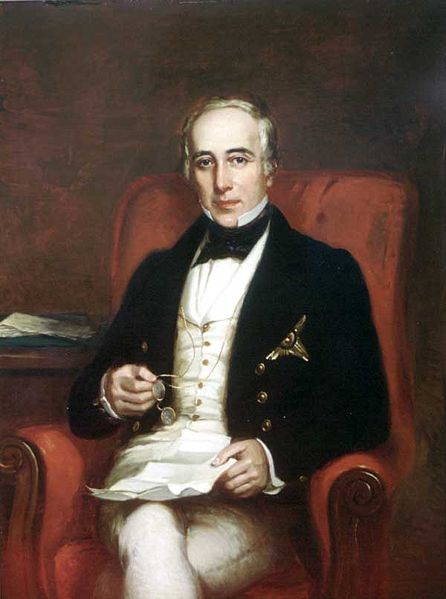
Lieutenant-Governor George Arthur ‘was delighted with someone who could deliver such a thunderous declamation about the evils of alcohol …’

The cover of John Biggs’ new book
And a discount for Tasmanian Times readers! Click the ad on the right hand side of the TT homepage for a discounted order form.
“… a narrative, placed in its social and economic context, which beguiles and entraps. Why have we not learnt from the past? Why repeat avarice, stupidity and abuse of position?”
— from the Foreword by Justice Pierre Slicer.
Here are stories about people, time and place. The people are father-son descendants of one family over five generations, the times range from 1833 to the present day, and the place is Tasmania. What do the stories of these five individuals tell us about the Tasmania in which each lived? Just as the Baby Boomers, Gen X and Gen Y are products of their times, so my ancestors are products of theirs. In telling the stories of my forebears, I aim to obtain a picture of Tasmania’s developing polity.
My great-great-grandfather Abraham Biggs was born in Bedford, England, in 1799. He arrived in Tasmania in 1833 – not of his own free will, or that of a vengeful English magistrate, but of God’s, as he thought. Abraham was a Wesleyan lay preacher, whose views on alcohol were later expressed in a letter to his brother William (24th November, 1848):
For though I have been but once intoxicated and then but partially so, …yet I now see that by my (so called) temperate use of the intemperate drinker’s cup, I have been countenancing the greatest evil that the arch foe of mankind ever belched from his burning bedlam by which to madden the sons of God, and thus render them fit fuel for his worse than alcoholic fire…
Lieutenant-Governor George Arthur was delighted with someone who could deliver such a thunderous declamation about the evils of alcohol. Accordingly, he employed Abraham to preach temperance to the convicts, to dash their intemperance into pieces with the mighty hammer of God’s Word – and yet Abraham records that he himself drank three to four pints of home brew a day. Not surprisingly, Abraham was more successful as a carpenter and builder than as God’s dispenser of antabuse. He made a fortune selling cheap prefabricated houses to the rapidly expanding Melbourne following the Gold Rush, but lost it as that boom collapsed.
I call Abraham’s the Stabilising Generation. Such men as he were needed in Van Diemen’s Land to raise their families and thus help to civilise a raw society that was based on Arthur’s two dimensional feudalism, where his favourites were the barons, and assigned convicts their serfs. The Abrahams provided the third leg needed to stabilise that two-legged stool before the convicts and emancipists, who formed the great majority of the population, could provide it for themselves. On the other hand, Abraham and his compatriots were selectively blind to the dark side of convictism: cruelty and an unnameable horror amongst the prison population that Abraham coyly referred as ‘the deformity of vice’ (presumably he was referring to sodomy). The free settlers used prudishness and hypocrisy to distance themselves from the convicts’ suffering: a fatal flaw that had long-lasting ramifications.
Alfred Biggs was eight years old when he arrived in Hobart Town. He alternated between banking and school-teaching, shuttling from one to the other when things went wrong as they frequently did: he usually chose the wrong people with whom to pick a fight. When Alfred was schoolmaster at Campbell Town, the rector, the unpleasant Rev. Dr. Basil Craig, undermined Alfred at every turn, partly because the Church of England, in a long battle with the state was trying to wrest back control over state education, and partly because Alfred and Craig loathed each other on sight. The Board of Education acted on Craig’s complaints, and without hearing Alfred’s side, they sacked him. He refused to go, setting up school in his brother’s brewery, now a restaurant, just south of the Red Bridge. Yet despite or because of these problems, Alfred pursued his real interests. In 1874, he photographed the Transit of Venus using his friend Dr. William Valentine’s telescope, and in 1876 he set up the first long distance telephone call in the Southern Hemisphere, between Campbell Town and Launceston, using the Morse code line alongside the new Hobart-Launceston railway track as the landline. He went to Launceston where he continued with astronomy, experimented with seismology, and wrote regular science columns in The Examiner. The people of Launceston affectionately called him ‘our Astronomer Royal.’
Tasmania became self-governing on 1st January, 1856. Uncertain as to how to deal with this thing called ‘democracy’, 22 governments rose, tottered and fell from that date to Alfred’s death in 1900, giving permanent public service bureaucrats undue power, as Alfred had found to his cost. (It is arguably worse today for independent bureaucrats have been significantly replaced with politically appointed minders). But despite the political and economic uncertainty in the last half of the nineteenth century, the general public was interested in literary, scientific and philosophical ideas, and through the press, public lectures and the Mechanics’ Institutes, Alfred had a supportive context for his scientific work. While others made their contributions in commerce and industry, Alfred helped build the intellectual upper storey. I call Alfred’s the Elaborating Generation, which is what Alfred and others had been doing – elaborating materially and culturally what the Stabilising Generation had started.
Walter Biggs was born in Bothwell in 1865, settling in Scottsdale in 1903. He established a retail business with five outlets throughout the north east. Scottsdale at that time was a rich farming community, had a vibrant social life – and the reputation of being Mother Lion’s most patriotic cub. The London secretary of the Royal Society of St. George, of which Walter was at one time secretary of the Scottsdale branch, wrote:
Your lovely island is by general consent more than any other colony like the old home. The names of your counties – your Devon, Cumberland, Kent, Sussex, etc. – must ever seem to remind you of the cradle of your race … It is indeed gratifying to hear of so many going from your little town to fight the Empire’s cause in South Africa.
Scottsdale was a hotbed of outsourced patriotism, in which Walter enthusiastically did his civic duty: as church organist, British Israelite, freemason, one time warden of Scottsdale, and patron of a range of clubs and societies. When he sold his retail business, Walter established the Scottsdale branch of the Launceston Bank for Savings. He became known as ‘Pater Biggs’ for the paternalistic way he sternly advised his customers: deposit frequently, withdraw cash rarely – which delighted head office no end. He and the local headmaster devised a ‘penny banking’ system that was later adopted by the state Education Department.
Walter told his own ten children with a logic they failed to appreciate that ‘because I was spoiled as a child I shall ensure that the same mistake is not visited upon you.’ It wasn’t. He firmly believed that punishment built character. Walter’s generation was of right thinking men, straight limbed and true. I call them the 3P Generation: Patriotism, Paternalism and Punishment. As for left thinking men, Walter would have given them a jolly good thrashing had he been given half the chance.
An interesting footnote: Walter’s house is now a medical surgery run by Dr Paul McGinity, who in 2009 was crucified by the medical profession, seemingly for refusing to join a large medical clinic run on corporate lines. I hope that Walter’s ghost rises from the house he built and descends on the perpetrators of that injustice to give them a jolly good thrashing too: he would certainly have favoured the old style family practice with the human touch over what he probably would have called ‘that new-fangled creation of mountebanks.’
Oscar Biggs was born in Scottsdale in 1904. As a student, he infuriated Leicester McAulay, lecturer in physics at the University of Tasmania, for sending up in a uni-revue type skit Leicester’s father, Alex McAulay professor of physics. Leicester thereupon failed Oscar year after year, as did E.A Pitman, professor of mathematics, who Oscar had crossed in some way of which he was unaware. A bit like Alfred (and a bit like his own son), Oscar crossed his superiors with self-destructive regularity. He finally graduated, after eight long years of frustrating study, at the start of the Great Depression. He obtained a job teaching at Clemes College, but he was unhappy with what ‘that skinflint, Bill Clemes’ paid him. Oscar’s real love was music. He was a fine organist and was offered an overseas scholarship in 1934, but in those cautious times he decided to stick with teaching for peanuts; at least they were certain peanuts. Oscar moved to Hutchins in 1939 and got on well until the appointment of Paul Radford as headmaster, ‘that unspeakable beast’ as Oscar publicly referred to him. Oscar was well respected by his students, and interestingly, given his father’s example, he didn’t use corporal punishment at Hutchins, at a time when most other teachers did (and do not now). He suffered increasing health problems, dying at the young age of 64. Oscar and his wife Ella, also in increasingly poor health, became obsessed with ‘putting aside for a rainy day’, ‘cutting your cloth to suit your purse’ and in Ella’s case particularly, ‘having Faith’ – which doesn’t seem to have done much for either of them. Whether individuals were personally depressed or not, this might be called the Depressed Generation, pressed down as they were by the cataclysmic events of the Great Depression and World War 2.
John Biggs, me that is to say, was born in 1934. I followed my father to Hutchins, which was a predictable mistake given everything. The one outstanding benefit I received from school was in 1947 when my class built a large hut in Chauncy Vale Wildlife Sanctuary in Bagdad. A subversive seed had been sown, had headmaster Radford known it, that eventually resulted in the greening of John Biggs. But back then, still in a haze of right wing religiosity, I thought my future might lie in the Anglican Church and became much involved with churchly activities at St David’s Cathedral. However, my experiences there were not encouraging. No, not that sort of experience; this sort:
I joined the Cathedral bellringers. The ringers being male, the girls in the Cathedral Youth Fellowship wanted to learn bellringing too. But the Dean of the Cathedral, Percy Fewtrell, ruled emphatically: ‘No girls up the tower.’
‘Why not?’ we asked.
‘Bellringing could possibly affect their childbearing potential,’ he replied after thinking deeply on the matter.
Could it now? Dr Billy Wilson was a leading Hobart gynaecologist known to one of the ringers. Yes, Dr Wilson would be most interested to come up the tower and see what was physically involved in bellringing. He watched the ringers in action and concluded it would be very good exercise for girls; it couldn’t possibly damage their child bearing potential. Then the penny dropped. The Dean’s concern was that, up the tower, the girls’ childbearing potential might be enhanced, not damaged.
But thanks to the expertise of Dr Wilson, the Dean’s bluff was called. The girls participated in the exotic delights of campanology, and their childbearing potential was unaffected either way.
And that was only one incident. The poor old Dean was only echoing the post-war push by government and church, for different reasons, to put women back in the home and reverse the trends towards gender equality that the war had started. Which led to such puritanism as this; it was a right put off.
I went to the University of Tasmania majoring in psychology and philosophy, both of which convinced me – a complex argument that I’ll pass over here – that Christianity was not for me. I was outraged when my philosophy professor Sydney Orr was sacked for being a very naughty boy, so they said. Actually I now think he probably was – but he was also responsible for a Royal Commission into the running of the University whose final report was damning. Orr’s dismissal without notice was comeuppance time, it was widely believed. He sued for wrongful dismissal and lost. This told me more than a little about how the old boys’ network worked in the Establishment that operated from the Tasmanian Club. Disillusioned, I saw my future elsewhere than in Tasmania.
I call mine the Bridging Generation, our aging legs have one foot in one set of values and the other in quite a different set. Abraham might have ridden to work on his horse and, one hundred years later, Oscar in his Austin Ten, yet on matters of religious belief and of values to do with patriotism, modesty, manners and morality, especially sexual morality, Abraham and Oscar, four generations away, would have been in strong agreement. On these matters I would be closer to the Baby Boomers, Gen X and Gen Y than I would be to my own father, only one generation away. On the other hand, I would be closer to my father on values to do with the work ethic, sustainability, avoidance of waste (but for different reasons: his economic, mine environmental), and social obligation. Skiting and dobbing were cardinal sins then; today skiting is a necessary survival strategy and dobbing in your neighbor is officially encouraged (could be terrorists, you know).
James Lovelock’s Gaia hypothesis , once seen as the freak-think of hippies, is now recognized – in general terms – as a serious account of how the planet self-regulates. This idea gave birth to environmentalism, which didn’t really become a political force here until the outrage boiling over from the flooding of Lake Pedder solidified into the United Tasmania Group, and from there to today’s Greens.
The 60s and 70s thus saw a seismic shift in the political dynamic: the rise of environmentalism, which has social obligation at its very centre; and the emergence of neoliberalism, which minimizes social obligation. That profound face-off is today where we really are politically, not the phoney face-off between Liberal and Labor, which is not a matter of genuine policy differences but only of personalities and name-calling. That conflict, between naked self-interest on the one hand, and environmentalism’s concern for society and the planet itself on the other, is behind Tasmania’s current political struggles.
Prior to the 70s, a social contract existed between politicians and their electorate. The Liberals saw their responsibility as looking after the business world, as they still do, but then they also recognized a responsibility to the underprivileged by supporting a welfare state; government needed to be large to support the national interest as a whole. Margaret Thatcher blew that apart with her devastating assertion: ‘There is no such thing as society! One’s duty is to oneself and to one’s family – and devil take the hindmost!’ Minimize taxes, minimize public expenditure, hand the provision of services to the private sector, and let market forces prevail. Hawke and Keating followed her general line by deregulating on a broad front in the early 1980s. Until then, the Labor Party had seen its role as protecting the interests of the workers and of the underprivileged, financed with a regulated capitalism, but all that went out the window with deregulation. Today, the Labor Party too is in thrall to the corporate world – and the gap between rich and poor in federated Australia has never been greater, the quality of public infrastructure – transport, utilities, and services – is scandalous, considering the size our population and our national wealth. (This general argument is expanded in Lara’s Metaphor, http://oldtt.pixelkey.biz/index.php?/article/laras-metaphor/).
While I was teaching at a school in England, a fellow teacher and an Anglican priest, thundered at the lunch table: ‘You can’t be a Christian and vote Tory!’ A challenging notion for this one-time Christian who was then inclined Torywards. Now, I see that the priest had been absolutely correct. Except for one amendment; nowadays a Christian can no longer vote Labor either. Under neo-liberalism, the meek wouldn’t have a hope in hell of inheriting the earth.
Autumn leaves fall to their roots, according to a Chinese proverb; just so, after forty years abroad this sere leaf fell back to his roots. A lot had happened in Tasmania in the meantime: the Pedder flooding, the successful Franklin protests, the attempted bribery by Rouse, the sacrifice of sustainable and selective logging that provided a quality industry for the ugly vandalism and waste wrought by indiscriminate woodchipping, Labor and Liberal politicians in cahoots to downsize and virtually disable parliament itself simply to stop the rise of the Greens. I returned to Hobart permanently in time to witness Bacon renege on his promise to his own Tasmania Together’s request to stop old growth logging by 2003, and waive a $300 million licence fee for the poker machine industry. Then followed Lennon’s crass handling of the pulp mill that was nevertheless supported by both major parties, state planning legislation put in place that in effect mimicked the pulp mill legislation, the incredible list of stuff-ups, ranging from Bartlett’s Tasmania Tomorrow to the now seemingly crippled Forestry Agreement …
The Tasmanian electorate has effectively been disenfranchised. Both Labor and Liberal parties are in lockstep as they pursue policies the majority of the public do not want, as exemplified in policies relating to forestry, gambling and development. The common theme is that favoured corporate interests take priority over the public interest. Which pretty well describes what Lieutenant-Governor Arthur in his way was doing in my great-great-grandfather Abraham’s time.
And here, unfortunately, seems to be the answer to the question in my subtitle, a conclusion I am happy to acknowledge that Linz had already drawn in the very first issue of TT in October 2002: http://www.oldtt.pixelkey.biz/jurassic/state.html
1. Alfred’s story has also been told by Margaret Giordano in Watcher of the Skies, Launceston: Regal: 1995.
2. Stephens, Geoffrey. The Story of Hutchins: The Macquarie Years 1846-1965. Hobart: The Hutchins School, 1979. p. 298
Tasmania Over Five Generations: Return to Van Diemen’s Land?

John Biggs
40° South Publishing
Note: The book will be launched in Launceston on the 3rd February by Tim Thorne at Petrarch’s Bookshop, 89 Brisbane Street, at 6 pm; and in Hobart on the 4th February by Andrew Wilkie at the Hobart Bookshop 22 Salamanca Square, at 4 pm.
All are welcome. If attending the Launceston launch, RSVP by phone: (03) 6331 8088, or email: [email protected]
First published: 2012-01-20 03:07 AM