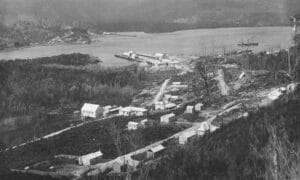
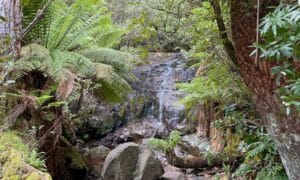
Site earthworks. Pic: Code Green
The site of Gunns proposed pulp mill was formerly a Private Conservation Area (Sanctuary) and classified as IUCN Category V where the interaction of people and nature over time has produced an area of distinct character with significant ecological, biological, cultural and scenic value: and where safeguarding the integrity of this interaction is vital to protecting and sustaining the area and its associated nature conservation and other values.
http://www.parks.tas.gov.au/index.aspx?base=5730
However, this status was revoked by the Tasmanian State Government in 2007 (under section 21 of the Nature Conservation Act 2002).
http://www.austlii.edu.au/au/legis/tas/consol_act/nca2002237/s21.html
I am unable to determine whether the proper procedures were followed but have found the following proclamation to revoke part of the area made by then Governor, William Cox and David Llewellyn on 17 September 2007:
http://www.austlii.edu.au/au/legis/tas/num_reg/putnca20022007n88511/
When Gunns referred the proposal under the provisions of the EPBC Act on 30 March 2007 the site was described by Gunns as follows:
4.2 (k) Other important or unique values of the environment
The Project Area is in the vicinity of the Tippogoree Hills Forest Reserve.
The Pulp Mill Site is identified as being within the Long Reach Private Sanctuary and Long Reach Conservation Area pursuant to the Nature Conservation Act 2002. The Long Reach Conservation Area comprises the narrow coastal area along the foreshore and the existing rail line. The Long Reach Private Sanctuary comprises 607 ha, which includes the woodchip mill, thermal power station, railway line and golf course. The area was first declared a sanctuary in 1952 under the Animals and Birds Protection Act 1928 at the request of the owners, the then Australian Aluminium Production Commission (now Comalco).
Comalco subsequently approached the then National Parks and Wildlife Service (PWS) in 1986 and again following the rezoning of the site to Major Industrial Zone under the Planning Scheme with the intent to revoke the conservation status. This is yet to occur.
The State Forest area for the solid waste disposal area is an Informal Reserve. Informal Reserves are areas on State Forest, other than a Forest Reserve, that are managed as a protection zone under the Management Decision Classification System. An informal reserve can also be an administrative reserve on public land that is managed to protect CAR values.
http://www.gunnspulpmill.com.au/epbc/Gunns_Limited_Bell_Bay_Pulp_Mill_Referral.pdf
Gunns Project Status Report as at 30 August 2011 shows that the company has now purchased six adjoining titles with a total land area of approximately 965 hectares. In addition, Gunns purchased a separate site near George Town to be used for a workers’ accommodation facility.
This document was used by the Director of the EPA to justify his spurious decision that the project had achieved “substantial commencement”. Refer to pages 19 and 20:
http://www.gunns.com.au/Content/uploads/documents/MEDIA%20RELEASE%20-%202011%2009%2028%20-%20Pulp%20Mill%20Project%20Permit%20Status%20Affirmed%20-%20EPA%20-%203.pdf
The document shows that Gunns purchased the main pulp mill land area of 590.70 hectares on title 152001/1 from Rio Tinto Alcan in October 2007.
However, to my astonishment, Gunns has also been allowed to purchase a 31.79 hectares area on title 152545/1 of Informal Reserve, managed for protection, within Tippogoree Hills State Forest to the east of the East Tamar Highway on which to construct the solid waste disposal facility.
The location of the Informal Reserve (highlighted in dark yellow) is shown on the following map which was prepared by Forestry Tasmania for the Supplementary Tasmanian Regional Forest Agreement in 2006. The map also shows the site of the pulp mill to be a Private Reserve (highlighted in orange).
http://www.forestrytas.com.au/uploads/File/pdf/reserves.pdf
It appears to me that the State forest land was revoked under the terms of Section 15 of the Forestry Act 1920 and subsequently sold to Gunns under the provisions of the Crown Lands Act 1976.
http://www.austlii.edu.au/cgi-bin/sinodisp/au/legis/tas/consol_act/fa1920139/index.html#s15
http://www.austlii.edu.au/au/legis/tas/consol_act/cla1976134/index.html#s8
However, State forest can only be revoked by proclamation if approved by each House of Parliament or upon recommendation by the Tasmanian Planning Commission and I am unable to find any public record of this process being followed.
Forestry Tasmania is empowered to sell land under the provisions of Section 16 of the Forestry Act but only if it was previously purchased for forestry operations.
Gunn’s Environmental Impact Management Plan (EIMP) Module I-J: Solid Waste Disposal Facility & Local Reservoir Construction prepared for the Commonwealth on 20 October 2008 provides details of the proposed works and a location diagram. According to Gunns this module was approved on 5 January 2009.
http://www.gunnspulpmill.com.au/permits/epbc.php
The diagram on page 3 of the following document shows the site boundary outlined in red which is split into the 2 separate titles.
http://www.gunnspulpmill.com.au/permits/epbc/IJ/EIMP%20Module%20IJ%20solid%20waste%20disposal%20and%20local%20reservoir%20construction.pdf
The majority of the works are on title 152001/1 but the top left hand side section which incorporates much of the solid waste disposal site is on title 152545/1 which Gunns admits “is not compatible with the Agricultural Zoning of the land on which part of the development is located.”
However, there is no public record of any amendment to the George Town Planning Scheme which would be required to permit such a use.
http://www.georgetown.tas.gov.au/site/page.cfm?u=287
It should also be noted that section 5.9.6.1 vii of the scheme (page 58) stipulates that for developments in the Bell Bay Major Industrial Zone:
“A foreshore corridor shall be provided to maintain the environment and
visual amenity of the river foreshore. Development shall be set back a
minimum 60 metres from the Tamar River Crown Reserve or as provided in
the development plan, except where specifically required for wharf and
associated installations.”
Furthermore, the area appears to be classified as a Skyline Protection Area in accordance with Section 6.4 of the scheme which prevents the logging of trees though Gunns erroneously claims this can be protected as follows:
“The proposed landfill is situated in a depression in the lower section of the Tippogoree Hills, below the ridgeline. This positioning reduces the visual impact from the clearing of trees required for construction of the landfill, thus protecting the integrity and scenic qualities of the Skyline Protection Area.”
Gunns also states with regard to the solid waste disposal facility (which includes the quarry):
“The facility is an integral component of the pulp mill although it is located away from the main site. It will be on land owned by Gunns, within the Bell Bay Major Industrial Zone.”
However, as noted above, the land on title 1520011/1 does not appear to have been rezoned.
It does appear however that George Town Council has no jurisdiction to invoke the terms of its planning system by virtue of Section 9 of the Pulp Mill Assessment Act under which Provisions of Acts, planning schemes, etc. do not to apply to project.
Crucially though, Gunns does not have the permits necessary under the terms of the Water Management Act 1999 to construct either the water reservoir or landfill pond (Pulp Mill Permit – WM2 and WM3), which Gunns says in its own IIS are “integral to the operation of the pulp mill”, and it defies logic that the project can be said to have “substantially commenced”.
The permits for these works lapsed on 30 August 2011 as the dam works were not substantially completed within 4 years (i.e.30 August 2011) of the Pulp Mill Permit coming into force – refer Section 8 (5) (b) of the Pulp Mill Assessment Act and Section 4 of the Pulp Mill Assessment Amendment (Clarification) Act 2009.
http://www.austlii.edu.au/au/legis/tas/consol_act/pmaa2007248/s8.html
http://www.austlii.edu.au/au/legis/tas/num_act/pmaaa200965o2009481/s4.html
Gunns statement that “the landfill, water reservoir and quarry are integral to the operation of the pulp mill” can be found on page 12-681 (i.e. page 204 in the PDF document) of the following document:
http://www.gunnspulpmill.com.au/iis/V2/V2b.pdf
Gunns also says with regard to the water reservoir that “a secure and reliable water supply is fundamental to the operation of the pulp mill” and identifies likely hazards including “potential flooding of the East Tamar Highway, which runs parallel to the proposed dam embankment, some 200 m downstream of the toe; potential flooding of the pulp mill site; potential flooding of the Bell Bay Rail Line; and potential flooding of the major overhead power transmission lines”.
Furthermore, “the preliminary assessment of the consequences of dam failure suggested that there is a population at risk of between 11 and 100 persons and, in accordance with Appendix D of ANCOLD Guidelines on Assessment of Consequences of Dam Failure, the likely damage and loss will be Major. This indicates that the dam is likely to be assigned a hazard category of High B. Accordingly, this dam will be designed to meet appropriate standards to ensure any such risks are minimised.”
http://www.gunnspulpmill.com.au/permits/epbc/IJ/EIMP%20Module%20IJ%20solid%20waste%20disposal%20and%20local%20reservoir%20construction.pdf
Matters are further complicated by the fact that the part of the pulp mill site is located within a 7 km2 area of the Tippogoree Hills covered by an Exploration Release Area (ERA887) under the Mineral Resources Development Act 1995 for which applications can be made until 12 March 2012.
Follow this link and download the Information Sheet for further details:
http://www.mrt.tas.gov.au/webdoc2/app/default/era_detail?Id=4595
ERA887 arises from the revocation of RL3/1997, formerly held by B3 (Bell Bay Bluestone) Pty Ltd, for Category 3 Minerals (Construction Materials) and was referred to on page 12- 685 (or 208 in PDF) of the preceding volume of Gunns IIS as follows:
“The landfill, quarry and water supply reservoir are located within an area covered by a Retention Licence under the Mineral Resources Development Act 1995. Licence RL3/1997 Category 3 – construction materials, is held by Tasmanian Hardrock Pty Ltd over an area of 7 km2. The licence expires on 19 December 2007. Under provision in the Mineral Resources Development Act 1985, landowners are permitted to use stone on the property on which it was mined without the need to obtain a mining lease. When Gunns purchase
this property, they will be able to utilise the quarried dolerite on the site. Gunns will still need to seek permission from Tasmanian hardrock to mine the site.”
As a final observation, given all the above, it is hardly surprising that Gunns has been unable to obtain finance or a Joint Venture Partner for such an odious and unethical proposal which is fraught with huge risk.
PB is a “Tasmanian-based free spirit independent of any political party”.