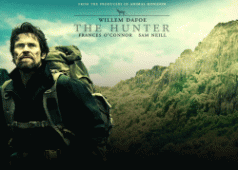
For his feature film debut he took an award winning novel about one man on the hunt for the Tasmanian tiger and turned it into a work that attracted an international star, national media attention and a huge opportunity for Tasmania. Togatus spoke with Daniel Nettheim, the Director of the new film, The Hunter, which stars the man best known for his role as the Green Goblin, Willem Dafoe.
Q: Willem Dafoe has generated a lot of media attention for the movie, was it difficult to get him onboard in the first place?
A: It was actually surprisingly easy. We didn’t send the script out until we were pretty confident with it – and it did take eight years to write the script – but it was remarkably straightforward. We sent the script to his manager who liked it and passed it on to him and we got a call saying Willem was interested. No, “intrigued” was the word. I immediately booked a flight to New York to try and convert that into a meeting. At the end of the meeting he said, “great, I would like to work with you guys.”
Q: At what point did you decide that he was the one you wanted for the main character?
A: From very early on in writing the script we were interested in Willem. We were kind of fortunate that the main character was an outsider. The world was our oyster in terms of our casting opportunities so we wrote a list of our favourite actors, and then we had to go “right, who is approachable among these people”. I found out that Willem was actually a pretty approachable person. He’d done another film in Australia called Daybreakers. I knew people who had worked on it and they all spoke highly of Willem and what a great collaborator he was. I thought in this world of ego driven stars he sounds like a person that would be great to go on this journey with.
Q: You also have a strong Australian cast, was it harder in a way to convince them as mainlanders to come down here?
A: To tell the truth everyone was really enthusiastic about coming down to Tassie. Sam Neill was here for longest apart from Willem. Also Francis and the kids were pretty much booked for the duration of the seven-week shoot. But a bunch of other really great actors from Melbourne and Sydney who we love – Sullivan Stapleton, Callan Mulvey, Dan Wylie, Dan Spielmen, Jamie Timony – they came for a day or two at time. They all commented on what a great atmosphere there was around the shoot and how beautiful it was to come down to Tasmania to do a day or two of work, go back home and come back later to rejoin the crew. None of them could wait to come back.
Q: What was it like working with Willem? I’ve heard him use the word collaboration about this film.
A: It really was. The script didn’t really indicate a whole lot of backstory or history or personal details, so it was really a role for an actor to take ownership of and invent a lot of the details. That is kind of how I pitched it to Willem in the first place and fortunately for me that is how he really likes to work, as opposed to being delivered a fully fleshed out character with all the details and not being able to participate in the realisation of that character.
The interesting thing about working with Willem is that he is really particular about doing things himself. He didn’t want a stunt double. There is one stunt double for one shot where he falls off a cliff, but for everything else he said, “you can’t double me with someone else, it’s got to be me.” When we are doing these really wide helicopter shots, that little person in the frame is always Willem. He would put on this heavy pack and walk for hundreds of metres away from the assistants, who would be hiding from trees so we couldn’t see them from the chopper. There is a shot near the beginning of the film where he is heading into the wilderness. It’s beautiful, the chopper comes up and around and you see him on this really amazing backdrop. We had to have a few goes at it. I would radio, “just keep walking in that direction,” and he would radio back, “sorry what direction? I can’t even see you, where are you?”. What I didn’t realise was the button grass he was walking on is really difficult to walk on. That stuff is just so marshy and so boggy. The film doesn’t show that- it looks like it should be easy and I had no idea. So we kept calling out “keep going, stop acting, we are going to appear at any moment.”
Another time you see him as a silhouette on the top of the mountain and he starts climbing down the rocks. I hadn’t been up there and I was down the bottom with the radio saying, “can you ask Willem to move a bit faster, he seems to be taking his time climbing down those rocks.” And the assistant would say, “I told him and he says he is trying. He says it’s a bit hard.” And I’m thinking it doesn’t look too hard. A bit later we went up there to film a shot looking down, and what I didn’t realise there were forty foot chasms between the rocks that would have killed him if he’d fallen. I had to apologise and go, “hey, sorry for bossing you round like that, I had no idea.” I guess my point is, and this is one of the comments Willem made after seeing the film, is that we’ve captured the way the environment looks, but we actually haven’t captured the physical reality of what it’s like moving through those locations.
Q: Had you been to Tas before you got involved with this film?
A: Yeah, quite a bit. My cousins have always lived in Tasmania, so from a young age we were coming down for Christmas holidays in Launceston. So I knew about the beauty of the place from quite early on.
Q: I’ve heard the nature is like an extra character in the film. Was that intentional?
Read the full interview on Togatus HERE: