DOWN at the journalists’ watering hole, Mahoney’s, Bentley had strict rules about who and who not to drink with at the bar. Generally they would have to be members of the pack, the tribe of journalism, although members of the public who wanted to talk cricket might be invited into the circle.
In an ideal world, Mahoney’s would be a no-go area for tourists, and there were plenty of those in Hobart during the summer months, especially when cruise liners were anchored in the docks just a few blocks away.
One hot summer’s afternoon, taking a beer before his shift started, Bentley had manoeuvred himself away from a tourist, clearly an American, seated at the bar, close to Bentleys well-worn, favourite position. White baseball cap, chequered pants and bright blue L L Bean shirt; this was not a man to get into conversation with, a conversation that no doubt would cover cruise liner food, deck quoits and the rough crossing of Bass Strait.
Someone was different about this tourist, however. He sat alone, and carried a sadness, a loneliness about him. What’s more, instead of studying the decor of the bar, old sepia and black-and-white photographs of Hobart, and beer advertisements from yesteryear, he gazed out of the pub’s window, to the art deco facade of the Chronicle building across the street.
The American then ran his eyes along Argyle Street to the slightly more restrained art deco industrial style of what had been the print works in hot metal days, a building that still housed the newspapers’ rotary press.
He’s a hack, retired, Bentley muttered to himself.
Journalists of old were members of a fraternity, their own tribe, spread in a patchwork of clans throughout the world and it was easy to recognise one of their own. Bentley’s clan within the tribe spread through the English-speaking world, from Britain to southern and eastern Africa, to Australia and onwards across the Pacific to North America.
What was it about journalists that they could recognise their own kind? Was it the same instinct that the wolf used to find the pack, even far from home, in an unfamiliar environment.
Bentley sensed he had stumbled on a hack from the pack admiring that old art deco building that housed a newspaper, and Bentley felt compelled to introduce himself and say hello.
Bentley was right, of course; his instincts never failed him. The cruise ship passenger was a retired and widowed journalist from the American Mid-West, finally getting to see all the places that had featured on the news wires during a half century in the newspaper trade.
The American leaned over the bar, trying to attract the attention of the landlady. As with most journalist and neighbourhood bars, the locals received priority and the American was having to wait.
“Hey, Leslie,” Bentley finally called over to the landlady. “I think there’s a gentleman here who needs a drink and is frightened to speak up.”
The American laughed and then turned to Bentley.
“Hey, what’s the local drink here? I want to have something Tasmanian.”
“Well it’s Cascade Draught or Cascade Ale on tap. I prefer the ale, but it’s not quite Michelob lite from Milwaukee.”
Bentley wanted to talk American journalism, to the man he suspected to be an ex-American journalist, and the reference to Michelob lite was a coded message to say that he knew the United States and had supped ales in American bars.
“So you know Milwaukee?” said the American, doing some fishing himself.
“No, but I lived in the States for a time, New York though,” said Bentley. “And I’ve drunk plenty of Michelob in New York.”
The American took a sip of the pale ale and nodded towards Bentley, indicating it was good.
“Saw you looking at our fine old newspaper building here,” said Bentley moving closer to the American. “That’s not usually on the tourist sights. You off the cruise ship in the docks I suppose.”
“Well you got that right. And I just like this fine old building here, takes me back to a time when every city back home had a building like this, a newspaper building like Clark Kent worked in.”
“Just call me Superman,” said Bentley with a laugh. “I work in there, and it’s the last real newsroom I’ll ever see. We’re a bit behind the times here, all that’s happening to newspapers, tabloid format, tits and bums or fanny as you would say. It hasn’t quite hit us on the Chronicle yet, but it will come.”
“I was in newspapers 47 years,” said the American. Bentley already knew it but he feigned surprise.
“Yeah? whereabouts?”
“Ah, in the mid-West. Won’t mention the paper, great in its day, but gone now. And you, what you do in this here Chronicle?”
“Sub-editor,” said Bentley matter-of-factly, “copy editor to you.”
“And the States, what you do in New York?”
“Correspondent covering the United Nations, went there from Africa as some kind of Third World specialist.”
The reference to Africa caught the American’s attention.
“I suppose you were down south, that’s where the story was in my time, South Africa, Rhodesia. Funny how the story dies for a western readership when there’s no racism in it, whites fighting blacks and all.”
“Yeah, ” said Bentley, not wanting to get caught up in discussion about the white-minority politics of the time, he’d had enough of that in his career.
“Rhodesia then?” the American persisted. He looked into his near empty glass and offered to buy Bentley a beer.
“Tell me,” he said after while, “I bet it’s a long shot, you never met her, but did you know a Sarah Webb Burrell.”
“Sarah Burrell?” said Bentley immediately. “Yeah, I knew her.”
He waited for what was to come next. Sarah Burrell had not been part of the hack pack in the old Rhodesia, she was a photo-journalist who had lived at its fringe, had chosen her friends among Rhodesians, and had chosen a lover from within the Rhodesian Army.
Rumours had been spread about her, rumours Bentley knew not to be true. It was said that she was a former high-class prostitute in New York, who followed a photojournalist lover to Vietnam, where she learned to swing a camera.
Bentley had been one of Sarah Burrell’s few friends among the journalists working in Rhodesia and he wondered what was to come next from the American; would be mention Sarah’s alleged lurid past. What did come, came as a surprise.
“So, was she beautiful, as beautiful as her words,” said the American softly, looking out of the window towards the art deco facade of the Chronicle building. “I sense she was a beautiful person at least. She had passion about her work, telling the story. And sensitivity.”
“Yeah, she was beautiful. She had been a model, but I mean she had a beauty that went beyond looks. But I don’t know about her words. I only saw her pictures. They were beautiful, dramatic. I never knew he wrote words. I thought she just took pictures.”
“Oh, words. And pictures,” said the American, his face lighting up. “But it is the words I’ll never forget.”
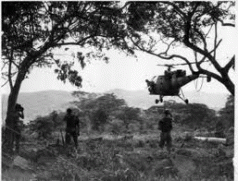
The brown-gold winter veld of north-western Rhodesia, where the land still speaks of the emptiness and the promise of Africa.
“Those words have stayed with me 30 years or more. Never forgotten them. She brought to the mid-West, and maybe a dozen other papers across the States, colour and emotion of a war in a far-off place. These human issues, the human face of war squared with the facts.”
The old journalist in the chequered pants had been a senior editor with a daily, big-circulation city newspaper when a letter had arrived from a far-off place. It was from a freelance journalist inquiring if the newspaper needed a “stringer” to cover the Rhodesian war.
The letter came with a sample article, which immediately made an impact with the journalist. It was a feature story, with pictures, about farming wives in the white-ruled country being given lessons in automatic firearms to help their husbands defend their farms from guerrilla attack. The paper published the piece, and sent Sarah Burrell a money order for $70.
More pieces followed, including the article with the reference to the golden-brown winter veld that the journalist had never forgotten.
Bentley had been at the sharp end of foreign news reporting, had been a full-time correspondent and a stringer, and it was good to hear from the other perspective, the other side of the news-gathering business, the editor receiving and commissioning copy in a far-off place of his own.
“The stories kept coming, maybe one a week, sometimes a little less. They were not hard news, but features, background, colour and it gave the war a human face. These were the people fighting for their lives, fighting for everything they’d built. You might support African expectations and aspirations but the whites had their lives, too. They were of that place. Who’d say Americans were not of America. The white perspective was important, and that’s what Sarah wrote.”
Bentley stayed silent. He wanted to discuss American newspapers, and not white African politics, or even Sarah Burrell.
“And I ran them when I could. There was no commitment. Freelances do not ask or expect promises to publish, they just take their chances, and hope that someone will show an interest. If it’s good enough they should.
“But sometimes being good enough was not enough,” he continued. “Domestic news, all news, competes fiercely for newspaper column inches, as you know. When a city gets snow-bound, struck by a tornado, or mired in political crisis ….” the American tapered off, in deep thought.
“I know,” said Bentley, “Africa can seem a long way away. ”
The American, who now revealed his name as William, said that he had always admired stringers chancing their arm, and luck, in foreign places, in dangerous places. It was something he had never done and wished, now he was out seeing the world outside America, he had ventured to foreign fields as a reporter in his younger days.
“I don’t know about the danger, though,” he said with a nervous laugh. “And I suppose it was dangerous?”
“Sometimes,” said Bentley.
The retired editor said Sarah Burrell would telex him personally sometimes, usually when tearsheets or notification of payment had not got through to her flat in Salisbury.
“And I’d telex her back, when she said she was going into a war zone, say with the army, and I’d telex back and say, `Please be careful’.”
Sarah Burrell had written for the newspaper for about a year, and as the 12 months progressed the editor could feel that the sense of hope she had originally written about was giving way to hopelessness and despair.
“She telexed sometimes to apologise for not filing, but how many of us had noticed? That’s the lot of the freelancer; out of sight, out of mind. We don’t know these people personally, like our own correspondent sent to Africa or wherever at great expense.
“Who notices if they don’t file and who cares. Just take in agency copy if the story’s big enough, and Sarah didn’t do hard news anyway.”
The American journalist, sinking his third beer, said that Sarah Burrell had once given a reason for not filing, saying she had been suffering from depression, but she was getting better now and more stories would follow.
“I know that war was getting to her. I didn’t know her but then again I thought I did. Like she was as friend. I worried about her, told my wife and she said not to be stupid, she’s just some stringer in a foreign land.”
More stories followed for a time and then they dried up completely.
“I was about to telex her when a letter arrived at my newspaper from a law firm in Salisbury, making inquires about the `estate of the late Sarah Burrell’.”
The American stressed the word late and pain creased his face.
“Then I knew, knew why she hadn’t filed. There were no other details but then I felt compelled to establish some details about her. She had parents living in West Virginia, she was 33 and, yes, she must have been beautiful I suppose, because she had been a model in New York once.
“And she had written about conflict in Lebanon, and Vietnam. She was one of the last Americans to be evacuated from Cambodia.
“And she had told friends Rhodesia would be her last war.
“Were you one of them, her friends, and did she say that to you?”
There was an intensity in the American’s voice, almost a pleading. He wanted to know.
“Yes, she said that to me.”
Bentley was lying now, and he hoped the American would not detect it. He had seen Sarah Burrell the night before she was found dead, but he couldn’t recall her saying she was out of Africa.
The American also knew that the death of her lover, in an accidental shooting, had prompted her spiral into depression, and her taking the gun her lover had given her for protection to her own head.
“She still lives with me, and I never knew her. How about that?” said the American, looking now away from the Chronicle art deco building, and towards the road that ran to the docks.
“Hey, buddy I gotta get a move on. Ship departs in an hour.”
“Good taking to you,” said Bentley as the American made for the door.
“Well, I never,” said the American, “meeting someone who knew Sarah Burrell.”
All these years Bentley had wanted to set the record straight about Sarah Burrell, to clear her name with someone who cared, even someone who didn’t know there was anything to clear.
As Bentley sat at his desk an hour later, he heard a ship’s horn echoing from the docks. The cruise ship carrying the American was on is way. The American had a word picture of a beautiful Sarah Burrell to go with her beautiful words.