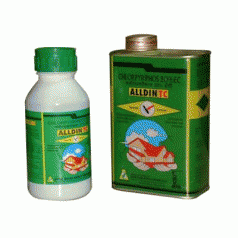
From the Pesticides Action Network (PAN):
As kids head back to school this fall, many will find learning an extra challenge. Scientists now estimate that as many as ¼ of all U.S. children may have lower IQs due to eating foods sprayed with pesticides like chlorpyrifos.
This is both frightening and fixable.
Fruits & veggies should make kids smart. The science is in, and action to get chlorpyrifos out of our food supply is long overdue. Help us tell EPA it’s time to protect children’s developing minds and bodies from this dangerous chemical.
Scientists have known for more than a decade that chlorpyrifos can be especially harmful to children. That’s exactly why it was banned from home use back in 2001. Three new studies this spring provide yet more evidence that chlorpyrifos can harm a child’s developing nervous system, including lowering his or her IQ by several points. There is also evidence of links to ADHD.
Chlorpyrifos food residue is the leading driver of dietary risk both because of its neurotoxic effects, and because so much is used. Ten million pounds of chlorpyrifos are applied to apples, peaches, sweet peppers and many other crops in the U.S. every year. The vast majority of us — including children — carry breakdown products of the chemical in our bodies.
Tell EPA it’s time. This month our public officials are finally reviewing the health risks of chlorpyrifos, in response to a lawsuit PAN and our partners filed in 2007. Add your name to our petition urging EPA to act now on this dangerous chemical that puts our children at risk.
Thanks so very much for all you do.
Dr Bleaney:
In Tasmania this pesticide may be used on turf pasture and forage feed crops, cereal crops, vegetables (including potatoes, corn, tomatoes) grapes, stone fruits (apples) and walnuts.
Preventative health care such as stopping children’s exposure to chlorpyrifos (an organophosphate- OP- insecticide), is the only ethical position to take. Preventative health measures will save lives and money.
Please note the contents of the letter to the US EPA: Australia should already have no allowances for this pesticide to be in foods and no children exposed to this chemical; if it was following an appropriate duty of care.
Please pass on to the ASCHEM committee and EPA board and director.
Please state what action will be taken as a consequence of the latest science /findings.
Dr Alison Bleaney OBE TPEHN http://www.sourcewatch.org/index.php?title=Pollution_Information_Tasmania#Tasmanian_Public_and_Environmental_Health_Network_.28TPEHN.29
The letter to the US EPA:
Dear Administrator Jackson,
We are pleased that your agency is — at long last — reviewing the health effects of agricultural uses of the organophosphate insecticide chlorpyrifos. As we noted in our 2007 legal petition, evidence of this chemical’s dangers has long been strong enough to warrant action.
We highlight here three issues of concern raised by the agency’s Preliminary Human Health Risk Assessment that is currently open for public comment:
1 – Chlorpyrifos food residues: The assessment proposes a reduction in the “FQPA safety factor” used to assess dietary risk for children, from 10x in the 2000 assessment to 1X in 2011. This makes little sense given new evidence of the dangers of low-level exposures.
2 – Dangers of drift: The assessment of chlorpyrifos drift from agricultural fields clearly shows that “residential bystander” exposure — which includes exposure of children at home and in school — is unsafe. The fact that real air monitoring data are used to reach this conclusion (rather than modeling), makes the finding all the more powerful, and the need to protect rural families and children from chlorpyrifos all the more urgent.
3 – New science strengthens the case: A decade ago, the evidence was already strong that exposure to chlorpyrifos increased the risk of damage to a child’s developing nervous system. The agency’s new assessment appropriately identifies several new and important studies linking prenatal and early-life exposures to cognitive delays, lower IQs and impaired motor control, among other things. New studies also show that newborns can be more than 100 times more sensitive to chlorpyrifos than adults.
We urge you to act now to protect all children from chlorpyrifos exposure. It’s high time EPA finished the job it began with the ban of chlorpyrifos home uses back in 2001.
Sincerely,
……
Meanwhile,
MEDIA RELEASE
CRC for Contamination Assessment and Remediation of the Environment
DDT ‘consistently found’ in humans: study
September 13, 2011 – for immediate release
Despite being banned almost thirty years ago, the pesticide DDT is still being widely found in human bodies, a leading health researcher says.
In a study of 146 human milk samples, most of the Persistent Organic Pollutants (POPs) found belonged to the DDT group, Professor Tze Wai Wong of The Chinese University of Hong Kong will tell the CleanUp 2011 Conference in Adelaide today.
“DDT was only one type of contaminant that we found,” says Prof. Wong. “There were also dioxins, other organochlorines and banned pesticides that were once widely used in agriculture.
“Finding them in human milk indicates that these pollutants are still present in food chain, which means that they’re highly persistent and have a slow decline rate, or, worse still, they are still being used in some countries in food production– neither of which is good news for consumers.”
Prof. Wong explains that human uptake of dioxins and other POPs is mostly from contaminated food products that originate from places with heavily polluted soil and water. Dioxins can also enter the body through contaminated air.
“This problem is not confined to the Asia-Pacific, but can be found across the world. Apart from previous use of toxic pesticides, the community’s diet, its methods of waste disposal and its level of industrialisation can contribute to the uptake of POPs as well.”
For example, nations that produce more industrial waste risk the contamination of marine products when the waste is dumped into the ocean, he says.
Countries that incinerate their waste, like Japan or China, are particularly susceptible to dioxin contamination of food, as it is often released through burning.
“We suspect that high concentrations of DDT will be found in communities which consume large amounts of seafood, dairy products, cattle and poultry, as animals tend to bioconcentrate these toxins,” he says. “In this case, Western Europe, Scandinavia and Japan are particularly at risk.
“People in China and Japan may also have high concentrations of dioxin in their bodies, as waste is often incinerated which release this compound into the environment.”
Prof. Wong says his research tends to show up pollutants which were present in the human environment decades ago, and are still around, rather than more recent contaminants.
“We’re measuring what was prevalent in the past. Its persistence shows that we need to be cautious about what we are doing now, because the effects of today’s pollutants on health are not likely to be felt until some decades later.”
Prof. Wong recommends increased vigilance in food production, and especially over attempts to introduce new chemical compounds into the food chain.
“We have always been quick to come up with alternative chemicals to replace old or banned ones. This is often done without asking health researchers to examine their effects on the human body. Industry and scientists need to start working together better.
“We also need to choose our food more wisely and rethink our dietary choices. Nutrition and flavour shouldn’t be our only considerations when planning meals. We also need to think about which foods may also contain high levels of contaminants.”
It is also important to re-evaluate current methods of waste disposal, and their possible impact on human and environmental health, he says.
“Eventually, everything that we use has to end up somewhere. We need to make sure that the human body doesn’t end up as the ‘last stop’ for toxic compounds.”
Professor Wong will deliver his presentation at 1.20pm on September 13.
Professor Tze Wai Wong is an environmental epidemiologist and public health and occupational physician. He is currently a research professor in the School of Public Health, The Chinese University of Hong Kong. He has conducted research for over 25 years and published over 170 papers in medical and scientific journals on environmental pollution and public health.
CleanUp 2011 incorporates the 6th International Workshop on Chemical Bioavailability in the Terrestrial Environment (7–9 September 2011) and the 4th International Contaminated Site Remediation Conference (11–15 September 2011). It is hosted by the CRC for Contamination Assessment and Remediation of the Environment (CRC CARE).
CleanUp 2011 is being held at the Hilton Adelaide hotel in Adelaide, South Australia.
More information:
Prof. Tze Wai Wong, CRC CARE, ph +852 9304 7636
Prof. Ravi Naidu, Managing Director, CRC CARE, 08 8302 5041 or 0407 720 257
Meredith Loxton, Acting Communications Manager, CRC CARE, 08 8302 3925 or 0429 779 228
Sharmin Patard, Communications officer, CRC CARE, 0437 917 352
http://www.crccare.com/
DISTRIBUTED BY SCINEWS.COM.AU