“…therefore as labour is a creator of use-value, is useful labour, it is a necessary condition, independent of all forms of society, for the existence of the human race; it is an eternal nature-imposed necessity, without which there can be no material exchanges between man (people) and Nature, and therefore no life … labour is not the only source of material wealth, of use-values produced by labour. As William Petty puts it, labour is its father and the earth its mother.” (page 10 of the Dona Torr 1949 edition of Volume 1 of Marx’s Capital)
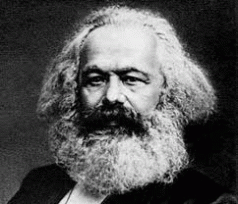
In the above quote, Karl Marx makes quite clear his view that human labour interacting with natures’ resources is the life sustaining process via which material wealth is actually created. The widely held view that money makes money is the appearance but it is not the whole reality involved in wealth creation. The use of money as a measure of value and a medium for exchange evolved after lengthy periods of barter, that involved the direct exchange of different kinds of useful materials and goods in earlier periods of human existence. The belief that money makes money has much in common with the view that milk comes out of a carton— true enough on a surface only examination.
Whether it is milk from various animals, or from, for example, soya beans or rice: two ingredients are essential to its appearance in cartons namely the availability of products of nature and of human labour. Milk does, these days, come out of a carton and interest on money does beget more money for the person whose deposited money is put into circulation. But in the case of money it is what actually happens in the process of its circulation to make the payment of interest possible that we need to consider in order to get to the heart of the matter. The fact is that the miser who hoards money makes no new money by hoarding on the contrary, particularly in these days of rising prices the hoard loses value quite quickly.
Possession of money only results in the possessor begetting more money if the money the possessor has is put into circulation. Before making a very necessary examination of what happens in the process of circulation we need to clear the air a little, by recognising that the question of wealth accumulation is much more complex, than the milk issue, because the methods of accumulating large sums of money are several and varied, and by no means always directly connected with production of wealth. These methods,include for example, honest labour and methods that are legal but immoral and others that are both illegal and immoral.
Regardless of how it is acquired, money is neither edible, nor can it quench your thirst or keep out the winter cold.
What possession of money does in capitalist societies – as well as allowing wealth accumulation via quite unproductive speculation and criminal like activities — is allow those who have, by whatever means, accumulated wealth in substantial measure to; (1) buy or hire the products from which saleable products are created, and the tools and machines that are in vogue at the particular time; (2) buy the all important labouring power of other people. Without human labour and the products of nature wealth creation can-not happen. As Karl Marx quotes William Petty as putting it when explaining the source of material wealth: “ Labour is its father and the earth its mother.”
“mudding the waters”
The above is a simple fact of life that once seriously examined and considered can be understood by most people. Bigoted right wing, pro-corporation ideologues spend time and effort in mudding the waters. A current problem is that few people have seriously considered this vital matter and many people tend to be influenced by these hired ideologues.
One of the tragedies of our era is that the very poor environmental record of the Soviet Union, much of Eastern Europe and currently China helps these right wing ideologues. The leaders of these countries gave lip service to Marxism but ignored Marx’s approach to our interpersonal relationships within the work processes and our relationships to the physical environment. Instead, as the American Marxist Harry Braverman pointed out in his 1974 book, they in their workplace relations systems and attitudes to the physical environment, copied the worst of capitalist approaches.(1)-
I am not claiming that Marx was an early ecologist or that he provided a detailed blue print but I do claim that the logic of his writings provides strong evidence of the likely-hood that in today’s circumstances he would be a leading environmental advocate. His writings also indicate that the immediately below judgment of a novelist who was a British Intelligence operator during the 2nd World War was correct.
English writer Ted Allbeury, who was in the British Intelligence Corps during the second world war, has his main character, in the context of a court case, say: “I said that Communism and Christianity both suffered from the same disadvantage. They didn’t work because nobody actually tried them. The Soviet Union was far from Marx’s manifesto and western civilisation gave similar lip-service to Christianity but never actually got around to trying it.” (Shadow of Doubt, Hodder & Stoughton 1996 Page 242)
To return to Marx’s writings, he reveals why the creators of wealth and those who accumulate large amounts of wealth, particularly when large companies are involved, are two very different sets of people. What then does actually happen when money is put into circulation whether directly by its possessor or via some financial institution?
Why is it the general rule, in modern corporation controlled societies, that people whose labour or interaction with the resources nature provides creates wealth are not the people who accumulate great amounts of wealth? The short answer is that the difference between the socially recognized value (price) of the labour power that the capitalist buys (paid as wages) and the value (price) of the products that the labour involved produces a surplus over and above the wages the capitalists pays her or him. The actual producer of the wealth represented in the material goods he or she produces is, via the function of the capitalist system, alienated from the product of their own labour. It is the capitalist who owns and controls what is produced in the mine or factory and in the case of Agribusiness the fields.
In the case of the employed worker the part of the value added to the end product, their labour has created, receive as their share of their productive efforts is wages. And the value of the wages received is normally less than the value added to the products created. How much less can vary quite considerably subject to a variety of factors including the prevailing legislative situation in the country concerned and particularly the strength of, or alternatively the lack of good quality organisation in unions and of course the political cultural climate prevailing at the particular time and place concerned. The current drive to dismember work process and deskill workers is driven by the fact that the bargaining power, level of control of their work processes and the price (wage rate) of skilled labour is normally higher than semi or so called un-skilled labour.
There are several possibilities as to the part of the new wealth created the particular capitalist appropriates. The commercial capitalist who, either as wholesaler or retailer or both, actually sells the goods or commodities produced, collect their part of the profit via the price they pay being less than the price they sell at. At a surface level this process, that is essential to the realization of profit, creates a new set of illusions. These illusions none the less dissolve once we recognise that the goods or commodities have to be produced before there is any-thing to sell. And that the products have to be sold before the cycle is completed and the profit is actually realized.
“to stay in the rat race”
The need to get a return on their investment large enough to enable them to stay in the rat race drives capitalists to the extremes that are currently all too evident. The growing gap between rich and poor and the consequent reduction in the purchasing power of potential consumers is a very major aspect of the current series of crises around our world. There is an inbuilt contradiction between production that is a social process and the private appropriation and or control of what is produced by a small minority who control so much of the means of production and distribution.
Further it is not only wage workers who are screwed. For example, in Australia the firms trading as Coles (new actual owners) and Woolworths make a lot of their money by screwing farmers and other small producers, and selling the goods thus acquired at much higher prices. The power large, retail plus, corporations exercise in the market is enormous as Coles and Woolworths practices and profits reveal.
The difference between what the capitalist pays the worker to produce and market the goods and the value of the goods produced by workers labour is the source of capitalist profit. What the Coles and Woolworths example reveals is that it is not only wage workers who get screwed by big capitalists but also small, and sometimes not so small, businesses involved in production and service provision.
In our modern societies we now have a recognized gap between the real economy and the money market. Despite all of its apparent power and the influence speculation has over what happens in our societies the latter is in realistic terms actually dependent on the real economy. The current US economy is in such deep trouble largely because of speculation and the out-sourcing of such a large part what used to be its production to cheap labour countries. (2)
These processes have both seriously weakened the US economy and created a political-social situation in which it is no longer only the Afro Americans plus Hispanics and other often illegal migrants in the USA that are forced to try and exist in the poverty that has historically been such an important part of helping to create the massive wealth and power of US corporations. Excessive capitalist greed is now very much a part of the cause of the series of crises capitalism is experiencing. A very real cause for concern is how greed, out of control egos, plus economic and social illiteracy at high political levels has fueled the development of strong fascist leaning trends like the Tea Party movement in the US.
Here again Marx’s Capital is relevant to recognizing that greed, in the final wash up, is self defeating despite that it brings very substantial shorter term gains to some. It does so by creating economic catastrophes, a myriad of social evils, and destroying the physical environment that is so necessary to human existence. Marx makes the point that in capitalist societies the production of goods to sell for individual profit regardless of the social and other consequence takes precedence over production of goods “capable of making life pleasant”. He draws on the writings of the ancient Greek intellectual, Aristotle who, a couple of millennia ago, had grasped the different social and economic character of production of things to make life pleasant and production for individual profit regardless of the social and economic consequences. ( Marx Karl vol. I of Capital p.p 129and 130 pub George Allen &Unwin LTD–Original 1873 and 1889).
Economically literate modern environmentalists add to the above the fact that we live on a finite planet. Fast forward a couple of millennia or so from Aristotle and a century plus from Marx. Of course the various rorts that are used to rob hard working and hard saving individuals of the small amounts of money or potential capital they have accumulated are a constant in our capitalist societies. These rorts have increased substantially as part of the privatisation of retiree pension schemes.(3)
It is the labour of human beings interacting with the products nature provides that actually creates wealth. ,Those whose major concern is to become wealthy at the expense of other people distort what Karl Marx wrote because he painstakingly studied and then clearly explained the truth of the matter of how wealth is accumulation by the few.
In his writings, Marx illustrates how it is that accumulated wealth becomes capital by means of a social relationship that exists within capitalist societies namely the capitalist who owns and controls the means of wealth production and the worker who is devoid of such means of creating the products necessary to human life. This results in the need for those without property in the means of production to sell their capacity to labour to the capitalists in order to access the necessities and, with luck, some luxuries of life. Without the labour of working people possession of wealth, of itself, cannot function as a means of producing the goods that when sold realise profit for the capitalist. It is recognition of this simple fact of life that explains why Marx viewed capital as a social relationship between owners of the means of production on the one hand and those without such means on the other.
Over recent centuries in which capitalist relationships in production have now prevailed in many countries the brutal measures that were used to dispossess small peasants or farmers in order to ensure a supply of labour for the rising capitalist class have been largely forgotten. Separating large numbers of people from the means of production of wealth and particularly of access to land whether as commons or privately owned was a feature of all early capitalist societies
My contention is that the above discussed contradictions between reality and current widely held perceptions are matters for serious thought and ought to become matters for open public discussion. At the same time there are a host of very immediate issues that concerned people need to address. In this latter regard there are some, what I see as, necessary immediate wider picture, steps towards a better human future outlined in my article “Corporation Power Causes Problems” published earlier HERE:.
As the collapse of corporation controlled globalization based on neo-liberal ideology continues, and the economies of yet more countries become its cot-case victims – and China at the least slows down – Australia needs to refocus. We need to focus much more on developing an economy that is more nationally self sufficient rather than continuing as a quarry for other nations economies.
Notes
(1) Braverman Harry Labor and Monopoly Capital The degradation of Work in the Twentieth Century pub. Monthly Review Press 1974
(2)This issue of the price of Labour is discussed by a prominent US advisor of past US governments in “THE WORK OF NATIONS” Preparing Ourselves for 21st- Century Capitalism by Robert B. Reich Published by Simon & Schuster Sydney 1991. Reich a leading US political economist, he served in the Ford and Carter administrations.
Having described the use of cheap labour in Mexico, Reich writes on page 210:
” The same story is unfolding world-wide. Until the late 1970s, AT&T had depended on routine producers in Shreveport, Louisiana, to assemble standard telephones. It then discovered that routine producers in Singapore would perform the same tasks at a far lower cost. Facing intense competition from other global webs.AT&T’s strategic brokers felt compelled to switch. So in the early 1980s they stopped hiring routine producers in Shreveport and began hiring cheaper routine producers in Singapore. But under this kind of pressure for even lower high-volume production costs, today’s Singaporean can easily end up as yesterday’s Louisianan. By the late 1980s AT&T’s strategic brokers found that routine producers in Thailand were eager to assemble telephones for a small fraction of the wages of routine producers in Singapore. Thus in 1989,AT&T stopped hiring Singaporeans to make telephones and began hiring even cheaper routine producers in Thailand.” End quote The consequences of this obsession with increasing profits by utilizing very cheap labour are part of the massive problems currently afflicting the so called American dream of getting rich and then still richer.
(3)This privatization of pensions economic rationalist or neo-liberal stunt is one more reason why leaders of both major political parties should be covering their heads in shame because of the very substantial losses it has cost a great many people. And because as I wrote in an article published in Search News in July 1999: “… retirees who live off super or investments are like all other investors in that their income derives from the return on their investment. Thus “future workers”– ( a term used by then Labor leader Kim Beazley in the context of trying to justify the push for privatization of pensions)– are the ultimate providers whether payments to the aged are in the form of government pensions, superannuation pensions or return on investments.”