Australia is currently in negotiation with eight other countries working out the details of a treaty which will be known as the Trans-Pacific Partnership Agreement. The other countries are New Zealand, USA, Chile, Vietnam, Brunei, Peru, Malaysia and Singapore.
When I said “Australia”, I did not of course mean the Australian people, nor the Australian Parliament. Neither we nor our elected representatives get to be aware of what is being decided unless and until legislation needs to be tweaked.
If past Free Trade Agreements are anything to go by, it will be too late by then.
The last example was during the run-up to the 2004 Federal Election, when discussion of the then pending AUSFTA was overwhelmed by other issues. This situation was exacerbated, as such situations usually are, by the fact that the major parties had broadly similar attitudes to the Agreement.
It is the intention of the corporate interests which are behind this Agreement to weaken current government controls on the labelling of genetically engineered food and on local content in media, and to remove favourable treatment of Australian firms in government purchasing together with preference for Australian workers on government contracted projects.
Threats are also posed to the Pharmaceutical Benefits Scheme (which narrowly survived the last Agreement) and the requirement of Australian governments to adhere to international labour and environmental standards.
One crucial target of those pushing the Agreement is the regulation of the finance sector; if these interests get their way, any attempt to legislate for the prevention of such practices as those that led to the 2008—9 worldwide implosion of financial institutions will be outlawed.
There are also implications for quarantine regulations, climate change policy, the rights of indigenous people and national security.
One thing Tasmanians might like to consider is the situation with our forestry industry if Malaysia and Australia both sign a treaty which weakens environmental protection in the name of loosening restraints on “free trade”. Ta Ann is a Malaysian company. Ta Ann is the biggest foreign player in Tasmanian forestry. (Gunns is, of course, essentially a foreign company if one goes by the addresses of its shareholders, but Gunns’ situation is not what it used to be.)
This is completely hypothetical, but if, for some reason, Gunns is unable to proceed with its pulp mill proposal for the Tamar Valley and Ta Ann should be inclined to take it up, then it will be impossible to impose environmental conditions on the development (or on any other of its activities), as this would constitute a barrier to international “free trade”.
The main point about this Agreement, though, is the fact that, by signing it, the Australian Government would be signing away its national sovereignty in a number of crucial areas.
You might or might not approve of genetically modified food crops, for example, but whatever your opinion, you probably would like the right to know whether the food you are consuming has been subject to genetic modification. Under the TPPA you will lose this right. Under the North American Free Trade Agreement, the Canadian Government lost the right to demand plain packaging of cigarettes.
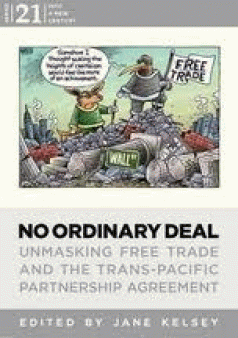
Further information on the Trans-Pacific Partnership Agreement is available in a book titled No Ordinary Deal and published by Allen and Unwin last year. Edited by New Zealand academic, Professor Jane Kelsey, it consists of a number of papers delivered at a symposium in Auckland in 2009.
Further and more up-to-date information is also available from the Australian Fair Trade and Investment Network (AFTINET) at http://aftinet.org.au/cms/.