Whatever the religious right says, those involved in the movement for marriage equality must remain respectful of every shade of difference and dissension within the public debate.
On Tuesday, 16 August 2011, Christian lobbyists from across Australia will rally (rallied) in Canberra to protest against allowing same-sex couples to marry.
This is an annual tradition that began in 2004 when John Howard promised a similar gathering in the Great Hall of Parliament House that he would forge ahead with his ban on same-sex marries. Nicola Roxon vowed Labor’s support to the same crowd.
A lot has changed since then. Support for marriage equality has shifted from 36% to over 60%, with 75% of Australians thinking it is inevitable. And in the lead up to the ALP’s National Conference, reform now has the support of almost every state Labor conference and leader.
This year’s rally against equality – or “for marriage” as the organisers put it – will probably be the biggest and most heated ever. It will also be the most defensive.
Since marriage equality hit political centre-stage at the last election, the major narrative on the issue from groups like the Australian Christian Lobby (ACL) has been that Christians are victims of aggressive secularists, Greens and homosexuals who want to do away with religious freedoms.
When Doug Cameron compared the ban on same-sex marriage to apartheid, the ACL said he was calling defenders of traditional marriage racists.
When Kevin Rudd’s sister, Loree Rudd, denounced marriage equality advocates as the global gay Gestapo, and an apology was called for from gay Holocaust victims, the ACL said Ms Rudd was being “abused and demonised.”
When Queensland Premier Anna Bligh called the ACL “homophobic” for campaigning against an HIV prevention ad featuring a gay couple, ACL Chief of Staff Lyle Shelton called it an attack on Christian free speech:
“Over-sensitive homosexual activists and their uncivil friends … are quick to jump from a great height with moral huffiness and personal abuse on anyone they perceive to step on their toes.”
The Christian persecution narrative reached an absurd low when the entire “traditional marriage” team withdrew from a University of Tasmania debate on same-sex marriage in Launceston last month.
After Tasmanian Labor MP Brenton Best drew attention to the past anti-gay campaigning of State Liberal Michael Ferguson, the latter said he wouldn’t debate because he feared “demonization” in such a “toxic environment” of anti-Christian hate.
ACL chief Jim Wallace and Australian Family Association spokesperson Terri Kelleher then withdrew in solidarity.
The university scrambled to find three replacements and the debate – which would have given Ferguson an excellent platform to exonerate himself from any accusations – went ahead without so much as a cross word the whole night.
This persecution narrative is nothing new. The American religious right and radical conservative movement play the victim card constantly.
Republican presidential nominees have even pledged to support a presidential commission to “investigate harassment of traditional marriage supporters.”
The reason the persecution narrative has reached such a pitch because it is both politically convenient and culturally powerful.
At the political level, claiming victim status is a substitute for addressing the issue of marriage equality itself and diverts attention away from the weaknesses of the case against reform, chiefly its heavy reliance on the Bible.
It is also a way to divert attention from whose rights are actually under threat and who actually threatens them. As Andrew Badcock wrote to the Hobart Mercury after the Ferguson debate debacle:
“I haven’t been to any rally that declared Christians are incapable of raising children or should not be able to marry, but I have had the misfortune to attend rallies where this was said of gay and lesbian people without any factual backing.”
In particular, the Christian persecution narrative diverts attention away from the outrageous slurs against gay and lesbian people by some advocates on the religious right.
The ACL claimed its Queensland director Wendy Francis was the victim of “cyber bullying” during the HIV ad fracas mentioned above because someone called her “disgusting” on Facebook.
Compare that to Francis’s statement when she was a Family First candidate comparing same-sex marriage to child abuse and you see how untethered from reality the Christian persecution narrative has become.
Most pointedly, the religious right’s persecution narrative sets it up to (a) run scare campaigns about angry, litigious gay activists trampling religious freedoms from the altar to the classroom, and then (b) demand exemptions from whatever equality law is on the table to protect these freedoms.
The most recent example of this was a successful church demand for even broader exemptions from New York’s anti-discrimination laws to ensure faith communities would not be forced to recognise same-sex couples once they were allowed to marry.
In Australia, churches are already free to turn away couples they dont want to marry, and free to refuse services to couples they don’t recognise. But this won’t stop some of them seeking even wider exemptions when marriage equality finally hits Parliament.
Beyond the political sphere, the cultural power of the persecution narrative lies deep in Christian history and theology.
To be persecuted is a sign of holiness. Christ Himself warned His followers they would be despised for His sake. Some Christians ask, if this sinful world is not persecuting me, am I really on the right path?
When perceived persecution comes, it is to be embraced as a sign that one’s convictions are right and any wavering unthinkable. In this way the narrative goes around in a circle and becomes an easy way for religious leaders to corral their followers.
But what’s easiest isn’t always best. The persecution narrative doesn’t win public debates.
As momentum for marriage equality grows and Australians ask to know more about the issues, the persecution narrative will look increasingly hollow and irrelevant.
Perhaps the religious right doesn’t feel it can or should win wide popular support? Perhaps it feels that marshalling just enough adherents in just enough marginal seats is sufficient to hold the major parties hostage?
If so it has already lost. According to polls in the United States and Australia, the strength of feeling in the majority who support equality is quickly growing to match the strength of feeling in the minority opposed to it. When this happens, mega-churches in marginal seats will cease to matter.
The persecution narrative also risks inciting violence from those who feel under threat, however false that threat might be.
Already this year self-identified Christians have lashed out at marriage equality protesters in Adelaide and Brisbane. My fear is that as the debate heats up the religious right’s overheated rhetoric may inspire more renegades to violence.
“Crying wolf” is another problem. When Christians in Australia or the United States claim persecution they devalue the very real persecution Christians suffer in other parts of the world, particularly in parts of Asia and the Middle East.
When the public gets the impression Christians are under attacks as much from Doug Cameron as from extremists in Iraq or India, it will cease to care about the latter.
Unfortunately, it seems there is nothing marriage equality advocates like myself can do to turn the Christian persecution narrative around.
Earlier this year, when Australian Marriage Equality pledged to respect the convictions and freedoms of those against equality, the pledge was dismissed by the ACL with examples of contrary behaviour, almost all from the United States.
We have to accept the persecution narrative will go on its merry way no matter how respectful we are to those who denounce us or paint us as bogeys. But this doesn’t take away from the importance of continuing to model respect.
Among supporters of marriage equality there is naturally impatience, frustration, even anger. This will probably grow as resistance to change becomes ever more desperate and shrill.
But there is no place for such feelings in public debate, now or ever.
Whatever the religious right says, those involved in the movement for marriage equality must remain respectful of every shade of difference and dissension within the public debate.
Only when we show we are capable of the understanding and tolerance we have requested from the Australian people will we receive that understanding and tolerance in return.
Rodney Croome AM is Campaign Director for Australian Marriage Equality and an Honorary Lecturer in Sociology at the University of Tasmania. First published by Rodney Croome ABC Religion and Ethics 15 Aug 2011: HERE
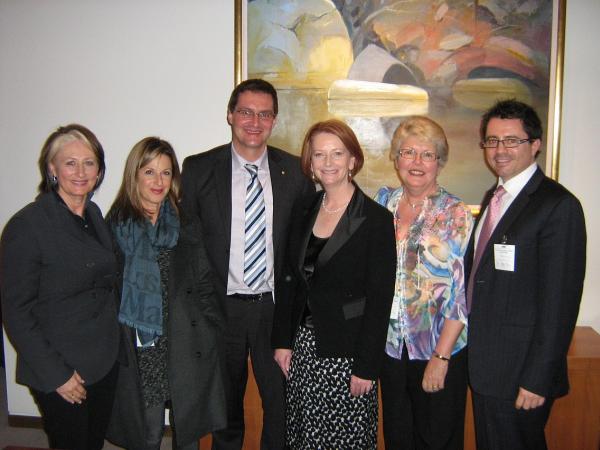
*A photo taken at the meeting is attached to this email. Right to left: Kerryn Phelps, Jackie Stricker-Phelps, Rodney Croome, Julia Gillard, Shelley Argent and Paul Martin.
• AUSTRALIAN MARRIAGE EQUALITY
Media Statement
Tuesday 23 August 2011
GILLARD HEARS CASE FOR MARRIAGE EQUALITY FROM REFORM ADVOCATES
In an Australian first, marriage equality advocates have met Prime Minister, Julia Gillard, to put their case for reform.
At Parliament House this evening the Prime Minister met a range of advocates for reform to hear their views and to answer their questions about her stated opposition to the issue.
It was the first time an Australian Prime Minister has formally met advocates for marriage equality.
Attending the meeting were former Australian Medical Association President, Kerryn Phelps and her wife, Jackie Stricker-Phelps, Parents and Friends of Lesbians and Gays (PFLAG) national spokesperson, Shelley Argent, Australian Marriage Equality (AME) campaign director, Rodney Croome, and same-sex mental health specialist, Paul Martin.
Professor Phelps and Mrs Stricker-Phelps said they told the Prime Minister about the pain of not having their overseas marriage recognised in Australia and gave her letters written by their children about the need for equality.
Professor Phelps said, “I am very pleased we have opened a dialogue with the Prime Minister and hope to continue to talk to her about this issue”.
Mr Croome emphasised the importance of marriage equality as a way of promoting inclusion and participation in family life and told the Prime Minister she has a historic opportunity to make Australian a more just and equitable nation.
“In response to reports that the Labor Party may adopt a conscience vote on marriage equality before the National Conference has a chance to deal with the issue in December, the Prime Minister gave us an assurance there will be a debate on marriage equality at the National Conference”, Mr Croome said.
Mr Martin spoke to the Prime Minister about the link between mental health, internalised homophobia and the inability to marry.
“I felt Ms Gillard listened respectfully and seemed to take on board what I was saying. She accepted information about marriage equality and mental health from a recent statement by the American Psychological Association.”
Mrs Argent said the meeting was a great opportunity to let Ms Gillard know the importance parents put on the issue of marriage equality for their sons and daughters.
“I felt Ms Gillard listened and we gave her another perspective on an issue that not only affects couples but their families and friends.”
“The meeting gave me hope that if the National Conference is positive on this issue she won’t stand in the way of marriage equality being presented to Parliament.”
• Andrew Wilkie: Denison divided over same-sex marriage
The Independent Member for Denison, Andrew Wilkie, has reported his electorate’s wide and varying views on same sex marriage to Federal Parliament.
“While many people in Denison feel strongly about marriage equality I dare not hazard a guess at the numbers for and against, not least because both camps claim a majority and have polling to prove it,’’ Mr Wilkie told Parliament.
“The one point both opponents and supporters of same sex marriage agree on is the enduring value of marriage.
“And what I do know is that the Government needs to find a way to address this matter which recognises fundamental principles and respects both sides of the debate.’’
Mr Wilkie last year seconded a motion asking politicians to gauge their electorate’s views on same sex marriage and report back to Parliament.
“In total I’ve received more than 1,300 emails and letters, mostly from people in the electorate. I’ve met personally with some 50 constituents and over 350 people packed into the main lecture theatre at the University of Tasmania to attend my public forum on the issue,’’ he said.
“Both marriage equality advocate, Rodney Croome, and Presbyterian Minister and opponent of same sex marriage, Campbell Markham, described marriage as a ‘bedrock’ institution during their contribution to the forum.
“However Mr Markham, and many others who share the view that the current definition of marriage as a union between man and woman should be maintained, do so based on the belief that marriage is intrinsically linked to bearing and raising children, arguing “the bedrock of society is family, and the bedrock of family is marriage between a man and a woman’’.
“Moreover there was strong support for the widespread Christian belief that same sex marriage “will undermine the very fabric of God-ordained marriage, and ultimately have a very negative influence upon families, children and therefore our society as a whole’’.
“On the other hand constituents supportive of same sex marriage believe that without the right to marry, same sex partners are unable to live as free and equal citizens.
“They argued such a denial equates to discrimination and rejection of their most basic human rights.
“Mr Croome argued that “denying us the right to marry the person we love sends out the message that our love is not as good and our commitment is not as strong as it is for those couples who can marry. It says we are second-class citizens against whom it is okay to discriminate against.’’
More than twenty Members of the House of Representatives took the opportunity to report their constituents’ views on same sex marriage.
The Labor Party national conference is expected to debate the issue later this year and could resolve that a conscience vote be held on the matter.
Download Andrew Wilkie’s speech to the Main Committee of Parliament House:
Marriage_equality_24_Aug_11.pdf
• Australian Marriage Equality: Poll show majority support
Media Statement
Wednesday 24 August 2011
CONSULTATION ON SAME S-X MARRIAGE RETURNS MIXED RESULT BUT POLLS SHOW MAJORITY SUPPORT
In response to today’s parliamentary report-back by MPs on community support for same s-x marriages, marriage equality advocates have stressed that all opinion polls show a majority of Australians believe same s-x couples should be allowed to marry.
Australian Marriage Equality spokesperson, Peter Furness, congratulated those MPs who consulted in their electorates.
“All polls show a majority of Australians support marriage equality”, Mr Furness said.
“We are pleased many tens of thousands of Australians have contacted their MPs to express their support for equality, but clearly there are many who have yet to raise their voices and it remains our job to encourage them.”
“It was particularly pleasing to see MPs comment on the quality and heart-felt nature of many of the letters they received from supporters of equality in their electorates.”
“Our focus now is on the ALP National Conference and ensuring the strong support for this issue among the ALP rank and file is reflected in a new party platform supporting equality.
During today’s report-back some MPs reported support for marriage equality in their electorates while others reported opposition.
Some endorsed a civil union scheme which Mr Furness said dismissed as “entrenching discrimination against same s-x couples rather than removing it”.
Mr Furness welcomed the presentation of a petition singed by over 55,000 people who support marriage equality. The petition was organised by the activist group, GetUp!
For a summary of opinion poll results on same-sex marriage, visit:
http://www.australianmarriageequality.com/wp/who-supports-equality/a-majority-of-australians-support-marriage-equality/
For the GetUp! petition, visit:
http://www.getup.org.au/campaigns/marriage-equality/petition/sign-now
• Rainbow Labor: Wilkie backflips on marriage equality
Robbie Moore, Convenor of Rainbow Labor said he was outraged the Independent Federal Member for Denison, Andrew Wilkie MP did not reaffirm his own personal support for marriage equality or accurately reflect the views of Denison constituents in his report back to the Parliament today.
“As a constituent in Denison I recall very clearly how strong Mr Wilkie’s support for Marriage Equality was in the election campaign last year.
“It is a stance which I believe won him a lot of the progressive votes in Denison.
“I was pleased when in October last year he openly expressed his support for marriage equality laws and supported the push by Australian Marriage Equality for a conscience vote in Parliament.
“There is still a Media Release on his website from the 22 October 2010 which is testament to that.
“Mr Wilkie has previously said he believed all people should be treated equally and even described the Marriage Act as ‘unacceptable’ and ‘legislated discrimination’.
“Mr Wilkie previously called on the Prime Minister to respect the fact that the majority of Australians were in favour of marriage equality and that an overwhelming number wanted to see a conscience vote on the matter in Parliament.
“Given his history of passionate advocacy on this issue I was astounded that today he seems to have changed his tune.
“Today Mr Wilkie is arguing that the Government needs to find a way to address this matter which recognises fundamental principles and respects both sides of the debate.
“This is a huge backflip on his earlier stance and I don’t believe that his data represents the views of the majority of people in Denison.
“Not once did Mr Wilkie take this opportunity to reaffirm his personal support for marriage equality.
“As someone who has personally been fighting for a change to the ALP’s position on Marriage Equality and who was immensely proud of the decision at the State Conference in Tasmania, I am extremely disappointed Mr Wilkie has backed down from this fight.
“I am also disgusted that he reported back some of the extreme views of his constituents which has only heightened the toxicity of this debate.
“Given Mr Wilkie has refuses to compromise on any other issue, why is it that he is willing to compromise on marriage equality?” Mr Moore said.
Mr Moore said he was looking forward to the ALP National Conference in December and would continue to campaign for marriage equality both within the party and out in the community.
http://www.andrewwilkie.org/content/index.php/aw/press_releases_extended/andrew_wilkie_speaks_out_in_support_of_marriage_equality