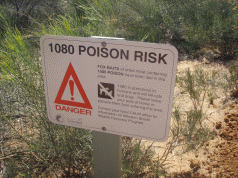
Tasmania’s peak farming body, the Tasmanian Farmers and Graziers Association, says a report on alternatives to 1080 for managing the damage caused by browsing animals underpins their belief that 1080 must remain in the toolkit to reduce the impact of browsing on farmland.
But at the same time, TFGA chief executive Jan Davis said she was staggered that the Tasmanian Government had kept farmers in the dark about the progress of the Tasmania’s Alternatives to 1080 Program report despite their constant demand for information and had sought to bury its release at the bottom of a related joint announcement with the Australian Government.
“I am incredulous that we had been told nothing about a report that confirms we have an overall 22 per cent productivity loss on our farms because of browsing by native animals and far greater than that where the land bounds the bush,” she said. “How would workers in the cities and towns like to lose a quarter of their income because of their inability to control stray animals?”
She was amazed the Tasmanian Government had not kept the TFGA informed.
“I mean ‘hello, we are the people affected by this’. This is one of our major economic and environmental problems and you tell us nothing about it? You bury it,” she said.
Ms Davis said the report confirmed that there was no one easy solution to browsing management; that farmers needed an arsenal of tools to keep browsing at bay: shooting, fencing and the ability to use 1080 in a responsible manner.
“The report shows a single control method is ineffective,” Ms Davis said. “Until there is a viable alternative to 1080, we have to be able to continue to use it, responsibly.
“We had already sought a $500,000 Budget allocation to implement the report once it was released. We agree with its findings, now that we have been able to read them. Now we want the commitment.”