

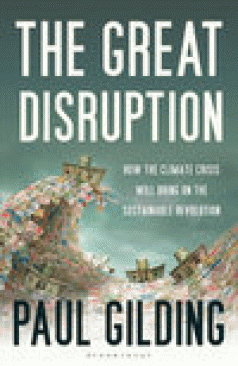
The Great Disruption
by Paul Gilding
Bloomsbury 2011
A work on climate change by a former head of Greenpeace International (1992-1994) will attract attention from readers wanting to know what he has to offer on this critical debate. The fate of humanity now hangs on what we decide to do, whether we make it, or end up sliding into collapse and a termination experience.
Paul’s path through life has been a rough and tumble experience, from working in a cake factory to chief of staff in a political office. At one point a single parent of two children, at another living in a squat in inner Sydney without running power or water. It is hard to image how Paul Gilding became an executive and founder of the Ecos Corporation, now travelling the World offering advise on sustainability and climate change.
Along the track to the writing of this book Paul found himself riding a mountain bike in the hills back of Sydney with Jorgen Randers, one of the team who wrote the 1972 ‘The Limits to Growth’, when they concluded that real action on the Earth crisis may be as much as a decade away, after some really big event that results in “a great awakening” and a global movement to act.
Landers is bouncing off other writers in this great debate, but does not appear to have come to Tim Flannerey’s position yet, of considering the matter of space development, if not yet (p. 279 ‘Here on Earth’), or the prospect of solar power stations in space like Al Gore (p. 71 ‘Our Choice’). He sees a future where individuals will use their collective power to bring about change and a new form of economy that will achieve a safe Earth by 2100.
The people power approach is a little at odds with his suggestion that we will end up in a war-like situation and if this is the case, then as in World War II, the authority of national governments will predominate over any wish of the people in a global emergency. Whether looking at the prospect of a growing bubble of unsustainable demands on the planet, or the ever tightening reality of the implications of a rising level of carbon dioxide (CO2), it is very hard to see how we are going to avoid a crisis which will force national governments to act, which could result in global wars over resources, along with massive famines as food crops fail and reserves vanish.
Gilding agrees with James Hansen’s conclusion (‘Storms of My Grandchildren’) that we must get CO2 below 350 parts per million (now at 392ppm and growing at 2ppm per annum) to win back a safe planet. Will we do it? Will we act in time? Paul Gilding may hold the key. You be the judge.
Paul Gilding will be at Fullers bookshop at 6pm on Wednesday 6 April
An international whirlwind promotion includes:
Perth 28 March
Melbourne 31 March
Brisbane 4 April
Sydney 5 April
Hobart 6 April
UK 11 April
Brussels 18 April
Amsterdam 20 April










