This is a story about love.
The love of an extraordinary people for their culture.
The love of an extraordinary people for one another.
And, the love of one man for these people.
I use the term “These People” a little, well, cautiously, delicately, with a twinge of embarrassment …” These People” … has been besmirched and used as a derogatory term by fat-bottomed privileged politicians seeking political advantage … terminology used to categorise and attempt to dismiss by easy classification the poor and disposssed who attempt – out of desperation – to travel across dangerous oceans in leaky boats.
Irrespective of political and philosophical disposition, “These People” is no term to use for human beings who think and feel and suffer just like we privileged Westerners – so often so, so much more than us.
So, these people are The People. The – some say original – people of the land called Burma.
The People are the Karen, the victimised, humiliated, subjugated but never broken people of Burma.
The man is Dan Pedersen, born journalist and storyteller. Born in Gippsland, Journo of Asia.
I met Dan a few years ago in the journos’ bar of the pub opposite the Mercury, Monty’s. He had washed up here in Hobart working on the Mercury as a sub-editor with a horror story to tell of his years in Thailand stringing for a range of Australian papers, most regularly the Courier Mail.
He had become convinced of massive political corruption within the ruling elite of Thailand. He wrote about it. Believing there was a contract on his life, he fled … ending up in Hobart.
It was not a happy marriage … Mercury, sub-editing and Dan. Dan is a story-teller, the rooter out of stories. An old-style journo who sits down with people and listens, and notes and writes.
And he missed terribly his Asia where he was such a natural fit.
He and Mercury, particularly marketing platform, 9-5 obsessed modern media management, spruce-besuited and simplistic, with precise rules of engagement, did not get on.
Goodbye Dan.
Then I hear from him again. He is in Mae Sot, Thailand. And he is fulfilling a lifetime ambition … to tell the story of the Karen, the oppressed minority of Burma, subjugated under the terrible yoke of the dominant Burman military junta who keep the acclaimed Nobel Peace laureate Aung San Suu Kyi trapped in political isolation in her Rangoon home.
I run Dan’s stories on Tasmanian Times, believing such stories of the Small against the Mighty, of the fight for freedom and justice are important … wherever they are.
Dan journeys regularly into the dangerous, fetid jungles of northern Burma to gather and write the stories of this tenacious people, the Karen. He becomes a contact point for journos from all parts of the world, and takes them there.
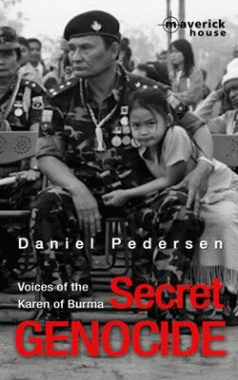
In Secret Genocide he tells their story.
And it is told in that wonderfully flowing story of the born storyteller in this sometimes eviscerating book..
For a secret genocide it is.
(As an aside, Dan is a man of principle … as he says in a foreword to his book, The paper used in this book comes from wood pulp of managed forests. For every tree felled, at least one tree is planted, thereby renewing natural resources.)
From the start, you get a strong sense of all that Secret Genocide is. It begins with this confronting re-statement of the four principles of the Karen revolution, as laid down by Saw Ba U Gyi, the first leader of the Karen Revolution:
1. For us, surrender is out of the question.
2. The Karen, we shall retain our arms.
3. The recognition of Karen State must be complete.
4. The Karen, they shall decide their own destiny.
It has been a struggle with no end in sight. As Dan writes:
(And in this little speech I will stop here, as Dan is here and he can tell it far more eloquently).
So I’ll end with that famous quote from Edmund Burke:
‘The only thing necessary for the triumph of evil is for good men to do nothing.’
Dan is a good man. He has taken up that challenge and been true to his craft. He has borne and bears witness … to a truth.
But on TT… a few more extracts of Secret Genocide:
In 1949 (a year after a swift granting of independence from Britain), the Karen people first declared to the world that they would defend themselves and their cultural identity. Since then, man has walked on the moon, television, internet and satellite technologies have become part of everyday life, and Burma’s neighbours have taken their place on the world’s economic stage. And still, the Karen have not found their peace. Some would say the modern world has bypassed the Karen people, while others speculate they have become entrapped by it, cast as pawns while the rest of the world establishes new economic and political hierarchies.
In little bamboo huts hidden in the jungle, their barefoot children are taught their language, rudimentary mathematics, and history as the Karen know it. There is no internet. There are mostly no telephones. Often, there are no books. Sometimes, backpacking medics turn up out of the blue and tend to festering bullet wounds and chronic ailments, reminding the Karen that they have not been completely forgotten about. At other times, however, Burmese troops or their allied soldiers turn up and burn down the Karen’s schools and churches, before turning their torches on their bamboo homes. Generally, the Karen have fled by the time the enemy arrives, and while their villages are being reduced to scorched earth and ash, they are already searching for a new place to live—preferably somewhere with a water supply and stands of bamboo from which they can carve a new settlement. But every now and then, the people give up, unable to take the constant threat of violence against their communities anymore, and make for the Thai border, where they become lost in the refugee camps a few kilometres beyond the frontier.
In the camps, they find a form of compromised peace, but freedom remains an elusive dream. They witness the freedoms enjoyed by their neighbours from behind bamboo fences and barbed wire. Through the slats, they see a country thriving, with flashy cars driving back and forth past their camps. They also see the soldiers, the one constant in their lives, penning them in and taking advantage of their plight. The Karen refugees are entirely dispossessed. They are not permitted to leave the camps, and they are not allowed to work because they don’t have the proper permits. Yet they must somehow be fed and, in many instances, they are sent on to a third country where they have to learn to make their own way, far removed from their customs and culture, their friends and family.
This is the plight of the Karen … as witnessed and as told to Dan in this profound record of a people’s struggle. In one interview Dan records this historical observation. The interview was with David Tharckabaw, at 73, the Karen National Union’s (KNU—the political organisation representing Karen interests) vice president. He came to Dan’s little restaurant in Mae Sot for dinner, with the express purpose of being interviewed for this book.
According to him, ‘Ever since the military came to power in 1962, the ultimate goal of the military establishment has been to set up the fourth Burman empire.’ He went on to say, ‘Only criminal regimes would think of setting up an empire in a multi-ethnic state like Burma, because the non-Burman ethnic peoples, which together form more than 40% of the population, will never accept it.’
The population of Burma comprises several ethnic groups, the majority of which (about 60%) are Burman. The Karen form at least 18% of the total Burmese population, and the other ethnic groups, including the Shan, the Rakhine, Chinese, Mon, and Indian, make up the remaining 25%. David described a prevailing social system in Burma that many countries have managed to cast into their history books, a dark period of serfdom and enslavement: ‘In the empire, the non-Burman ethnic peoples would be just slaves, like in the days of feudalism.’ He told me that ‘Burman feudalism in the days before the British came was very unlighted feudalism,’ and ‘only the royalty and their close relatives enjoyed special privileges. The people, even including Burmans, had no status except that of slaves. Forced labour, forced relocation, those were common things, and ethnic women were forcibly taken for marriage [and] for concubinage [under] the feudal laws; that was a common thing in the old days,’ he said.
The Karen claim they were the first people to arrive in what is now modern Burma, but they were soon overwhelmed by the arrival of the Burmans, who came in great numbers. The Burmans were a warlike people, and they chased much of the Karen population from their fertile delta lands into the hills of eastern Burma.
‘Only when the British came, those practices [slave labour, relocation and the taking of concubines] were stopped, and ethnic people like the Karen, they became civilised,’ David said as he lit another cigarette. He went on to say, however, that it wasn’t the British who developed the Karen culturally, but rather the American missionaries who brought Christianity with them.
As an example, he explains the Karen people’s stoic nature: ‘“God, I don’t know why this happened. I don’t like it; I don’t agree with it, but I thank you that you’re bigger than it, and you’re going to bring something good. So, we’re going to keep our eyes on you, no matter what happens to us. We will just keep going, looking to make something better in our lives and in the world around us, with whatever little bit of control we have,” these are the things the Karen demonstrate to me in my life.’
Published to coincide with the Launch of Dan’s book, Secret Genocide, Fullers Bookshop, Sunday April 17.