

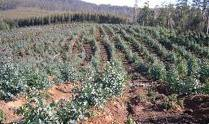
The history of this “so called” Protection of Agricultural Land Policy certainly caused a deal of uneasiness when being debated in both Houses of our Parliament.
Here are some extracts from hansard headed: STATE POLICY OF THE PROTECTION OF AGRICULTURAL LAND. Resumed from 6 September 2000. (page 27)
Mr WILKINSON (Nelson)- “whether the honourable Leader can confirm that the landholder would be able to or has the ability to erect homes on category 3 land, part of it may be category 4 and that was one of the concerns”.
Mr FLETCHER (Murchison)-I am very well aware that when Parliament approved the initial policy we were advised that it has general acceptance, only to return to our various communities and find there was an enormous outcry about the injustices of that particular policy leading to sufficient action to convince the Government of the day to rescind the policy and introduce an interim policy.
Mr WING (Paterson)- Mr xxx wrote a letter to me which I received earlier this week, and as he is not able to be present today, I want to read from it because it also expresses concerns that I have and share with him and the other gentlemen. Part of the letter reads: The issue of prohibiting houses on rural land extends to all rural land and not just prime land. Principles clause 2 states that dwellings alienate agricultural land. The guidelines are uncertain and could be whatever the RPDC deems to be appropriate. This could cause uncertainty for landowners and council planners. Many families in Tasmania may suffer financial loss because of the retrospective nature of this policy. Under the provisions of the draft policy land owners may erect a dwelling on prime agricultural land if they apply before 1st January 2001. This may suit some owners if they are ready to build, however a large number of families may not be able to finance a house within the time frame, or to be in a position to sell the land. An untimely death in the family may mean that a family has to sell their title of land. The land could be worth substantially less if they had to sell land which has been effectively sterilised. Could be a tragedy for some families.
The present owners of a title should not be punished for the mistakes of past subdivision.
All titles in existence prior to the commencement of this policy should retain the right to have a dwelling erected on the land and the right to build on the land should be transferable to a new owner.
If governments take action to take somebody’s property for a road or other public purposes they are required to pay compensation. If they want to introduce a policy which impacts financially very severely and adversely on property owners, then there should be some provision for compensation otherwise there should be some other means of dealing with the perceived problem.
Mr WING – Then goes on to say:
I cannot support this State policy for that reason and I cannot support it also, Mr President for the reason it will aggravate the already severe problem that this State has, a growing problem with the private tree plantation.
The policy includes intensive tree farming and plantation policy and there is an irony in that because it is a State policy on the protection of agricultural land.
I do not understand how it can be suggested that intensive tree farming and plantation forestry could possibly be seen as a policy to protect agricultural land. to smother and have the unrestricted right to smother prime agricultural land with a tree plantation. Locking it up for that purpose fourteen to thirty years or so is hardly protecting agricultural land so the title of this policy needs to be changed or the content of the policy, one or the other.
That ends the extracts from hansard.
There is now a sworn valuation dated 1/4/2011 indicating that the land value of one title prior to the rural zoning was $100,000. After the rural zoning was applied the valuation has dropped to $27,000. I am sure nobody will be surprised to be told that council rates are still being levied at the level prior to the new zoning, as is the case for all the other “rural” landowners I have contacted.
The question now is: Who was on the RPDC through this period, and what drove them to remove the land rights which are surely still our democratic rights under our constitution.
Those of you who are familiar with George Orwell Animal Farm had better get it out and have another read!
Earlier on Tasmanian Times:
How can this be possible and who is the winner?
How can this be possible?

Plantations a rural saviour
Address by Senator the Hon. Eric Abetz
Australian Government Minister for Fisheries, Forestry and Conservation
To Open the
Borden Regional OUTLOOK Conference
23 August 2006
Borden Pavilion, Stone Street,
Borden
Western Australia
Plantations
But today I particularly want to focus on plantations, something which I take a great deal of interest in as Australian Minister for Forestry!
As you know, the growth in the plantation timber industry is very positive news for the Great Southern Region.
I believe it will have far-reaching positive benefits for your region, and for the hardwood timber industry Australia-wide.
We need to remember that as we move out of harvesting old growth and native forests around the country, limiting our timber supply, there are only two alternative sources for timber:
1) Import more timber and timber products from overseas — bearing in mind we already have a $2b. annual trade deficit in timber and timber producers;
And also bearing in mind that often this imported timber comes from the unregulated forests of south east Asia, of the Solomons, or of the Amazaon.
Or
2) We can crop our own trees. That is, plantations.
It is very encouraging to see progress on the new timber processing plant near Albany, which will mainly use plantation blue gum timber.
Lignor will be the first in the world to apply its ‘engineered’ strand board and lumber technology to eucalypts, and I wish the venture every success.
In fact, I will be heading to Albany at the conclusion of this speech to inspect the Lignor plant with your local member Wilson Tuckey.
I am very pleased to see a real possibility for more employment in the forest sector in this region.
And I am also strongly in favour of more value-adding to our plantation timber resource before it leaves the region or the country.
In addition, we are already seeing that significant exports of woodchips out of Albany are making up for decreasing grain exports in the local economy caused by drought
Plantations tax review
I am sure you are all familiar with the review into taxation treatment of plantation forestry.
Plantation taxation has been one of the most challenging issues I have dealt with as Forestry Minister.
I am very supportive of the current “12-month rule” plantation taxation arrangement, and want to maintain it.
Whilst the future of this rule is currently being considered by Government, I would like to make a few points about the plantation sector and address a few “rural myths”.
The 12-month rule has been very successful in leveraging private sector investment to create plantations, through managed investment scheme arrangements.
It has also been very successful in bringing city money into the country
That is, city money creating rural jobs.
Something which offers a great counter to compulsory superannuation, which is often criticised for taking rural money into the city.
There are claims that plantations destroy rural jobs and rural communities.
Can I say, I have not seen any evidence of this.
In fact, all the available empirical evidence is to the contrary.
Rural Australia has, unfortunately, been in decline for the past 25 years.
The 12-month rule has been in existence in its current form since 2002.
What is actually happening is that plantations are creating new jobs and revitalising rural communities, particularly when they get to harvesting stage as they are starting to now.
There are also claims that MIS’ are driving up property prices at the expense of local farmers.
On that, let me just say that I am informed that more recently it has been New Zealand dairy farmers outbidding companies like Great Southern Plantations for land who are driving up prices.
And can I say I don’t know many farmers who would not prefer their land to be worth more rather than worth less.
Greater capital value means more equity to develop their farm.
But far and away the biggest criticism of MIS’ is the claim that the current taxation arrangements means there isn’t a “level playing field”
Claims that somehow the plantation sector is unfairly advantaged.
Let me make this point.
There never has been, and never will be, a rural sector in Australia which is untouched by special taxation rules.
And rightly so.
Australian farmers face fluctuating prices, closed European markets, and worst of all, the vagaries of the weather.
In fact, support for farmers and primary producers right across the nation amounts to hundreds of millions of dollars each year.
Five-year averaging of incomes, tax deductible farm management accounts, accelerated depreciation…the list goes on and on.
Schemes, I might add, which I and the Government strongly support.
In fact, the 2004/05 Productivity Commission Trade and Assistance Review reveals the following:
In 2004/05, a total of $1,144.7 million — that is, $1.14 billion — in assistance was provided to primary production, including drought funding.
Of this, just $40.3 million went to the forestry and logging sector.
That is, about 3.5 percent to the forestry and logging sector, including both native forest logging and plantations.
And that included $20 million to CSIRO, for research into forestry, leaving only $20 million for forestry and logging. I suspect the plantation sector’s share of this was very small.
Now consider the relative employment levels of these industries.
According to ABARE, 312,000 people nationwide are employed in the agricultural sector.
In the forestry and logging sector its 12,000 — that’s 3.8 percent of the agricultural workforce.
What I’m saying is this: relatively, the agricultural sector receives more assistance per worker than the plantation sector.
Tree farmers receive support mainly because a return on investment cannot be realised for at least a decade.
It is very difficult to encourage anyone to invest in an industry without the prospect of a return for a minimum of 8-10 years if there is not some small up-front incentive.
What farmer in their right mind would plant a wheat crop which took 10 years to mature, or fatten a steer from birth to age 10, if they didn’t have some support in the meantime?
I say all of this because, unfortunately, it has been some sections of the farming community who have been most vocal in their opposition to MIS’ on the basis that it provides ‘unfair’ assistance to the plantation sector.
Rural industries wax, and rural industries wane.
In one decade wool is in the ascendancy, then its dairy, then its wine, then it might be dairy again, and then it might be trees.
All these industries, to some extent or another, have specific and unique support from the Australian taxpayer.
To attack forestry MIS and the 12-month rule as the cause of some rural change is not only unfair, it is unhelpful given the support which the rest of the rural sector receives.
This is not to say that I don’t think the 12-month rule and the plantation sector can’t be improved.
I am very keen that we introduce secondary markets into the mix.
This will inject market-based honesty into the prices per unit for MIS plantations.
A secondary market will bring forward a price discovery mechanism for the market. As an investor, when you know how much a plantation is worth at year 4 or 6 or 8, you have a better idea of what constitutes a reasonable upfront investment.
This ought to ensure that MIS operators are not able to take excessive profits up front, which is sadly the perception that some people hold.
As an MIS operator, when you have 15 or 20 competitors in forestry, and a $1 trillion managed investment market to compete with, you can’t afford to be charging big dollars upfront without delivering solid returns at the end.
All these things are being considered by the current review and I look forward to a positive outcome for the entire rural sector.
Read the full article on Tasmanian Times, HERE
And,
Eric Abetz: The Truth About Tree Farms
Address by
Senator the Hon. Eric Abetz
Minister for Fisheries, Forestry and Conservation
“You can’t live in a pumpkin”
Sustainable Economic Growth for Regional Australia Conference
29 August 2006
Hotel Grand Chancellor, Launceston
Whilst the future of this rule is currently being considered by Government, I would like to take this opportunity to address what some call the “rural myths” about tree farms
The 12-month rule has been very successful in leveraging private sector investment to foster innovative agriculture and create timber farms, through managed investment scheme arrangements.
It has also been very successful in bringing city money into the country
That is, city money creating rural jobs.
When was the last time you heard people arguing against this?
Something which offers a great counter to compulsory superannuation, which is often criticised for taking rural money into the city.
Then there are claims that plantations somehow destroy rural jobs and rural communities.
People talk a lot about the damage tree farms will supposedly do to other farms, but no-one to date has presented me with any hard evidence.
In fact, all the available empirical evidence is to the contrary.
Rural Australia has, unfortunately, been in decline for the past 25 years.
The 12-month rule has been in existence in its current form since 2002.
What is actually happening is that plantations are creating new jobs and revitalising rural communities, particularly when they get to harvesting stage as they are starting to now – such as at Preolenna.
There are also claims that MIS’ are driving up property prices at the expense of local farmers.
On that, let me just say that I am informed that more recently it has been New Zealand dairy farmers outbidding companies like Great Southern Plantations for land who are driving up prices.
But is that a bad thing?
Shock horror to think that rural land values might actually be going up in line with the suburbs!
Can I say I don’t know many farmers who would not prefer their land to be worth more rather than worth less.
Greater capital value means more equity to develop farms.
And in many cases it means farmers are able to exit with dignity and sell their farm for a decent price which would not otherwise have been achieved
Open minds = open opportunities — an excellent theme
And herein lies the crunch.
The King Island Council is leading a push in Tasmania to have forestry outlawed as a legitimate rural practice.
I was relieved to see that the Resource Planning and Development Commission has reconsidered their ruling on this
As I am sure were most of Tasmania’s farmers, including those on King Island.
The farming community would be very nervous to have Local Government trying to put their stamp on what happens on farm land
Farmers should be able to grow on their land whatever legal product they like — be it cows or sheep or wheat or potatoes or trees or even pumpkins — and I’ll explain pumpkins in a minute
Not only is a tree farm ban the thin edge of the wedge, it runs totally counter to the theme of today’s conference of Adaptable Regions: open minds open opportunities
To lock our rural economy out of a potential growth area is a very unwise path to take
The rural economy is a fickle beast
Markets come and markets go
To say to the farmers of the future that “thou shalt not grow trees” – or any other valuable crop for that matter – is something which I think all farmers should rightly be very wary of.
You can’t live in a pumpkin
We certainly need and value the food and other rural commodities our farms produce
But it is absurd and silly to argue, as some stridently opposed to tree farms are, that you “can’t eat a tree.”
Of course you can’t.
No doubt our foresters could retort with: “you can’t live in a pumpkin.”
But just as you need food to eat, so you need a house to live in, furniture to sit on, and paper to write on
If capacity to eat the product is the test for allowable agriculture we would be without wool, cotton, lavender and other farm-based industries
We need a mature and sensible approach to change, not lazy catch-cries that fail the most basic tests of logic
Ultimately, it should be up to each individual land owner to decide what he grows on his land or who he sells it to
This is the Australian way and this is how it should be.
Conclusion
The great catch-cry of the 1990s in rural Australia was “diversification”
We sought to protect ourselves from a price shock in one rural industry by also growing other rural commodities
In many ways the theme of today’s conference Adaptable Regions: open minds open opportunities is a logical extension of this, from the individual to the community
Rural and regional communities need to protect themselves from commodity price shocks by opening their minds to all forms of rural commodity and rural investment
Indeed, some of these alternative crops, such as trees, even have the potential to revitalise communities which were formerly in decline
The fact is, a community which closes off options for the future is a community which surely dooms itself to a death of a thousand cuts
Can you imagine the state of play on say, King Island, if farmers there had been told in the early 1990s that they couldn’t move from sheep to beef when the wool market collapsed because it would “destroy King Island as we know it”, putting shearers and rouseabouts out of work and destroying the Island’s image as a producer of fine wool?
King Island would now be a ghost island had that happened
Of course, it didn’t, and farmers moved very successfully into beef production
Or can you imagine our East Coast not converting sheep country to walnut groves and vineyards?
The reality of modern life is that the only constant is change
Rather than trying to fight change, regional communities should embrace it and be in the vanguard, or at least allow those who want to avail themselves of new opportunities to do so.
The value of conferences such as today’s is summed up by the saying:
If I have a dollar and you have a dollar and we exchange them we both still have a dollar
If I have an idea and you have an idea and we exchange we will both have two ideas.
I wish you an enjoyable conference and thank you for your time today.










