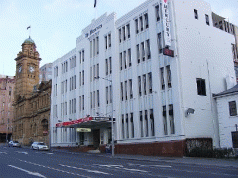
Last week 32 editorial staff members – reporters, editors, photographers – gathered nervously in the canteen area deep in the bowels of the Mercury building.
It’s an eerie place down there nowadays; a ghostly emptiness bounces off the cold concrete walls. The press, relocated to Glenorchy last year, has gone, along with all the production staff. In the past two years about 40 jobs have been axed from the Mercury across all departments. This week, it was announced the staff canteen would be closing down too, at least temporarily. The canteen was once the thriving heart of the building where journos, ad reps and the like met to grab a coffee or a sandwich between jobs. Now it’s like an abandoned movie set. There’s an awful poignancy to the stillness.
Most of the editorial staff remaining at the Mercury attended this meeting. Some were off-site and unable to make it. One chose not to come because he was so deeply upset by the latest plans to wield the axe on jobs at the Mercury that he feared he couldn’t trust himself to remain civil or composed. Make no mistake, staff are seething. The meeting started gently enough but within minutes there were heart-felt pleas from emotional staff members to resist News Ltd’s plans to export the editing of the Mercury to Melbourne.
The editors on the chopping block fear for their jobs and their families. Those facing the axe are career journalists with vast experience in Tasmania, interstate and overseas. They have worked 10, 20, 30 years and beyond to become editors in charge of designing pages and checking and editing stories for legal, factual and grammatical errors. Many have degrees and post-graduate qualifications. They represent a vast sum of knowledge of Tasmanian affairs after accumulating decades of day-in, day-out experience immersed in the news of the day.
In 2009, 15 editorial staff left the Mercury, including 12 redundancies. Most of these were editors. This exodus from the Mercury left a small brigade of editors to carry the load. It meant a massive increase in workload. Editors rarely stopped for meals and spent entire shifts at the keyboard at an increasingly intense workplace. But a strange camaraderie grew amid the pressure. The few staff left put their heads down and made it work. There were undoubtedly more errors getting into the newspaper, but productivity soared and there was a sense of pride within the group.
Mercury editor-in-chief Garry Bailey responded to this extra commitment and effort from editing staff by announcing plans to axe editing jobs from Hobart and export them to News Ltd’s NewsCentral in Melbourne.
Hobart staff were flabbergasted. They demanded, twice, in letters to Mr Bailey for him to address the group and explain himself. Mr Bailey responded with a terse letter to the union and with two group emails to staff which posed his Zen-like reasoning that the export of jobs was both inevitable but may not happen. No face-to-face chat, no explanation. Then, in a move which inflamed the situation even more, he took reporters in small groups into his office and reassured them their jobs were safe.
Most staff read this as a bid to divide and conquer; if it was, it failed.
The reporters who attended last week’s staff meeting remain firmly against the move to edit the newspaper in Melbourne. Because while some of the angst and anger in the ranks is purely because people stand to lose their jobs and have very bleak employment prospects in Hobart, there is also deep resentment and serious concern about Tasmania’s leading newspaper being edited in Melbourne by people with little or no knowledge of Tasmania.
It is an insult to Tasmanians.
Every day on the front page the Mercury boasts it is the Voice of Tasmania. Mr Bailey plans to edit that voice in Melbourne. It’s plainly and simply wrong.
Editing is a critical task in a newspaper. Politicians would give their right arms to be able to edit stories about themselves that appear in the news pages. A subtle phrase here, an emphasis there, can make a huge difference to the way people react to stories. Editing is far more than just checking for commas. With it comes a huge responsibility. Hobart-based editors live with their mistakes. A Melbourne editor won’t even know a mistake has been made.
Take for example the biggest Tasmanian story of the past 10 years, the Gunns pulp mill. Sue Neales, Simon Bevilacqua, Nick Clark and other staff reporters covered the issue without fear or favour, ably supported by editors mindful that the Mercury covers every aspect of the community debate and that all sections of the community have a voice. There has been great pressure on the newspaper from all sides of the debate.
Loggers and greenies alike have accused the Mercury of bias against them. But the fact is that in 50 years’ time when historians trawl through the old Mercury pages to piece together what happened during this tumultuous debate, they will get a fair and extensive record of the feel of the times. This is what a good newspaper can do. For this type of coverage to occur, newspaper editors need to know their community and understand the dynamics of its citizens.
A good newspaper will never be loved by the public because, as the fourth estate, it must stand at once in and out of its community. It must straddle the divides and to do so it must understand the divisions and their historical roots.This cannot and will not happen at the Mercury with Melbourne editors who may or may not have even been to Tasmania. The ramifications of exporting these editing jobs go far beyond the correct spelling of Campbell Town or Lin Thorp. This move cuts to the heart of what a newspaper is to its community.
The export of jobs has already started at the Mercury. Last year, the local pay office closed down and staff pay is now handled interstate. Some advertising accounts are now handled interstate. Sections of the newspaper, such as Escape, E-Guide, Your Money and the finance and world pages are now produced interstate. The CarsGuide, Taste and daily Mercury sport and news are next in line to be taken offshore. The Tasmanian Country, the Gazette, the Kingborough Times, Property, Style and the Sunday section of the Sunday Tasmanian have been given a stay of execution. But Mr Bailey has warned they are under review. There are fears they too will go offshore when Melbourne NewsCentral can handle the workload.
This brain drain from Tasmania threatens to destroy almost 160 years of history. The Mercury was started by a convict in 1854, a year after the cessation of transportation and the same year the island took on the name Tasmania. It was meant to be a new start; a chance for the views on this island to stand alone. The Mercury wanted to be a new voice, the voice of Tasmania, because this island is different from the rest of Australia. Its climate is different, its forests are different, its beaches are different, its businesses are different, its wildlife is different and its people are different.
The export of these Tasmanian jobs tears at the heart of this state’s sovereignty. Its Orwellian overtones are nothing short of frightening.
This week, Mr Bailey finally addressed the editors facing the axe. The editors at these meetings say he made no guarantees for any of their jobs. He said this round of job losses would focus on those editors who check and edit stories, while those who design the look of pages will be safe for now. He refused to rule out the prospect they would lose their jobs in any new round of cuts. He also confirmed the export of jobs was his call not News Ltd’s in Sydney and that he had made it because he felt it was inevitable and wanted to take charge of the matter. Anxious and stressed after weeks of insecurity, doubt and fretting, staff asked a few pertinent questions but generally felt that since Mr Bailey had staggeringly started the conversation with the comment that the changes were about improving the quality of the Mercury, there was little use in engaging.
For staff, it was clear at the meeting in the Mercury canteen last week that the move to export editing to Melbourne is the last straw. Staff have watched as job cuts and “efficiencies” have crippled the newspaper. Staff feel standards have been falling. How can a reporter do his or her job when there is no one on hand to answer phone calls because the reception and clerical staff have been laid off? How can a photographer understand the nuances of a particular story when he or she is running around like a headless chook, without the reporter, because there are so many jobs to be done?
Most staff at the Mercury feel a sense of shame for the Mercury’s shortcomings, but paradoxically most also feel a real sense of pride in the not uncommon successes, considering the conditions in which they are required to work.
An editor at last week’s meeting held in her hand a copy of the Saturday Magazine, which appears in the Mercury on Saturday. She held it high and addressed her colleagues. “This is what we’re capable of,” she said. “This was produced by Tasmanian reporters, Tasmanian photographers and Tasmanian lay-out editors and sub-editors. It’s great. It’s a fantastic piece of work. It’s Tasmanian. We’re capable of producing top quality work here in Tasmania. Why is there talk of exporting our jobs?”
Slowly but surely, section by section, the Mercury is losing locally produced pages and products like the Saturday Magazine stand as isolated examples of what the newspaper once was.
The canteen area, only 15 minutes earlier a cold empty chamber in the growing void behind the Mercury’s Art Deco facade, was suddenly alive with passion. Applause broke out. And then the testimonials began. One after another reporters, photographers and editors told of their struggles, triumphs and failures. They want to do better. They want to be allowed to do better. They are passionate about their jobs. They are capable, talented, willing and determined. They care about Tasmania.
Unanimously, they committed to resist further gutting of the Mercury and the export of Tasmanian editing jobs to Melbourne.