Which local council in Tasmania has not thought about, or initiated, improvements in its public open space in order to make their towns more attractive to locals and visitors? The topic of “makeover”, “revitalisation” or “upgrading” regularly appears on all councils’ agendas. And soon a call goes out to a contractor followed by a significant flow of ratepayer’s money.
Generally in Tasmania the end result of such makeovers is not spectacular. Sometimes even outright disappointing. “Better than nothing” one often hears. Exceptions confirm the rule.
However, the public and council executives need not end up with “better than nothing” if they start out their project with a more qualified brief for the contractor and clear cut demands for a desired outcome.
The ingredients for successful “urban revitalisation” or “liveability infrastructure planning” are as basic as they are effective if chosen knowingly and applied professionally.
The first thing to check is the mindset of those doing the ordering. Any investment in “makeover” should be regarded as an investment in infrastructure and not as a fringe activity of embellishment.
Achieving improved liveability in any community should be one of the most important council goals because a liveable urban environment has a very important flow-on effect on every aspect of the community’s wellbeing. Be that public health and fitness, social cohesion, attractive workplaces and commuting, agreeable microclimates, calmer traffic – and most importantly – a vibrant economic atmosphere.
There are a number of known tools to create a physical environment with which “liveability” can be achieved. By far the most effective single liveability tool are street trees.
This statement has to be immediately followed by a vigorous definition of what a street tree IS (and thereby, importantly, what a street tree IS NOT):
A street tree IS
• a clean trunk tree of 2.5 to 4 metres at planting,
• the result of a highly specialised tree nursery procedure, performed by specially trained nursery persons with the aid of special nursery installations and tools that facilitate this growing method,
• chosen from tree species that are known to perform well under harsh conditions of trees in public spaces that have to withstand onslaughts of many kinds, such as traffic, dust, heat, cold, high winds, hail, buffeting, soil compacting, animal soiling etc.,
• a tree that is planted out in avenues. Tree species can vary from street to street, but not within the same street for psychological place making reasons. The avenue effect only takes place when street trees are regularly spaced at intervals of 7 to 20 metres,
• a tree with a clean trunk and an overhead canopy, designed to create dappled shade (not dense, dark shade or no shade at all), which should benefit pedestrians or parked vehicles,
• the result of proper planning and is an excellent tool to achieving traffic calming.
A street tree IS NOT
• a glorified shrub, randomly stuck in a footpath, with no clean trunk, no canopy, obstructing pedestrians and cars parked at the curb,
• a tree with a clean trunk of less that 2.5 metres,
• a conifer or other tree with dense impenetrable foliage,
• a native Tasmanian tree (exceptions in parks, pocket parks, nature corridors or similar),
• a tree in the middle of the road, where it does not provide dappled shade for pedestrians or create a sense of place and blocks out communal long views.
Can genuine street trees be bought in Tasmania and is there a specialist who is up to scratch with the growing and planting methods described above? The answer is yes.
Since July 2010 there has been Simon Wood of Westland Advanced tree Nurseries, Seven Mile Beach. Simon has undergone a full immersion, intensive study tour to Switzerland where he attended high quality outdoor lectures in two leading street tree nurseries and was briefed by the globally highly esteemed Office of Parks and Open Space of the Zurich City Council. High ranking officers took the time to share with Simon their experience in liveability planning and their interaction with the public and those responsible for street tree management.
Zurich consciously uses street trees and greened traffic calming methods to facilitate social inclusion and successfully attract foreign companies to set up shop in the city.
Taking proper street trees seriously as a pivotal infrastructure investment should be one of the priorities of every Tasmanian council. While we can not easily change whole inner city traffic systems and move multi story car parks to better strategic positions in a town, we can with much less effort, traffic calm and tree up many inner city streets, link roads to the peripheries (suburbs) as well as most suburban streets, car parks, industrial areas, roundabouts etc. All at relatively low costs with immediate benefits to be experienced by everybody within a short time. The presence of street trees prepares the ground for further liveability improvements.
This – once applied with determination, but also with the needed professionalism – will truly transform Tasmania quickly into a more liveable and therefore more desirable place to work, invest in and live in.
Spot the difference

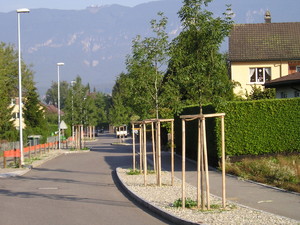
from this (Tasmania) … to this (international standard)
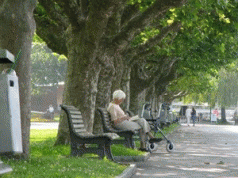
Good examples of street tree infrastructure (sight lines, canopies, spacing, comfort, inclusion)


Download the article: Street_trees_magic_final.doc
(The authors have no financial interest in any business to do with the provision of liveability infrastructure. Our involvement is strictly limited to that of the self funded “Liveability Initiative” http://www.liveability.info providing up to date information on all matters concerning liveability. All photos: Peter Brenner)