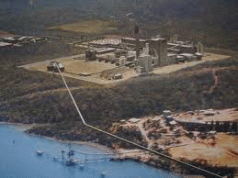
The change of Premier in Tasmania was taken as an opportunity to proclaim that Gunn’s Mill was back on the agenda. Rather than claim that she would clean up the mess she had inherited our new Premier has stated that she is in favour of a pulp mill, and that she would not rule out the State Government as guarantor for the mill. The machinations were complicated but the Gunn’s plan to commit even more Tasmanian soil to growing chemically dependent trees for pulp is now officially back on the Government’s agenda. Even worse the possibility of a government guarantee for the mill that could end up costing tax payers hundreds of millions of dollars is obviously being considered.
The ‘common ground’ for a pulp mill between leaders of main stream environmental organizations, with Gunns, has been lifted from secret talks status to declared State Government policy under consideration status. The environmental figures involved in the ‘common ground ‘fiasco appear as having forgotten that they are supposed to act in the interests of a sustainable environment. Even worse again the ‘common ground ‘process has restored disgraced former Premier Lennon as an official and very active player in the pulp mill gamble.
A major purpose of this article is to highlight the real dangers this situation poses for Tasmania’s future. The environmental problems success for Gunn’s bid to tie Tasmania’s economy to continuing and extending the spread of chemically dependent monoculture plantations of trees for pulp looms is a horror prospect. There are two major issues involved. One is the health problems that stem from even more poisons, from chemically dependent monoculture plantations of trees for pulp, in our water. The other is the future of soil productivity in parts of our State taken up by these chemically dependent monoculture plantations for pulp. The soil fertility destruction arising from clear felling, hot fires and other “war on nature” practiced by Forestry Tasmania is a deadly serious problem.
I have borrowed the phrase” war on nature” from Tim Flannery’s most recent book, Here On Earth. This very useful book, despite its lack of reality in relation to some vital economic matters(1) contains valuable information pertaining to both of these vital issues“. It could be argued that, as distinct from the professional apologists for Labor and Liberal Party’s policies, honest readers who share Flannery’s social conservatism bent might well be jarred into reality by the scientifically based arguments that comprise much of his writings.
I refer here, particularly, to his well argued points for example that ‘pesticide companies ‘in their scramble for short term profit have “set us on a cataclysmic course”. And his chapter ”Restoring the Life –Force “where he explains the sense of Australian Aboriginal use of light burn fires to preserve the carbon in the soil. This tried and tested approach to the use of fire contrasts sharply to the hot fires used for example by ‘Forestry Tasmania’. Forest practice in Tasmania with its clear felling and excessively hot fires ensures that carbon in the soil is destroyed and then anything positive left is killed off by chemicals.
Paul Lennon with Liberal party support enabled the disgraceful laws that place Gunns above and beyond the control of the rule of Law. Premier Giddings appears as pledging continuance of this disastrous course. An immediate task for people concerned for Tasmania’s future is to build a public opinion that enables action to enforce the rescinding of these laws and re-establishes due process in development planning.
What I believe needs to be done is to develop a major campaign for the rescinding of these laws. Pressure needs to be put on all parliamentarians, including the Greens, to take up this issue. Then there is a necessity to address the incompetence of the current top public servants in Forestry and promote competent people who are interested in sustainable forestry, rather than in replacing existing forests and high quality agricultural land with chemically dependent , water poisoning and soil fertility destroying monoculture plantations for pulp. The public subsidies to keep the pulp for paper industry afloat, that have been calculated as being in the order in excess of $63millions a year over the last 12years,(x) should stop NOW.
The real cost to human health and life and to the public budget that is involved as result of poisons in our water needs to become an issue in the public debate.
Notes:
(x)For more detail on these and closely associated questions see WWW.nwtptas.org.au/ John Biggs’ article “The state of democracy in Tasmania” and Max Bound’s article “Although difficult, positive change is possible” see WWW.nwtptas.org.au/
–(1)Flannery, Tim Here on Earth (Text, 2010: p. 233) For more information on this aspect see my article “Although difficult, positive change is possible” see WWW.nwtptas.org.au/ In his chapter “Of war and Inequality “Flannery uses figures on what has happened in China and assertions that things are about to get better in India.. Unfortunately he ignores the environmental horror story that is happening in China, and under states the still existing poverty of many in China. The reality of plunder of underdeveloped countries by the USA and other developed countries also tends to be over looked by Flannery. The likely immediate future situation in India unfortunately might not be as bright as he suggests. This despite that there are parts of India in which people power movements have imposed some improvements.