

There is an urgent need for a national rapid reaction force for fighting bush fires.
The recent fires around Perth, and in Victoria, raise the question of whether we have our priorities right in addressing this problem. The floods and cyclone have, quite rightly, diverted attention to the need for national, rather than state, intervention to address the problem. In this case the military have been called on for rescue and for logistical support for reconstruction. In the case of major bush fires, the states are responsible for at least the initial reaction but their fire services are not equipped for tasks of this magnitude.
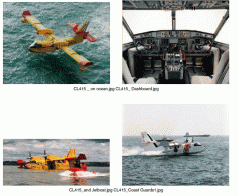
Why won’t the Premiers and the Federal Government agree to a Federal rapid reaction force for major fire events. This should be based on the Bombardier CL415, the world’s only aircraft specifically designed for the task of fighting wildfires.
I, among others, believe that it is time that there should be a Federal service, akin to the French Securite Civil, specifically dedicated to rapid response to bush fires, with secondary value in maritime surveillance and relief in coastal disaster zones. This is a highly specific task, required specialised equipment and highly trained personnel. For this reason the force should be separate from the military, who are not specialised for rapid response.

I made a submission to the Victorian Royal Commission into the Black Saturday bush fires, and sent copies to the Premiers of most Sates, in which I pointed out the need for such a force. In the copies sent to the premiers I highlighted the fact that, in the event of future fires, the public might resent the fact that no consideration had been given to the establishment of such a force. In most cases I received complacent replies pointing out that there were considerable numbers of aircraft that could be made available if needed. This is equivalent to suggesting that we do not need fire trucks because tractors and utes can be adapted to serve the purpose. I hate the fact that I am now in the position of being able to document the fact that ‘I told you so and you would not listen’.
I believe that the recent fire near Mandurah, in Gippsland and near Perth highlight our lack of preparedness for events of this magnitude. Each State has its own forces and equipment and they appear reluctant to cede any power in this area. The result is that they rely on makeshift aircraft (agricultural sprayers and helicopters) instead of availing themselves of the CL415. This may be because they fear the expense of these aircraft, not taking account of their far greater capability. They have a range of 2400 km and a cruise speed of 333 km/h so could, from a base at Adelaide, have reached the Gippsland fire at the end of January (which burnt out 8000 hectares but was followed immediately by the Victorian floods) in under 4 hours, allowing a further 3 hours of fire fighting before re-fuelling was necessary. They could have reached Perth from Adelaide in little longer than it is reported that fire appliances would take to reach Perth by road from Albany.
These aircraft are amphibious and can scoop 6,000 litres from a free surface in about 12 seconds. With the Canning dam less than 30 km from the fires south east of Perth, they would be able to scoop up a load, fly to the fire, dump the load precisely and return to scoop another 6000 litres in about 10 minutes so that one aircraft could deliver 36,000 litres an hour to the fire zone. The aircraft can also seat 9 persons in addition to the crew of two so that relief crews could be carried to the fire area, allowing the aircraft to be operated almost continuously during daylight, while ensuring that crews do not exceed their duty hours. They are also able to operate at tree-top level so that the water is not atomised into tiny droplets. Unlike helicopters, they do not produce the strong down-wash that has the potential to spread embers.
Short-sighted complacency of the governments must end. There is the need for a national approach.










