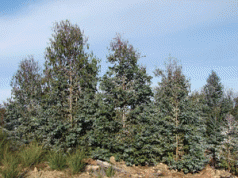
These are FSC certified monoculture plantations and the issues, including those of workforce occupational health and safety, are very similar to those here in Tasmanian plantations.
COMMUNITIES AND TREE MONOCULTURES
– Uruguay: Tree plantation workers and agrotoxic spraying (World Rainforest Movement)
One of the promises made by plantation companies to gain support – from the government and from local communities – is that they will create employment. What they fail to specify beforehand is the type of employment they will create and under what kind of working conditions, in terms of both salaries and workers’ health and safety.
The majority of jobs on tree plantations, except for pruning, involve the use of agrotoxic substances at one stage or another. In the nurseries where the seedlings are raised, it is mainly fungicides that are used, on an ongoing basis. Preparing the land for planting involves the use of chemical herbicides, fertilizers and insecticides. After the trees are planted, agrotoxic chemicals continue to be applied for a year to control the growth of weeds. Finally, when the trees are thinned or logged, herbicides are used once again to eliminate the sprouts.
A recent study by PAN-Uruguay on tree plantation workers and agrotoxic substance use (see “Uruguay: trabajo y agrotóxicos en la forestación” in http://www.rapaluruguay.org/agrotoxicos/Uruguay/FOSA.pdf) reveals some interesting facts. The research was carried out on plantations operated by FOSA (Forestal Oriental S.A.), a transnational company that is owned by UPM (formerly Botnia) and which among other things is certified by the Forest Stewardship Council (FSC).
The study provides a detailed list of the chemical substances used by the company, including different herbicides (acetochlor, glyphosate, oxyfluorfen, haloxyfop-methyl), the insecticide fipronil, and various fertilizers (ammonium sulphate, phosphate), noting that these substances are potentially carcinogenic and can cause hormonal alterations, among other health impacts. Therefore, as the study reveals, while it is true that the substances used on the plantations are authorized by the Uruguayan Ministry of Agriculture, Livestock and Fisheries and by the FSC, it is no less true that they are all highly toxic, both for the workers who handle them and for the environment.
The use of these agro-toxic products means that workers are subjected to ongoing, prolonged, daily exposure to chemical substances. Moreover, some workplaces do not provide sufficient drinking water or adequate hygienic conditions, which aggravates exposure to these substances. The half hour that workers are allowed for lunch is not enough time to fully remove their protective gear or to properly wash their hands, and so most normally only take off their gloves and masks to eat.
The workers reported that “the way the company hires workers is by announcing that there are job openings, and those who are interested can sign up.” Potential candidates then make a first visit to the site and “check” for themselves whether or not they are fit to do the work required, because if they suffer adverse reactions to the products being used (headaches, vomiting, dizziness), they are obviously not cut out for it. In other words, the products used are so toxic that they allow for the “self-selection” of staff based on their ability to physically withstand them. The wife of one of the workers added that “after I washed his coveralls I would throw the water [from the wash tub] on the grass, and it would turn brown, as if it had been burned.”
Another point that should be stressed is that the work of applying these substances with a backpack sprayer – categorized as unskilled labour, despite the degree of specialization involved – is carried out on a piecework basis. This demands high levels of output if workers hope to earn a decent day’s wages, and on days when bad weather keeps them from working, they don’t get paid at all. Walking long distances over vast stretches of land among weeds and furrows carrying a backpack that weighs around 16 kilos makes it almost impossible to withstand wearing a protective suit, especially in the summer.
One woman reported that “every worker had to cover a melga (the width between two furrows). You had to hurry, because everything was scheduled for the work to be completed in a certain amount of time, without taking into account the temperature or how ‘dirty’ the fields were.”
According to the testimony of another worker, the hot summer season is the worst. “When we took off our coveralls it was like they’d been taken out of a pail of water, they were soaked with sweat.” “After walking 30 metres you feel like you can’t walk anymore. But you have to walk for kilometres. The ground isn’t level, you have to walk up and down hills, and it’s exhausting. Between the weight you have to carry and the high shrubs it’s really difficult to walk. You end up with terrible knee pains. You have to walk long distances carrying a lot of weight, and you get blisters and calluses from walking so much.”
“The weeds are tall and some of them have thorns, like tutía (sticky nightshade), thistle and amor seco, which has tiny thorns that stick to your coveralls around knee-height. You also have to be really careful to make sure the thorns don’t tear a hole in the hose, because even if that happens you have to keep working, because if you stop, you don’t get paid. Since you have to meet a minimum quota, you have to move really fast and sometimes you even have to run. Sometimes when you’re rushing, the cap on the backpack sprayer comes loose and it drips onto your body.”
On top of all of this, workers are hired through outsourcing or subcontracting. This system and the fact that work crews are constantly moved around makes union organization difficult, since workers are isolated in small groups, working under the orders and rules of the subcontracting company that hired them. This lack of organization prevents workers from being able to demand better pay, better occupational health protection, and other workers’ rights.
One worker clarified that “there is no union organization in Forestal Oriental. There is also very strong social pressure against unions, and the way that workers are hired, through subcontracting companies, makes organizing very difficult.”
The chemical products used also affect the fauna. They accumulate in the soil and get into local waterways, by seeping through the soil or being washed into the waterways by rain. Some of the consequences of the resulting contamination include the death of hares as well as armadillos and other species of native fauna; the degradation of the soil, which suffers a significant loss of organic matter and an increase in acidity, leading in turn to the alteration of normal values of other physiochemical properties; the contamination of water in wells and cisterns used for human consumption; and the death of fish in freshwater rivers.
Meanwhile, the PAN-Uruguay report reveals that Forestal Oriental, in conjunction with Bio-Uruguay (a private institution), carried out a research study into biological pest control of leaf-cutting ants (the insect that poses the greatest threat to plantations) using entomopathogenic fungi (see http://www.biouruguay.org/noticias/photos/informefinal%20hormigas2.pdf). What does this mean? That in view of the danger posed by fipronil – which is now recognized as being highly toxic not only to bees but also to human beings – a non-polluting alternative was found for controlling leaf-cutting ants using a native fungus considered harmless for the people handling it and for the environment. But although this research was completed in May 2008, the company is still not using this safe alternative solution on its plantations.
Despite all of the above, the company is protected behind the green label granted by the FSC (a label that has been discredited internationally, partly because of endorsing practices like these), which certifies its plantations as “environmentally appropriate, socially beneficial and economically viable.” The case of FOSA provides overwhelming proof that monoculture tree plantations cannot be legitimately certified, because they have serious impacts on the environment, obstruct the right of workers to organize, endanger the health of workers, and economically benefit the plantation companies alone.
Article based on “Uruguay: trabajo y agrotóxicos en la forestación”, a joint publication of Rap-Al Uruguay (http://www.rapaluruguay.org) and Rel-UITA (www.rel-uita.org) authored by María Isabel Cárcamo, e-mail: [email protected]. The publication is availabe at http://www.rapaluruguay.org/agrotoxicos/Uruguay/FOSA.pdf
And,
We owe a great debt to Nicolas Kristof, not only for his pioneering attention in the New York Times to endocrine disrupting chemicals, but also for this superb coverage of an equally important question for CHE — the impact in income disparities on health. Here are the last two paragraphs:
“Inequality is divisive, and even small differences seem to make an important difference,” Professors Wilkinson and Pickett note. They suggest that it is not just the poor who benefit from the social cohesion that comes with equality, but the entire society.
“So as we debate national policy in 2011 — from the estate tax to unemployment insurance to early childhood education — let’s push to reduce the stunning levels of inequality in America today. These inequities seem profoundly unhealthy, for us and for our nation’s soul.”
Equality, a True Soul Food – NYTimes.com
January 1, 2011
Equality, a True Soul Food
By NICHOLAS D. KRISTOF
John Steinbeck observed that “a sad soul can kill you quicker, far quicker, than a germ.”
That insight, now confirmed by epidemiological studies, is worth bearing in mind at a time of such polarizing inequality that the wealthiest 1 percent of Americans possess a greater collective net worth than the bottom 90 percent.
There’s growing evidence that the toll of our stunning inequality is not just economic but also is a melancholy of the soul. The upshot appears to be high rates of violent crime, high narcotics use, high teenage birthrates and even high rates of heart disease.
That’s the argument of an important book by two distinguished British epidemiologists, Richard Wilkinson and Kate Pickett. They argue that gross inequality tears at the human psyche, creating anxiety, distrust and an array of mental and physical ailments — and they cite mountains of data to support their argument.
“If you fail to avoid high inequality, you will need more prisons and more police,” they assert. “You will have to deal with higher rates of mental illness, drug abuse and every other kind of problem.” They explore these issues in their book, “The Spirit Level: Why Greater Equality Makes Societies Stronger.”
The heart of their argument is that humans are social animals and that in highly unequal societies those at the bottom suffer from a range of pathologies. For example, a long-term study of British civil servants found that messengers, doormen and others with low status were much more likely to die of heart disease, suicide and some cancers and had substantially worse overall health.
There’s similar evidence from other primates. For example, macaque monkeys are also highly social animals, and scientists put them in cages and taught them how to push a lever so that they could get cocaine. Those at the bottom of the monkey hierarchy took much more cocaine than high-status monkeys.
Other experiments found that low-status monkeys suffered physical problems, including atherosclerosis in their arteries and an increase in abdominal fat. And as with monkeys, so with humans. Researchers have found that when people become unemployed or suffer economic setbacks, they gain weight. One 12-year study of American men found that when their income slipped, they gained an average of 5.5 pounds.
The correlation is strong around the world between countries with greater inequality and greater drug use. Paradoxically, countries with more relaxed narcotics laws, like the Netherlands, have relatively low domestic drug use — perhaps because they are more egalitarian.
Professors Wilkinson and Pickett crunch the numbers and show that the same relationship holds true for a range of social problems. Among rich countries, those that are more unequal appear to have more mental illness, infant mortality, obesity, high school dropouts, teenage births, homicides, and so on.
They find the same thing is true among the 50 American states. More unequal states, like Mississippi and Louisiana, do poorly by these social measures. More equal states, like New Hampshire and Minnesota, do far better.
So why is inequality so harmful? “The Spirit Level” suggests that inequality undermines social trust and community life, corroding societies as a whole. It also suggests that humans, as social beings, become stressed when they find themselves at the bottom of a hierarchy.
That stress leads to biological changes, such as the release of the hormone cortisol, and to the accumulation of abdominal fat (perhaps an evolutionary adaptation in preparation for starvation ahead?). The result is physical ailments like heart disease, and social ailments like violent crime, mutual distrust, self-destructive behaviors and persistent poverty. Another result is the establishment of alternative systems in which one can win respect and acquire self-esteem, such as gangs.
Granted, humans are not all equal in ability: There will always be some who are more wealthy — and others who constitute the bottom. But inequality does not have to be as harsh, oppressive and polarized as it is in America today. Germany and Japan have attained modern, efficient economies with far less inequality than we have — and far fewer social problems. Likewise, the gap between rich and poor fell during the Clinton administration, according to data cited in “The Spirit Level,” even though that was a period of economic vigor.
“Inequality is divisive, and even small differences seem to make an important difference,” Professors Wilkinson and Pickett note. They suggest that it is not just the poor who benefit from the social cohesion that comes with equality, but the entire society.
So as we debate national policy in 2011 — from the estate tax to unemployment insurance to early childhood education — let’s push to reduce the stunning levels of inequality in America today. These inequities seem profoundly unhealthy, for us and for our nation’s soul.
—
Just to live is a gift.
That is why it is called the present.
— Anonymous
And,
includes footage from action early in 2010.