Unneeded differences in the environmental movement have been created by the sad misconception that the destruction of wilderness is the only aspect of the environmental disasters our world is facing that really matters. Serious environmental thinkers have long recognized that preservation of large areas of wilderness, whilst important to the human future, is only one part of a much wider struggle needed to end the increasing pollution of air, soil, fresh water and oceans. We all make mistakes and need to learn, and sometimes relearn.
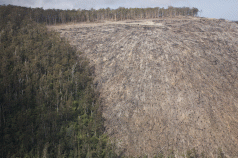
In a realistic evaluation of where we are at in the struggle to save Tasmania’s forests made in a recent review of Palamar’s(1) paper on environmental issues and movements a group of us concluded that “The hard fact of the situation in Tasmania is that, after several decades of campaigning and struggle, the destruction of Tasmania’s forests continues at full blast.”
Two articles on Tas Times Robert McMahon’s “War and Peace “ (8-11-10, HERE) and Peter Henning’s “The Future Eaters”(25-11-10, HERE) (2) contain information and analysis that explain what is being put in place by Gunns and those in political parties and public service – plus representatives of some ENGO’s,(Environmental Non Government Organisations) and even some Greens who wittingly or otherwise appear as acting for Gunns.
Utilising the invaluable insights contained in Palamar’s analysis of the American environmental movement our review of Palamar made the point that refusing to give prominence to the health and social justice issues raised by the poison in our water and other damage to our environment from monoculture plantations, deprived the environmental movement of the very arguments that have real potential to mobilise a majority of Tasmanians to support the required radical change in current forestry practices.”
In our review, we drew attention to how downgrading the negative effects of the irresponsible use of herbicides, pesticides and other dangerous chemical substances, is undermining the struggle to save our forests as well as encouraging practices that threaten the health and well being of us all.
The effect of economic and social expectations and policies can no longer be denied as being key issues in genuine and effective environmentalism
The corporation dominated structural characteristics of modern societies combines with exaggerated technological optimism and control nature ideologies to encourage increased pollution and resource destruction, there by destroying people’s health and well being. Our review focus aimed to achieve recognition that multi-species plantations, that do not require diversity destroying chemicals, are what is required in terms of plantations; rather than chemically dependent monoculture plantations for wood pulp that seriously downgrade rather than restore the environment.
An essential part of ensuring a viable future for humanity is the necessity to maintain a physical environment capable of allowing human and other species to live with nature. Life depends on the physical environment that provides the food we eat and the water we drink. Poisoning our water is no way to a future.
We need to include ecological imperatives in our calculations. Humanity’s chance of survival can be enhanced by recognizing the realities that become apparent when we look beyond the currently encouraged surface perceptions about what makes our societies tick. An important aspect of our problems is the character and current purposes of technological change, namely to enhance short term private $ profit by the few. These few have, by devious means, accumulated massive amounts of capital which they use to dominate governments and people.
The question is how can we change it all?
The faulted economics involved in environmental destruction
We need to recognise the far reaching consequences of the truth of what Canadian John Ralston Saul, who is himself not without qualifications in economics, wrote in the published version of his 1995 Massey Lectures, to quote: “If economists were Doctors they would today be mired in malpractice suits.” These remarks were made by Saul in the context of his criticism of corporatism. A critique he developed much further in his later book on corporation controlled Globalism (3).
We need to examine why it is that the advice of two outstanding economic thinkers of the twentieth century was ignored in favour of a nonsense and massively damaging, pro-corporation economic theory that is called variously economic rationalism, neo-liberalism, or economic fundamentalism. America’s J.K. Galbraith argued the need to tax the rich and Australia’s H.C. Coombs advocated moving away from consumerism to a less ecologically suicidal path.
In his last book The Return of Scarcity the late H C. (Nugget) Coombs argued that, “the logic of the economic system will tend to concentrate even further wealth, income and power with the few…” He was also quite clear in his view that consumerism had to be replaced with a societal approach that was much less environmentally destructive. (Coombs 1990 p.165)
Here Coombs advocates a more realistic approach than does for example, Hamilton’s proposition, see p. 237 Growth Fetish (4), “that we can ignore the power of capital”. Ignoring the power of capital is to ignore the role of the owners and controllers of capital in destroying our environment and poisoning our water and foods and also to ignore the suffering being caused because of the vast and growing gap between rich and poor.
Hamilton along with many other environmental figures would do well to read and assimilate what Raj Patel has documented in his book “Stuffed and Starved” (5) about the life wrecking role played by corporations in pushing low quality foods and beverages and also in creating starvation. Hamilton’s “ignore the power of capital” idea ignores the consequences for both people and our environment of the power of the few over the many in our deeply divided world.
This sort of unreal thinking is the Achilles’ heel of those who refuse to grapple seriously with the economic, social and political power that corporations exert over governments, economic policies and actions. The consequences of this power in terms of the environmental havoc currently in vogue cannot continue to be ignored.
If we are to understand the background to the attempt to ignore reality that is so widespread among mainstream environmental activists then some knowledge of the history of the modern environmental movement is helpful. Dr Peter Hay’s 2002 book (6) includes a comprehensive survey of this History. One rather disturbing example cited is the archaic views expressed in “The Population Bomb (1972) written by an early environmental writer namely Paul Ehrlich . On Page 174 of his own 2002 book Hay reveals that Paul Ehrlich “advocated that the United States use its economic and military power to rearrange under developed nations according to their capacity to mend their destructive ways.”
Here Ehrlich failed to recognise that while over-population has become a serious environmental issue the centre of the world’s environmental problems resides in the Western World, rather than in the underdeveloped world. Additionally, it is the pillaging of the natural wealth from once self reliant economies of the underdeveloped countries by the United States in particular, but also by other Western countries, that drives the lack of social infrastructure, access to information and the poverty in underdeveloped countries. In turn this whole process negatively affects the over-population issue in a variety of ways.
It could be argued that the current over-emphasis on wilderness at the expense of the health and wellbeing of the underprivileged, and eventually all of us, is not entirely removed from the faulted economic and social analysis reflected in Ehrlich as above quoted. In fairness to Ehrlich and others, it should be noted that Hay indicates that Ehrlich later moved away from his above quoted, to my mind disgraceful, position and the ignorance of some basic social and economic realities it reflected.
Some promising paths to find answers
In his recent edition of ‘A Big Fix” (7) Professor Ian Lowe suggests the need for some new approaches to science as well as the need for openness in political and economic discourse and on page 86 he suggests “… inverse approaches that work backwards from undesirable consequences to identify better ways to progress”. If we work backwards from the role of the Gunns corporation and the power over governments they have exercised, in the current and immediately past events surrounding forestry, it becomes clear that several mainstream environment movement figures are avoiding the real problems involved in the forestry scandal.
At a general level there is much in both Galbraith and Coombs that is appropriate to resolving our present situation see Footnote (8) for more detail. Professor Ian Lowe’s “A Big Fix“ published by Black Inc. in 2009 and priced $19.95 should be easy to procure and contains some excellent advice including his conviction that if political remedies are to be viable they must be worked through and developed in open public discussion rather than in secret talks. He argues that there are going to be losers as well as winners and people need to know what it is they are being asked to support – and why.
In Tasmania the forestry issue looms as a continuing further set of ecological and economic disasters waiting to happen and thus it is necessary to take a properly considered and a democratic approach to putting in place the radical changes required if our State is to have a future. Forestry is by no means our only problem. However, a combination of the anti-democratic legislation and massive public subsidies to try and maintain the uneconomic and ecological suicidal wood pulp for paper industry has created a roadblock against necessary change. It downgrades the chances of the type of development needed for Tasmania to prosper, or for that matter even survive as a place to live.
A priority needs to be to rescind the legislation that has put Gunns and a pulp mill proposal above the law and proper processes. These disgraceful pieces of anti-democratic legislation need to be replaced with new laws – laws that restore due process and proper procedures. Further there is need for legislation that enables open discussion, both in the public domain and in parliament, of the policies to be implemented and steps taken to change the present rush to even greater and much more apparent economic and ecological disasters. Forestry policy is not the only potential time bomb set to blow up in our collective faces. Corporation controlled globalism has created the recent and now redeveloping economic crashes of recent times. The current seafood export to China crises is but one example of such looming problems.
In the forestry industry itself
Clearing the decks by changing the current anti-democratic laws and replacing the current top public service bureaucrats who have helped create the current crisis are important immediate steps. The public purse also needs to be used to empower people who are interested in and have some real knowledge about forestry issues rather than merely interest in forest destruction and or chemically dependent, soil degrading and water poisoning monoculture plantations.
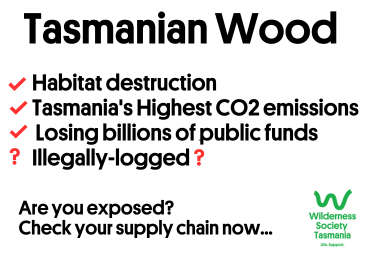
The use of public money to the tune of an average of in excess of $63 million over each of the last 12 years (9), now wasted on support for forest destruction, could do much to help establish small scale and sustainable productive industries, both existing and potential. These industries could include food producing, and where ecologically and economically appropriate food processing ventures, aspects of timber production or whatever. The emphasis would need to be on ecological sustainability, social usefulness and economic viability.
We need people who recognise the need to understand the consequences of failing to take to account longer term consequences of economic decisions and have the urge and have developed the mental approaches and capacities to grapple with the complexities and interconnections that are involved in modern societies. It is not that most of our top public servants are necessarily natural dimwits, the biggest part of the problem is that they have become so schooled and practiced in serving the interests of large corporations rather than the interests of most people and our environment.
The longer we leave the implementation of the long overdue radical changes in the approach to our forest industry the harder it will be to create an economically viable and ecologically sustainable industry and economy. Given the power that corporations exercise over so many parliamentarians a grassroots movement working to create real and beneficial changes appears as an urgent need. Several aspects of just such a movement have emerged or are emerging. But even though much remains to be put in place – the potential is real.
The character of this movement is quite diverse particularly as regards the backgrounds of the people featuring in providing reliable information and ideas for change. It includes people from diverse political and social backgrounds whose concern for the human future has brought them together. Leading activists particularly from the Tamar Valley, in the struggle against Gunns Mill have contributed a new level of understanding of problems generated by the uneconomic and ecologically disastrous Pulp Mill.
Scientific water testing has revealed the presence of toxic poison apparently in leaves from E. nitens trees bred to produce chips for wood pulp to make paper. This work and the circulation of information about the damaging effects of herbicides and pesticides by Dr Alison Bleaney has recently received important further validation from an important national figure.
Dr Bleaney’s information, arguments and efforts are given further credence by 2007 Australian of the year Tim Flannery in his 2010 book. “Here on Earth”( pub. By Text) Flannery ‘s chapter on Gaia Killers recounts the work of Rachel Carson in her 1962 book “Silent Spring”. He then makes an uncharacteristically hostile criticism of corporations – to wit: “With the illusion of a quick and permanent fix, the pesticide companies had set us on a cataclysmic course”. Flannery had preceded this quoted statement with the comment that before “the war on nature” other approaches to pest control had worked effectively. Flannery then commented that “The trouble was that the corporations couldn’t make money from these approaches”. (see Page 168)
This all brings me back to the earlier mentioned work of several leading activists in the Tamar Valley. In his paper Bob McMahon calls for the re-establishment of Unity with the Greens and some other earlier protesters against wholesale forest destruction. As pointed out many times, by several people, including earlier in this article, poisoning our water and downgrading soil quality is not a way to a future. Building a diverse and sustainable economy that includes a revamped and sustainable approach to forestry issues can provide a future for Tasmania.
To conclude with useful advice from Professor Ian Lowe who advocates a bottom-up rather than the current top-down approach: “We have to accept that you can never change only one thing in a complex system. Changes always have costs as well as benefits, losers as well as winners. So if we are to create sustainable future we will need to develop new social institutions and better processes for making these difficult decisions” (10).
NOTES
(1) Palamar C.R. Director of Environmental Studies, Antioch College, Yellow Springs, OH1 “ The Justice of Ecological Restoration: Environmental History, Health, Ecology, and Justice in the United States” from Human Ecology Review, Vol. 15, NO. 1,2008 Society for Human Ecology
(2) Mc Mahon Robert “War and Peace pub. Tasmanian Times 08-11-10“ Henning Peter “The Future Eaters: Being Vigilant for The Man 2007-2010 “pub.Tasmanian times 25-11-10
(3) See Saul John Ralston “The Unconsious Civilisation” pub Page 4 Penguin Books 1997 and “The Collapse of Globalism” pub. Penguin 2005)
(4) Hamilton Clive “Growth Fetish” page 237 pub Allen &Unwin 2003
(5) -Patel in his “Stuffed and Starved” book points out that: “The hunger of 800 million happens at the same time as another historical first …the one billion people on this planet who are over weight. “ The latter made so by the rubbish food advertised and otherwise promoted by greedy profit hungry corporation controllers who largely control the world’s food chain. (Pub. Black Inc 2009 ISBN 9781863954495 pbk.)
Other aspects of corporation frauds and theft from less developed countries are revealed—- and USA’s Governments part in aiding and abetting this robbery of the poor countries are documented in for instance John Perkins “Confessions of an Economic Hit Man”(pub Elbury Press 2005 ISBN0091909104) and Noam Chomsky’s “Hopes and Prospects” (pub. Peguin Books 2010 ISBN 978-0-241-14501-2 )
(6)Hay Peter “Main Currents In WESTERN NVIRONMENTAL THOUGHT” Page 174pub UNSW Press
(7)Lowe Ian “A Big Fix” Page 86 Pub Black Inc 2009
(8 In his “The Return of Scarcity” H.C.Coombs argues that —-The outcomes from technological change, particularly in conditions of increasing scarcity will include a weaker bargaining position for wage earners. He goes on to write ” I believe it is necessary, therefore, to consider conscious intervention to offset the effects of scarcity on those with low incomes. I do not think such intervention impossible. Scarcity creates the opportunity for an increasing ‘unearned increment’ to be extracted by proprietors. It would not be technically difficult to ensure that a substantial part of that increment accrues to the community generally.”(Coombs 1978 reprinted 1990 p 33)
Comment: The fact is that the exact opposite to what Coombs advocated several decades ago is what has actually happened. The rich aided by compliant economists and politicians, have been able to become ever richer as the extent and depth of poverty extends. This raises the need for a new way of doing economics and politics. A way that empowers people to challenge the greed and out right, if legal, theft perpetrated by corporation chiefs; a way that recognises that we live on a finite planet and must live with rather than try to destroy nature.
Those who have read Galbraith, will be aware that whilst unduly reticent to be too critical of the role of American politicians, particularly those in the US Democrats; he was quite strong in his criticisms of fellow economists and in his opposition to decreasing taxation on the rich. He argued that those who advocated reduced taxation of the rich were self interested, quite wrong and that elected governments needed to have the means to intervene in the economy particularly in times of economic difficulties.
These sorts of views of competent, and in their time highly respected, economists and the sense they made, were able to be sidelined by the power and greed of those who had accumulated massive amounts of capital. That hard fact of history suggests the need to look at ways of curbing that power of unelected and greedy irresponsible people. An initial step is obviously very heavy taxation on very high incomes like for instance the recent $9million per annum grab by a CEO. To my mind that is only a first necessary step. Legislation that sets definite limits on how much capital an individual or tiny group of individuals are allowed to accumulate needs to become an issue of public discussion and ultimately of legislative action. It is a after all deemed as being permissible to limit the wage levels of workers
(9) See Christine Milne In her “Where has your money Gone” article on Tasmanian Times 02-06-10, HERE opened a public discussion on the level of public subsidies needed to keep the Gunn’s dominated forestry industry afloat . Then Graeme Wells in Beware of politicians bearing gifts, HERE estimates that the level of public subsidy to have been as high as $766 million over the last 12 years
(10) Lowe Ian “A Big Fix” Pub Black Inc page 93