FOREST PRINCIPLES PROCESS MUST NOT BE PRE-EMPTED
Implement Agreed Moratorium Call
Nick McKim MP
Greens Leader
The Tasmanian Greens today reiterated that the implementation process of the Forest Principles Agreement negotiated by industry, environmentalists and union stakeholders must not be pre-empted, but be allowed to progress through the agreed process.
Greens Leader Nick McKim MP said that the agreed Principles make it clear that a moratorium on logging of high conservation value forests should be in place while industry restructuring talks are underway, and called for work to implement such a moratorium to begin immediately.
“The Greens confirm our position that for the Forest Principles to progress all parties need to ensure that the established process to develop an implementation strategy to restructure the industry is not pre-empted,” Mr McKim said.
“Clearly any talk of new contracts or extension of current contracts is pre-emptive.”
“Work to get in place a moratorium on logging of high conservation value forests must begin immediately, as this is fundamental to ensuring that all the hard work and good faith invested into developing the agreed Principles continues through to the next stage.”
“The Forestry Principles have laid the groundwork for a once in a life-time opportunity to remove conflict from the forestry debate and to restore confidence in a restructured industry, and we all need to work together to build on those foundations and avoid risking undermining them,” Mr McKim said.
Gunns eyes plantations amid peace deal strain
By Felicity Ogilvie
The first cracks have appeared in the peace deal between loggers and conservationists in Tasmania.
Tasmanian timber giant Gunns says it will continue to log native forests if the native forest peace plan fails.
The Managing Director of Gunns, Greg L’Estrange, says the company would rather exit native forest logging and build a plantation based pulp mill. But it is going to cost $2.5 billion to build.
Mr L’Estrange says the future of the controversial project is highly dependent on the peace plan that has been negotiated between the timber industry and environmental groups.
The plan would ease investors concerns about community opposition to the mill.
It is now in the hands of the State and Federal Governments, but Gunns says it cannot say when it will fulfil its promise to stop logging native forest.
“We don’t have a fixed timetable. It’s very dependent on getting the right outcome for the industry structure,” Mr L’Estrange said.
“We’ve said that from the start, we’ve been saying that right from the start of these discussions back in May.
“It’s very important to get the right structure. It’s not necessarily about Gunns Limited, it’s about the whole of the industry and reshaping the industry for it to be sustainable.”
He says the long term plan is to eventually focus on plantation-based logging.
“We would cross that bridge when we get to it but we certainly see that our plantation business has opportunities to be developed,” he said.
“We’re confident that we can do that. We think that the right structure longer term is in that sector and I think that over time we would gravitate in that direction.
“But the speed will be dependent on what the structure looks like in the industry as a result of these discussions.
“If they do fall down, we need to ensure that that will mean there will be an ongoing cut at current levels. Our facilities are well placed to cater for that.”
But Mr L’Estrange says Gunns would continue to log native forests if the peace plan falls over.
“For a period of time, because we have our facilities and businesses that would need to be operating but basically, if the peace talks fell over… the community of Tasmania are saying that they want to continue to log the native forest.
“That would be the principle reason why they fell over and so that they would like the industry to continue to extract and process those raw materials.
“What we are saying is that we would recognise that position from the community and we would steer our businesses in that direction until we found an alternative.
“We don’t see ourselves in that sector for the longer time, but it does not mean that we don’t think that there’s a lot of good things about the industry, just that we think our future and the interests of our shareholders lie in another direction.”

Bartlett’s forest promise
SUE NEALES | December 04, 2010 12.01am
PREMIER David Bartlett yesterday guaranteed one of Tasmania’s biggest timber companies that it could continue logging in public native forests until at least 2027.
Visiting McKay’s sawmill and timber yard in Glenorchy, Mr Bartlett also told worried workers their jobs were safe.
Bernard McKay, the owner and managing director of McKay Timber, which employs 115 workers around the state, was delighted with the Premier’s commitment.
Mr McKay said he had been told by Mr Bartlett he could continue to harvest trees from high conservation value “old growth” forests and regrowth forests that have already been logged until 2027.
“That’s a huge relief, that’s what we wanted to hear,” Mr McKay said.
But the Premier’s promise appears to pre-empt the outcome of future negotiations between environmentalists, the forest industry and state and federal governments about an end to logging the state’s native forests.
The forest industry has been asking the State Government to guarantee “wood supply” security from native forests to 2027 since the signing of the peace pact or “Statement of Principles” in early October.
The document commits to an immediate end to all logging of an estimated 600,000ha of high conservation value forests and a transition, over an unspecified time, from logging the remaining 600,000ha of public native forests.
But it also contains apparently conflicting guarantees that sawmillers will continue to have access to the same quantity and quality of native timber, and that existing logging contracts will be honoured.
European sawmills’ profitability is being squeezed by high log costs and declining lumber prices, reports the Wood Resource Quarterly
Sawlog costs in Europe have gone up more than lumber prices the past year, reports the Wood Resource Quarterly. With the expected decline in lumber consumption, many sawmills in Europe are considering reductions in their operating rates. As a consequence, prices for sawlogs are likely to drop from their two–year highs in the coming months.
Download the full article:
FPMU_Europe_lumber_market_3Q_2010.pdf
A DAY IN THE STYX CELEBRATES HCV FORESTS AND A STYX NATIONAL PARK
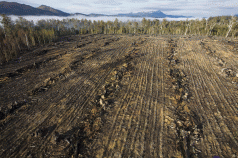
The high conservation values (HCV) of Tasmanias native forests and the prospect of new national parks and reserves as part of the implementation of the recently signed Statement of Principles were on show today as people gathered in a coupe planned for logging in the Styx Valley.
The event showcased current citizen science projects in HCV forests including the volunteer driven researching of carbon storage of our forests and devil surveys and led walks into research areas.
People have come out today to celebrate the conservation values of our spectacular native forests and embrace the opportunity of seeing those values protected in new national parks and reserves around the state, said Vica Bayley, spokesperson for the Wilderness Society.
Industry and environment stakeholders reached agreement that high conservation value forests like those in the Styx will be protected. This should happen firstly by a moratorium on logging and finally through formal, legislated protection in reserves like national parks.
Speakers at the event included well known conservationist Geoff Law, wildlife veterinarian and devil expert Collette Harmsen and Still Wild Still Threatened campaigner Ula Majewski.
Citizen science projects like community carbon accounting and the devil surveys highlight the incredible values in our native forests an reinforce the agreement to ensure they are protected, continued Mr Bayley.
We urgently need the Gillard Federal government to support the forest peace plan and a commitment to kick off the moratorium and begin the process of delivering the outcomes the statement of principles promises.
The event was held in coupe SX9B, an area planned for logging but currently under a temporary exemption pending the outcome of the implementation peace plan. It is close coupe TN34B, a HCV coupe currently being logged and subject to controversy.
The ongoing logging of high conservation value forests like the Styx highlights the urgent need to implement the peace plan and protect the forests identified as having important conservation values like carbon storage and habitat for threatened species.
TARKINE NATIONAL PARK PUSH
People Power Succeeds in Redrawn Road Option
Paul O’Halloran MP
Greens Member for Braddon
The Tasmanian Greens today reiterated that a declared Tarkine National Park is the best way to guarantee appropriate protection for the north-west’s natural and cultural icon area, and to provide a solid foundation on which to encourage appropriate investment in local tourism opportunities.
Greens Member for Braddon, Paul O’Halloran MP, said that following consultation with local stakeholders over a redrawn Tarkine Road option, there was conditional support for the project to progress through the planning process, subject to the development of appropriate and rigorous Tasmanian Devil mitigation strategies for Stage Two.
Mr O’Halloran stated that while Stage One of the proposal, upgrading existing roads from Tayatea Bridge through to Kannunah Bridge had been agreed by key stakeholders to proceed through the planning process, any support for Stage Two, from Kannunah Bridge to Arthur River, was subject to stringent Devil impact mitigation.
“The Greens will continue to pursue our proposed Tarkine National Park as this clearly will provide the best possible protection for this iconic area’s world-class natural and cultural qualities, as well as share any economic benefits around the region from Zeehan and Corinna on its southern borders to Smithton in the north,” Mr O’Halloran said.
“This revised proposed Tarkine road still has a long way to go, but crucially it does not include any of the sensitive areas of last year’s controversial and unacceptable plan, and nor does it involve any new roading.”
“Local stakeholders and community representatives are to be congratulated for their courageous stand against a divisive and destructive proposal, and to instead work constructively towards an alternative route option.”
“The Greens fought long and hard against the previous unacceptable proposal, and we will continue to scrutinise closely this revised option, especially Stage 2, in consultation with local stakeholders.”
“It is our understanding that a new referral will need to be submitted to the Commonwealth under the Environment Protection and Biodiversity Act (EPBC).”
“Should this two-stage revised option secure all necessary ticks, hopefully it will demonstrate to Labor, and all decision-makers, why it is important to consult and work with the community to identify non-controversial proposals that fit with the vision and aspiration of locals and all Tasmanians,” Mr O’Halloran said.
Media Release 3/12/2010
Conditional support for revised Tarkine Road
The Tarkine National Coalition has expressed conditional support for the revised Tarkine Road project.
The revised project removes the controversial new roading sections from the original proposal, and utilises existing roads on the current tourist route. The Tarkine National Coalition is also pleased that the Minister has adopted our recommendation to schedule works on the Tayatea to Kunnunah Bridge section as stage one, allowing time to investigate and trial Tasmanian devil roadkill mitigation measures prior to committing to the second stage from Tayatea to the Arthur River township.
Tarkine National Coalition’s support is conditional on appropriate mitigation of impacts on the endangered Tasmanian devil.
“We welcome the new more consultative approach, and congratulate the Minister on adopting this revised route subject to mitigation measures,” said Tourism Project Officer, Scott Jordan.
“We are particularly pleased to see the Government adopting the TNC’s suggestion of prioritising the Tayatea to Kunnunah section as stage one, allowing them the time to get the science and engineering right before commencing the more difficult second stage onto the coast and the Arthur River township.”
“We think this staged process will allow for good faith discussions and we offer conditional support subject to adequate mitigation of impacts on Tasmanian devils and other threatened species.