FORESTRY Tasmania has detailed its plans to spend $22 million of federal and state government funds sitting unused in its cash reserves.
Forestry Tasmania general manager Hans Drielsma said yesterday the government-owned forestry business had committed all remaining grants it had received during the past five years as part of the Tasmanian Community Forest Agreement to future projects.
Confidential financial data released (to the ABC) by Forestry Tasmania under Right to Information laws two days before Christmas revealed FT had received $140 million in government grants since 2005 under the TCFA, but had spent just $118 million.
Funds earmarked to be spent establishing new plantations, researching ways to reduce the need for clearfelling and assisting leatherwood beekeepers and speciality timber users to cope with reduced access to logged native forests remained partially unused.
Dr Drielsma yesterday justified Forestry Tasmania’s reasons for holding on to $22 million of targeted TCFA grant money.
He said a new special species timber yard at Smithton funded by $800,000 from TCFA funds and due to open early in 2011 was proof that grants provided to Forestry Tasmania under the 2005 agreement continued to be invested as intended.
He denied Forestry Tasmania had hoarded the unspent $22 million, claiming instead that it had adopted a “prudent approach”.
• Earlier, Wednesday Mercury:
*$22m in forests funds sit idle
FORESTRY Tasmania has hoarded $22 million of federal and state government grants it has received since 2005 as part of the five-year Tasmanian Community Forest Agreement.
Confidential documents released two days before Christmas under Right to Information laws reveal Forestry Tasmania has received a massive $140 million of the $221 million handed to the Tasmanian forestry industry since 2005.
In a deal struck between Prime Minister John Howard and Premier Paul Lennon, the 2005 TCFA protected an extra 170,000ha of old-growth forests.
In return, the Tasmanian forest industry was promised $221 million over the next five years to establish plantations, reduce clearfelling of native forests, adapt regrowth forests to enhance sawlog production and to revitalise sawmills and help the industry restructure.
The two pages of Right to Information data released by Forestry Tasmania on December 23 at 3pm show the State Government’s forestry arm benefited from $140 million, or 63 per cent of the package.
But by June 30 this year, Forestry Tasmania had spent only $118 million, leaving $22 million of grants already paid to it for specific programs sitting idle in its coffers.
Forestry Tasmania’s annual report for last financial year showed the government business had only $27.4 million of cash in its assets base at the end of June this year, while reporting an annual operating loss of $8 million.
Most of the $140 million paid to Forestry Tasmania since 2005 was allocated under a $115 million commitment to fund additional plantation establishment, productivity improvements in existing plantations and to thin state-owned native forests to increase the production of commercial logs from regrowth forest.
The detailed new funding and expenditure data, requested by Taroona quantity surveyor Malcolm Mars, show Forestry Tasmania has spent $99.7 million of this $115 million allocation, with just over $15 million unspent.
It has used the $99 million to:
• Establish nearly 12,500ha of eucalypt plantations costing $75 million since 2006.
• Prune and fertilise its exiting plantations at a cost of $20 million.
• Thin native-regrowth forests, costing $5 million.
An $8 million payment to Forestry Tasmania to support the leatherwood beekeeping and specialty-timber industries has also not been completely spent.
Nearly $3 million of this state grant sits in Forestry Tasmania’s cash reserves.
A $13.1 million payment to Forestry Tasmania to support reduction of clearfelling has not all been spent as intended.

Dr Warwick Raverty
• No fugitive mill odours: Ivan Dean writes to the Ex:
Dr Raverty’s assessment of the mill gas containment system outlined in his letter is at best ill-informed and at worst alarmingly mischievous
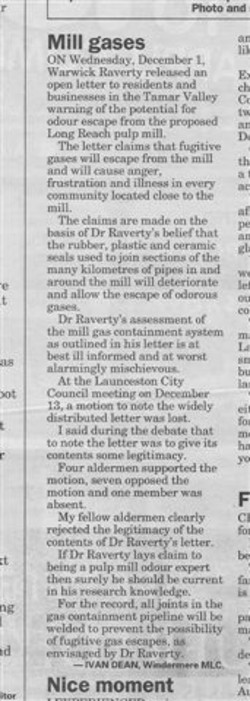
The letter, transcribed:
Mill gases
Examiner 30 December 2010
On Wednesday, December 1, Warwick Raverty released an open letter to residents and businesses in the Tamar Valley warning of the potential for odour escape from the proposed Long Reach pulp mill.
The letter claims that fugitive gases will escape from the mill and will cause anger, frustration and illness in every community located close to the mill.
The claims are made on the basis of Dr Raverty’s belief that the rubber, plastic and ceramic seals used to join sections of the many kilometers of pipes in and around the mill will deteriorate and allow the escape of odorous gases.
Dr Raverty’s assessment of the mill gas containment system as outlined in his letter is at best ill informed and at worst alarmingly mischievous.
At the Launceston City Council meeting on December 13, a motion to note the widely distributed letter was lost.
I said during the debate that to note the letter was to give its contents some legitimacy.
Four aldermen supported the motion, seven opposed the motion and one member was absent.
My fellow aldermen clearly rejected the legitimacy of the contents of Dr Raverty’s letter.
If Dr Raverty lays claim to being a pulp mill odour expert then surely he should be current in his research knowledge.
For the record, all joints in the gas containment pipeline will be welded to prevent the possibility of fugitive gas escapes, as envisaged by Dr Raverty.
– IVAN DEAN, Windermere MLC
What Dr Raverty said, HERE: Why the Tamar Valley is the worst pulp mill site …
• Advocate: Logs bound for China
COURTNEY GREISBACH
26 Dec, 2010 11:21 AM
SIX thousand tonnes of unfumigated logs are on their way to China.
North-West Coast company, Tas Land and Forest, watched on Thursday as the first shipment of its new niche market left the Burnie port.
Tas Land and Forest announced earlier this month in The Advocate it was launching into a niche log export market.
Managing director Kent Lyon said private plantation land owners will now get more for their products with lower grade logs being exported to China and Korea.
Mr Lyon said the top grade logs (about 40%) will continue to be sent to Bell Bay, but the lower grade logs will be sent overseas.
Previously land owners the other 60% would be turned into woodchip.
Landowners will now be paid on a sliding scale dependant on the quality of the logs.
Shipments from the Burnie port are expected every month providing good weather.
Earlier on Tasmanian Times: Urgent need to address shortcomings in the forests agreement. The Examiner poll, HERE