

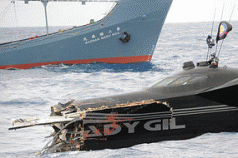
The sinking of Sea Shepherd’s Ady Gil – Pete Bethune replies
Maritime New Zealand releases final report into the collision between The Shonan Maru No.2 and Sea Shepherd’s Ady Gil
What has the MNZ report found?
The report finds that the masters of the Shonan Maru No.2 and the Ady Gil were both responsible for contributing to and failing to respond appropriately to the “close quarters” situation that led to the collision. This goes against established international maritime anti-collision rules and expected standards of good seamanship.
What does “close quarters” mean?
All vessels, wherever they are operating, are expected to maintain an appropriate safe distance and avoid the risk of collision. This distance will depend on various factors, such as the prevailing weather conditions and the size and manoeuvrability of the vessels involved. The International Collision Regulations require that masters understand their obligations so that their vessels do not end up in a “close quarters” situation, which greatly increases the risk of collision.
Did MNZ find any evidence of either vessel master deliberately causing a collision?
There is no evidence to suggest either party deliberately caused the collision. However, earlier events between whaling and protest vessels contributed to a tense operating environment and probable uncertainty over each other’s intentions. That notwithstanding, both masters failed to comply with the International Collision Regulations and to act as prudent seafarers should have.
Who, then, was responsible for the collision?
The report finds that both masters of the Shonan Maru No. 2 and the Ady Gil were responsible for either contributing to, or failing to respond to the “close quarters” situation that led to the collision.
The master of the Shonan Maru No. 2 initially had responsibility for keeping his vessel clear of the Ady Gil, due to its position as the overtaking vessel. He had ample opportunity to avoid the close quarters situation that subsequently developed, but failed to do so.
However, once the close quarters situation became apparent, the master of the Ady Gil failed to respond by taking appropriate evasive action – choosing instead to maintain his course and speed, which allowed the close quarters situation to develop into a collision risk.
More at: http://www.maritimenz.govt.nz/News/Media-releases-2010/20101118a.asp
What Pete Bethune has said about the MNZ report (1)
A Maritime New Zealand investigation has found both vessels disobeyed international anti-collision rules for “close quarters” encounters.
Neither the Shonan Maru No. 2 captain or Mr Bethune were charged with deliberately causing the impact.
“The collision appears to have resulted from a failure on the part of both masters and the crew of both vessels to appreciate and react appropriately to the potential for collision,” the report says.
The report says the Shonan Maru No. 2 kept at an unsafe speed and turned starboard to put itself in a collision course with the Ady Gil.
As the overtaking vessel, the Shonan Maru was responsible for avoiding a collision and had sufficient room to do so, the report says.
The report says is near certain the ship’s captain knew the Ady Gil was there and did not adjust his course despite having “ample opportunity”.
But the report criticises Mr Bethune and his crew for not keeping a good lookout and contributing to the collision.
Mr Bethune should have kept well clear of the oncoming whaling vessel, but instead maintained his course and speed, the report says.
Its helmsman did not monitor the ship’s radar and left himself little time to take evasive action, it says.
Investigators found there was insufficient evidence to say whether the Ady Gil’s helmsman’s acceleration of the ship before impact contributed to the crash.
Mr Bethune says he accepts the reports findings and has moved on from the incident.
He has retracted an earlier statement that the collision was “attempted murder” on the part of the Shonan Maru No. 2 captain.
“Having been on the Shonan Maru and met the crew, they’re just doing a job. I’ve met the captain. One day I could see myself sitting down and having a beer with him.”
But he remains adamant the ship turning in “the last 10 seconds” to adopt a collision course was a deliberate attempt to damage the Ady Gil.
“If they didn’t mean to murder us, they certainly meant to damage out vessel.”
He has no regrets about his actions in the Southern Ocean.
“In the end it was just a boat and I have six guys here who are happy to be alive.
“In many regards the sinking of the Ady Gil has done more for stopping whaling than anything else we could have done there.
“Whaling is a big issue in Japan now. It’s put the spotlight on the issue.”
From: http://www.nzherald.co.nz/nz/news/article.cfm?c_id=1&objectid=10688466
What Pete Bethune has said about the MNZ report (2)
Pete Bethune talks to 3 News following the release of Maritime New Zealand’s report into the Ady Gil collision with Japanese whaler Shonan Maru 2.
What are your feelings now, having read the report?
I’m pretty happy with it, it acknowledges the Shonan Maru was the give way vessel…
[The report] takes away the Japanese argument that we deliberately put ourselves in their way.
How do you respond to the report’s findings that the Ady Gil should have made more of an effort to move?
The way I looked at it is, leading up to the collision, we were basically a stationary vessel or moving at 3 knots. You don’t expect someone to come and run you over and in hindsight, looking at it, sure we could have just gone somewhere else – that was possible, but we just didn’t expect someone to come and run us over. That’s my mistake.
But, it’s clear in the report, we had the right of way, they were the overtaking vessel, they have an absolute obligation to keep clear of us and they failed to do so.
Keep in mind, a collision at sea, it is never 100 percent and zero percent, there is always culpability on both sides – and I’m quite accepting of that.
And I do accept that we could have done things a little bit differently but, from a legal perspective, they are the major cause of this collision by deliberately steering into us and then deliberately turning to starboard in the last 10 seconds and the report says that. Sure, I could have done things a little bit differently, in hindsight, but I just never expected they would try and run me over.
What would you like to see happen from here?
There’s nothing that can happen.
One thing the Japanese were very clever on, they waited for six months before submitting the rest of their data, so the Maritime Safety could never produce this report in six months and there’s a six-month time limit on prosecutions.
It’s impossible for the Japanese to be prosecuted by Maritime New Zealand.
For us to take action in Japan, the word we’ve had is that it would cost $2 million to $4 million, and to recover a million or two for a boat is just not worth it.
It’s just time to move on.
I’m happy that the report is out and that it does basically say what we’ve said all along – that they were overtaking us, they turned to starboard in an act that was deliberate.
Whether they deliberately tried to kill us, the report doesn’t say. Certainly they deliberately acted in a way that lead to an extraordinarily dangerous situation.
What happens now with regards to the boat?
Cut our losses. Move on.
The only option open to us now is legal action in Japan and Japan is a tough place to take legal action – it’s just not worth it.
It’s just time to move on.
I’m kind of philosophical about it, the loss of the Ady Gil – while it’s a shame to lose what I believe was an iconic New Zealand boat – it has served a purpose and its been part of an historic campaign for the anti-whaling movement and the spotlight is on whaling like never before and you’re starting to see that now.
The Japanese, they are talking about pulling out of Antarctica, they’ve started talking about the need to replace their fleet.
I think, the loss of the Ady Gil, while it’s a shame to lose it, some good has and will come from this in terms of hopefully finally getting the Japanese out of Antarctica.
Do you still feel you’re fighting a worthy cause? Are you still passionate after all you’ve been through?
Antarctica is a special place mate, and the Japanese have no right to be down there.
For me it’s a matter of right and wrong – they’ve got not right to be down there.
I don’t regret my actions. I still think it was the right thing to do at the time.
A lot of people in New Zealand have sort of said I’m a cowboy and things like that – but they were calculated risks and pretty much, it panned out as we expected in terms of prison time in Japan.
And I’ve got no problem with what happened to me through this campaign.
It’s a shame to lose the boat, but aside from that, I was lucky to be part of an historic campaign.
Are things starting to change?
I think the Japanese are looking for an out from Antarctica now. I’ve got no problem with the prison time I’ve served, the fact that the boat’s gone Those are the risks you take when you take on a foe like Japan. I don’t regret it and I think it was still the right thing to do and the fact that Japan continue whaling, it’s because they make so much money.
These things are not battles that you win overnight.
Society does gradually change what it finds acceptable and there is a mood swing starting to happen in Japan over this. A lot of Japanese are starting to say, ‘Is it worth all of this hatred from Western countries towards us, over an industry that only makes $50 million?’
Things like, the Ady Gil going down, my time in prison, all the confrontations in Antarctica, they do serve a purpose and it’s part of what will stop whaling but, not an easy battle to win this.
From: http://www.3news.co.nz/Pete-Bethune-on-MNZ-report-transcript/tabid/1160/articleID/186852/Default.aspx
What Pete Bethune has said about the MNZ report (3)
REPORT ‘FAIR ENOUGH’ – BETHUNE
Ady Gil captain Pete Bethune supports the report’s findings and believes it goes some way to vindicating he and his crew.
“On the whole I think the report was fair enough.
“It does concur with what we said all along – we had right of way and the Shonan Maru was the aggressor in this case.”
He says no-one was ever going to emerge totally innocent.
“When there is a collision at sea, it’s never 100 per cent and zero per cent blame. There’s always culpability on both sides.
“From our position, it said we could have kept a better lookout, and I am quite accepting of that. But it’s not easy when you’ve got water cannons hitting you. It’s not easy to keep an effective lookout.”
But he thinks the Japanese will take little notice of today’s findings.
“I think they will probably ignore it. Or they might cling on to the fact that it does say “hey the captain on the Ady Gil did fail to keep a good lookout”. But when you look at the rest of it, I imagine they will ignore the report.”
Bethune says he will not be taking legal action against the Japanese based on the report’s findings.
“I could take this document and prosecute Japan in a Japanese court, but it would cost millions and to recover a million or two for a boat – it’s not worth it.
“It’s time to move on,” he said.
“It’s taken 10 months for this report to come out. If it had come out within six months, it would have been possible for the Japanese to be prosecuted under maritime law in New Zealand, but that six month time window is gone. Mainly because the Japanese took five and a half months before they provided any information.”
Bethune says he stands by his crews actions in Antarctic waters.
“Up until a year ago, most Japanese had no idea how upsetting this is for New Zealanders and Australians and they know that now.
“Antarctica is our backyard; we shouldn’t be letting them down there.”
From: http://www.stuff.co.nz/waikato-times/news/4359944/Japanese-protesters-sinking-share-blame-report










