Mark, I brought property here in 96, impressed by what I had seen and looking forward to breathing some of the cleanest air on the planet. (After a working life spent in polluted cities).
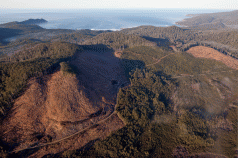
There are three houses between my property and the West Coast, the rest is now known as the Tarkine. Every year I witness mushroom clouds of smoke from deliberately lit trash reduction burns.
The smoke from those burns hangs about for days giving my son asthma and exacerbating my asthma. It also plays havoc with the flowering of my crop when those burns occur during autumn.
I noted shortly after arriving that there was a glaring disparity between the condition of the council road on which I live. The end serving an area of state forest was in excellent condition. The end serving the dozen or so residences was a goat track and had not been competently maintained for years. I enquired as to why and was told by someone in the Wynyard Forestry Office that they had a close relationship with the council roads foreman. When I enquired as to how I would develop such a relationship the gentleman I spoke to started to explain then went very quiet, said “I had better stop now or I will get into trouble” and hung up. Forestry pay no rates!
The Forestry Practices code calls for increasing standards of road construction for increasing rates tonnages carted per day. One could reasonable infer that this requirement addresses the industry’s duty of care to its employees in addition to practical productivity issues. However, once on public roads this requirement is discarded as irrelevant. It leaves the general public playing log truck lotto and utterly defensless against idiots who think it is appropiate to drive in a manner that has empty skells hanging at right angles to the prime mover on blind corners on one lane gravel roads, or failing to give way on single lane bridges and failing to stop when they run someone off the road and through fences.
The obvious failure of the police, all levels of government and workplace standards to adequately address the glaring public safety issues is nothing short of incompetent, and in some cases the reversals in position over a very short time without any explanation are cause to question the motivation of those whose positions have changed.
The development of a series of legal arrangements over time that exempt your industry from the constraints upon the rest of us further irritates and in the case of the last restrictions on land use without compensation angers. As I said at the time, wars have been fought for less.
The above are personal experiences, and not an exhaustive list by any means.
Mark Poynter, I have been an observer for much of my time in Tasmania, partly out of respect for my duties to my employer and business partners, and partly because I have some sympathy for the contractors trying to make a living in what is an obviously incompetently run industry. Thankfully I no longer have to worry about my employer or business partners so I am free to post under my own name and to say what I think.
Your industry has to date faced foes whose objections are largely ideological and who are basically pacifist. It is making peace with their representatives. When it does so ordinary Tasmanians will have no-one countering your industry and as it will continue as it always has to screw them whenever they get in the road of its grubby, greedy ambitions. It will then face the consequences of acting with total disregard for the rights, property and wellbeing of ordinary Tasmanians. Based on the views expressed by my wide circle of aquaintances, pacifism is not a widely held attitude, and tolerance for fools does not rate highly either.
There is a nitens coupe due for harvesting at the end of my road. Industry would be well served by having its drivers be very bloody careful. The social licence for a pulp mill is not granted by the Wildo’s or the Tarkine mob. It is granted by ALL tasmanians and if your industry continues to treat us like shit you will not get one. That social licence to operate at all is not beyond being revoked by an angry public.
In closing I contrast the attitude of entitlement to the public resource evident in your industry’s actions and attitude to that exibited by Terry Long of the Tasmanian Minerals Council when advising his membership of the implications of the Regional Forests Agreement. He spoke of the need to be perceived by the public as responsible citizens as the ability to profitably continue operation was dependent on the public’s perception of their intent and ability.
I contend that the lack of controversy over mining activity in this state is evidence of the wisdom in his words, and compelling proof of the incompetence of the leadership of your industry.
That incompetence is further underscored by the lack of profitability, the number of companies either in receivership or under administration and the declining share price of those not. All the commentary about science, and putative attempts to dismiss my sort as deluded by “activists telling lies” is a crock of shit and manifestly fails to address the fact your industry has behaved as little more than an overgrown schoolyard thug for
years.
I, and, I know, many others are over it.
First published: 2010-10-04 03:48 AM
Simon Warriner is “a balding, slightly overweight middle aged immigrant who has a trade qualification in motor rewinding, and experience in the dark arts of vibration analysis and infrared thermography (Working out why mechanical things shake and break, and looking at temperatures rather than colours). I have worked for companies restoring businesses after disasters and am currently working in the metal recycling industry on the days when I am not building my house or working on my small farm. I have been a partner in a profitable business. I have an interest in politics and its influence on the lives of real people that was fostered by a 58kg great aunt who would ring the PM of NZ at 10 pm and let him know what she thought. Her comment that those who held power was that they get buried in the same dirt as the rest of us has remained with me. I share my life with a partner working in the public service and a nine year old son, a passive agressive cat and a mob of cattle. I dont suffer fools well and detest bullies. I have the good fortune to be surrounded by people who share my views and values.”
Meanwhile …
Gunns top brass aren’t tipping in their own money
David Symons
October 5, 2010
After a few shaky months, news from the timber giant Gunns has been brighter of late. Aggressive buying from Phil Mathews’ hedge fund has help lift the share price out of the cellar, and the company’s 2010 financial statements hint that construction of the long-delayed $1.4 billion Bell Bay pulp mill could start this year.
But, despite the positive headlines, it seems Gunns insiders are increasingly nervous about the company’s future. When it comes to their own hard-earned, they are not keen to be unsecured creditors of the company they work for.
This is showing through in dwindling balances in an unsecured note scheme that allows Gunns executives to deposit cash with the company, presumably with an interest rate a little better than a bank deposit. The unsecured notes rank behind more than $500 million of bank debt.
Gunns’s annual financial statements break out the unsecured note balances, with the last three annual reports telling the story of a product whose popularity has faded with Gunns’s declining fortunes.
In June 2008, when Gunns’s health was relatively robust, the scheme held $7.8 million. Since then it’s been one-way traffic. By June 2009 a number of depositors had headed for the exits and the scheme held $4.8 million.
Despite Gunns’s success in freeing up $70 million through the sale of wine, hardware and surplus land assets this year, and with the company remaining on good terms with its lender at the ANZ Bank, Gunns’s board and management are increasingly sceptical.
And, Simon Warriner, Comment 36: My point, which you seem to be ignoring, is that there is a great, and judging from the reaction in Burnie last time the forestry trash reduction burns got smoking, growing portion of the population who now dislike the woodchip industry. And they are not the usual suspects. Tbey are increasingly the quiet ones. I have in my circle of aquaintances several ex log truck drivers. All very competent individuals and if you think my views harsh you should cop an earfull of theirs… (not your usual TT greenie ratbags).. I know a number of farmers who bitterly resent that plantation owners are not forced to share fencing costs.
Don’t miss…

Forests for the Future – Huonville public forum examines industry crisis and emerging solutions:
A public forum in Huonville this coming Sunday will explore issues relating to the economic and employment crisis facing the native forest logging industry, community concerns about ongoing logging of high conservation value native forests and the solutions that could emerge from industry and environment group resolution talks.
Speakers from the Huon Valley Environment Centre (HVEC), The Wilderness Society and the West Wellington Protection Group will discuss these issues with what is hoped to be a diverse cross section of an interested and inquisitive public.
“The forests of the Huon Valley are at a cross roads. High conservation-value forests are being logged for the Ta Ann veneer mill, who have a long term contract to continue to source logs from Tasmania’s native forests. And the emerging threats, in the form of proposed forest furnaces, could see remaining areas of priceless, unprotected forest destroyed,” said Will Mooney, from the HVEC. “Meanwhile, forest contractors and workers continue to face uncertainty and job losses.
Vica Bayley, spokesperson from the Wilderness Society said that “the industry crisis is driving good faith discussions between environmental groups and segments of the Tasmanian forestry industry, offering an exciting chance to end the conflict over logging and deliver a durable resolution that provides new opportunities for regional areas.”
As jobs are still being lost and talks are ongoing, critical areas of high conservation-value forest continue to be logged. A recent aerial survey of wilderness areas revealed disturbing imagery of new logging operations in sensitive and controversial areas, like coupe CM19A, just kilometres from the famous South Coast Track in Tasmania’s far south. While logging in remote areas degrade wilderness and other values, communities continue to be impacted by logging plans in their immediate area.
Jenny Cambers-Smith of the West Wellington Protection Group said “local residents have come together to oppose logging in the high plateau adjoining Wellington Park. The area is home to endangered animals including Tasmanian Devils, is an important water catchment for surrounding townships and is a fragile link between Wellington Park and the Tasmanian Wilderness World heritage Area. For the community, the value of the existing forest is far greater than the dollar value of its timber.”
Forests for the Future Forum
When: Sunday 10th October
Where: Huonville Town Hall
3pm, 40 Main Road, Huonville
Will Mooney, Vica Bayley, Jenny Chambers-Smith
Paul ‘Basil’ O’Halloran MP Greens Tourism spokesperson
NORTH WEST AND WEST COASTS NEED TARKINE ROAD FUNDS REALLOCATED NOW
Region Struggling Due to Accommodation Downturn, and Failure to Reallocate Tarkine Road Funds
The Tasmanian Greens today reiterated their call for Labor to reallocate the $16.3 million that was previously allocated to the now abandoned Tarkine Loop Road proposal, into a range of local job-creating projects as outlined in the Greens’ Diverse Economic Vision for the Tarkine Region.
Greens Tourism spokesperson Paul ‘Basil’ O’Halloran MP said the North West and West Coasts are being hit hard by the current downturn in tourism accommodation in Tasmania, and it is crucial that the remaining Tarkine Road funds are allocated right around the region, including Smithton, Rosebery and Zeehan, so that all can share in the benefits rather than one part of the region, as was the case with the Road proposal
“The economy of the West and North West Coasts is suffering due the downturn in tourism accommodation, and Labor’s failure to re-invest the funds that they had previously allocated to the now-abandoned Tarkine Road proposal,” said Mr O’Halloran.
“There would be widespread economic benefits for the entire region, including Rosebery, Smithton and Wynyard, if Labor could only see sense and re-allocate the remaining $16.3 million.”
“Our unique Tarkine region is placed perfectly to become the ‘Kakadu of north-west Tasmania,’ all it will take is a bit of vision and political will,” Mr O’Halloran said.
Reference: A Diverse Economic Vision for the Tarkine Region (234KB), released by Nick McKim MP and Cassy O’Connor MP, March 2009.