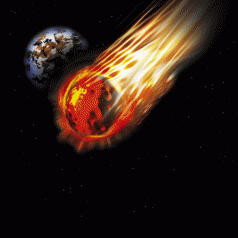
Sorry to bother the good people of Earth, but a little rock has just been found wondering around with an Earth kiss written across it. This could be a near miss, or it could be a king hit, the emperor of all catastrophes. Do we wait to see what happens, or take action?
Tasmania could be its bullseye destination.
1999-RQ36 is half a kilometre wide, with the expected arrival set for 2182, just 172 years away. That’s good news: we have time to prepare. We have time to act. Even mine the rock to dust and build a few star cities.
Considering the detail that it is now 41 years since the Moon landing and humanity is still struggling to maintain a presence in low Earth Orbit, we may well need a hundred years to get ourselves into a position to be able to make this rock safe and even useful. If we keep space development racing ahead at the current backward slide, we may doom humanity to be trapped on Earth and helplessly wait for the arrival of this celestial hammer.
Could this be the opportunity that will spark action to create a safe future on Earth by:
Making the sky safe by building a permanent and sustainable presence in space so that human society will have a future on Earth and among the stars?
Making the Earth safe from global warming so that humanity will have a certain and healthy future on Earth?
A common enemy can unite warring tribes to stand and face the foe. So, will 1999-RQ36 become our common enemy and get human society mobilized to climb out of the box canyon that we are busily working our way into on Earth?
Read all about it …
Astronomers discover new threat to Earth
Stuart Gary
ABC Online Thursday 29 July 2010
Astronomers have detected a half-kilometre wide asteroid that appears to be on a collision course with the Earth – in 172 years time.
Reporting in the journal Icarus, scientists say the asteroid named 1999-RQ36 has a one-in-a-thousand chance of hitting the Earth in 2182.
Known as a PHA, or potentially hazardous asteroid, the asteroid was first discovered about 10 years ago and since then astronomers have been plotting its orbital trajectory.
Co-author of the study, Dr Maria Eugenia Sansaturio from Spain’s Universidad de Valladolid, says the total impact probability for 1999-RQ36 is estimated to be 0.092%, and that 2182 is the most likely year for an impact to occur.
The research also involved scientists from Italy’sUniversity of Pisa, the INAF-IASF Research Institute in Rome and NASA’s Jet Propulsion Laboratory in Pasadena California.
The scientists used two mathematical models to estimate the potential of an impact between the 560-metre wide asteroid and the Earth through to the year 2200.
They also made some 290 optical observations and 13 radar measurements to help define the asteroid’s orbit.
The Yarkovsky effect
Although the orbit of 1999-RQ36 is now well determined, there remains a significant orbital uncertainty because, besides gravity, its path is influenced by the Yarkovsky effect.
Associate Professor Dr Charley Lineweaver from the Australian National University’s Mount Stromlo Observatory says the Yarkovsky effect is caused by the heating of rotating bodies.
“The principle is best demonstrated on Earth by the fact that it’s usually hotter in the afternoon, than when the Sun is directly overhead at lunchtime,” says Lineweaver.
“This means that the hottest part of the surface isn’t facing the Sun, but has rotated 20, 30 or whatever degrees away from perpendicular.
“It’s not much, but on a body the size of a small asteroid, photons emitted from the hottest part of the surface act like a sort of rocket exhaust pushing the object in the opposite direction. Because the object is rotating the opposite direction is not away from the Sun but at an angle to it, which over time can provide enough pressure to slightly modify the orbit.”
According to Lineweaver, this provides a degree of uncertainty in orbital projections for the asteroid.
“And it’s that level of uncertainty that’s the real issue for now,” he says.
http://www.abc.net.au/science/articles/2010/07/29/2967908.htm
As reported in Space Daily:
http://www.spacedaily.com/reports/Potentially_Hazardous_Asteroid_Might_Collide_With_The_Earth_In_2182_999.html