2. Maloney’s Marginalia: Bass, the dunny door of politics
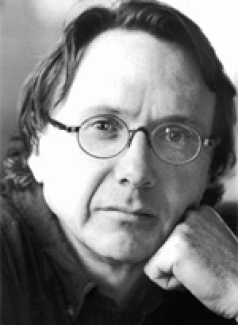
Shane Maloney writes:
BASS, FEDERAL ELECTION 2010, SHANE MALONEY
‘Expect the Unexpected’ declares the sign at the Launceston airport exit. I take it for a promise as I lob for a quick squiz at Bass, north-east Tasmania’s perennial side-swapping electorate.
With three weeks remaining until the election, the country doesn’t need, doesn’t want, doesn’t give a stuff about and won’t change anything worth a damn, perhaps the Taswegians will provide a flicker of enlightenment.
Bass occupies the eastern top of the island, separated from Braddon in the west by a pointy protuberance atop the electorate of Lyons. The overwhelming majority of its 66,000 voters live in Launceston and surrounds. In the hinterland, they grow poppies for the pharmaceutical industry, French fries for McDonald’s and plantation timber for ponzi-scheme tax dodges. Scottsdale, the only other major town, is a hotbed of Bible bashers, notably but not exclusively Exclusive Brethren. Further east, Bass extends out to Flinders Island, the Bermuda of Bass Strait.
In the past six elections, it has changed hands six times. It is, in short, the dunny door of Australian politics. Labor won it in 2007. If flap factor runs on form, it’ll swing back to the Liberals.
The Labor and Liberal candidates are new to the fray. The Labor incumbent, Jodie Campbell, decided not to recontest after her personal life went train wreck. Her would-be successor, Geoff Lyons, is a hospital administrator. Safe, amiable and solid but not exactly a household face.
Steve Titmus, his opponent, on the other hand, is former local news anchor with a high recognition factor. He’s so well-known that Gunns hired him to front an infomercial campaign, prompting Southern Cross television to recuse him from newsly duties on perceived conflict grounds.
The Greens, a hardy Tasmanian perennial, scored a 15% primary vote in 2007 but their focus is now on the Senate and they won’t be surprised if their Reps share shrinks down to the core. Their candidate, Sancia Colgrave is a political-class professional, ex-Labor, ex-Democrats.
The only other runner, Adrian Watts, from the Stark Raving Looney Lyndon Larouche Global Conspiracy Citizens Electoral Council of Gullible Nitwits, is campaigning on a pledge to put a Tasmanian on the moon, build the Franklin Dam and connect Eurasia with North America by high-speed train. Fair dinkum. It was in the Launceston Examiner, so it must be true.
So here I am, Saturday, thermometer poised to take the electoral temperature.
The actual temperature is 12 degrees and it’s drizzling. I’m standing in the liniment-scented lee of the changing rooms at Rocherlea footy oval, watching their under-19s get trounced by the lads from Longford.
…
The canteen serves a decent sav, so I have one, watch a family connection boot a goal for the visitors and head for the hustings in search of the candidates.
I’ve been ringing Steve Titmus for three days without a reply. I try again, get the same result. Maybe he’s door-knocking, but I don’t know where. If you’ve seen the poster, I’m told, you’ve met the man. Geoff Lyons is door-knocking, too, but he’ll see me when he’s finished.
Meanwhile, I take a quick turn of the Tamar Valley. My guide is local wine grower and holder of the unwinnable second spot on the Green’s Senate ticket, Peter Whish-Wilson. An ex-international banker, he’s one of the board-room savvy activists who stymied Gunn’s pulp mill project. The mill’s not completely dead, he tells me, but it’s off the boil as a divisive local issue. No shed burnings for a while now.
We tootle through a landscape burdened with picturesque scenery. Signs point to strawberry farms and riverside jetties. The rain has stopped and dappled sunlight falls gently upon the Christine Milne posters on fences in little hamlets commuting distance from the university. But despite its apparent charms, Peter tells me, the area has some very real problems. Tree changers come but don’t stay. Old Tasmania does not welcome change. Young people leave and don’t come back. There’s funding for infrastructure but not for recurrent costs. Attracting and retaining health care professionals is difficult. Youth unemployment feeds mental health problems.
…
Read the rest (and there’s a quite a bit more) HERE (you’ll have to register…)