

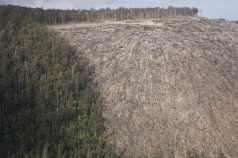
A NEW-FOUND pragmatism forced by economic downturn, public pressure and high-stakes politics has entered the previously hardcore centre of Tasmania’s forest industry.
Entrenched and polarised views are finally disappearing, or at least being slowly cast aside, in the face of an irrefutable need for industry change.
The ultimate conclusion, now expected in the next fortnight, is a massive pledge by the new government of Julia Gillard in the imminent federal election campaign of a bucketful of money to permanently restructure the native forest industry in south-east Australia.
The announcement is expected to be an end to all logging in high-conservation native forests and a gradual transition out of most native forest harvesting on publicly owned land to a plantation-based industry.
…
Signs have been emerging for months of real change afoot.
It was no more evident than in the resignations in June of Gunns executive chairman John Gay and board member and former Tasmanian premier Robin Gray in an effort to rescue its plunging share price.
Instead, the talk from the new-look Gunns since has all been about the need to obtain a “social licence” for its timber operations, including its still-possible $2 billion pulp mill.
The company has sold vast tracts of native forests and appears to be moving towards a future based entirely on plantations and high-value timber production for furniture and construction work, rather than on its bulk woodchip exports of the past two decades.
Strange moves for a company that just three years ago was proudly boasting of its power to make a premier, Mr Lennon, drive up the highway from Hobart to its Launceston headquarters to implore Gunns not to take its pulp mill to China.
Strange times from a company that was so omnipotent in 2007 that it was able to make a state government change its laws to ram its pet project through Parliament, and certainly not with “social licence”.
It’s a dramatic switch that not even the most optimistic of change-agents, forward thinkers or environmentalists could have anticipated.
No doubt the difficulty in obtaining international finance for the pulp mill has played a big part in the turnaround. It is impossible to imagine anyone being in talks with international forestry and pulp companies and not to realise the rest of the corporate world had a different perspective from that prevalent in some Tasmanian circles.
Equally, it must have been obvious to all those Tasmanians in the negotiations that sneering attitudes toward “greenies” or socially responsible consumers did not represent the way ahead.
But Gunns is not alone in its apparent transformation.
There also appears to have been a Damascus-like conversion in the thinking and attitudes over the past six months of many of the forest industry’s most-conservative diehards. It was on display for all to see yesterday at a special gathering in Hobart.
The occasion was the awarding of the first full Forest Management Certification for native eucalypt forests under the Forest Stewardship Council to sixth generation Bothwell farmers Peter and Anne Downie ( HERE ).
Just a couple of years ago, FSC certification and the international organisation behind it was widely condemned by most in the local forest industry as nothing but a conspiratorial shopfront encouraging the anti-logging beliefs of conservationists and greenies.
In that spirit, Forestry Tasmania spent enormous effort and taxpayers’ money in promoting its own Australian Forestry Standards to international buyers of woodchips, paper and timbers as being vastly superior to the FSC in its type of forest management systems.
But rather like the battle between Beta and VHS video systems in the 1980s, it was consumers who voted with their feet, and wallets, and sent the signals to retailers that the FSC “tick of approval’ was the only one they recognised as representing environmental sustainability and good forest management.
It might therefore have been anticipated that the presentation of the coveted FSC certificate to the Downie family after seven years of endeavouring to meet its rigorous criteria would have been shunned by industry heavies.
But far from it. There, filling the seats in a small reception room was a veritable who’s who of every major player in Tasmania’s forestry and environmental organisations.
Forestry Tasmania’s executive general manager Hans Drielsma, the strongest spruiker of the AFS standard’s superiority over FSC endorsement, was sitting prominently in the second row.
There too from the forest side of the debate was Timber Communities Australia’s Barry Chipman, along with Forest Industries Association of Tasmania chief executive Terry Edwards and Forest Industries council chairman Julian Amos.
All nodded sagely and enthusiastically as Mr Downie spoke about selectively harvesting the native forests on his family’s Lagoon of Islands property only every 150 years, of the need for no chemicals or hot fires, and the philosophy of looking after native Tasmanian eucalypt forests in the most non-interventionist and low impact way possible.
Mr Chipman even issued a press release afterwards, greeting the Downie family’s FSC achievement as “heartening news for Tasmanian timber families”.
…
So what has brought about this massive change so suddenly?
Certainly there is weariness from all concerned in the long-running and ultimately fruitless divide between environmentalists and the forest industry, combined with a new-found community enthusiasm for consensus and stakeholder engagement.
Think also of the success of the “Our Common Ground” campaign during the last state election, which some believe played a significant role in delivering the Greens the balance of power.
But more than anything, politics in Canberra combined with an economically haemorrhaging forest industry lie behind the new pragmatism.
The secret talks under way for the past year between environmental groups and forest industry organisations are continuing apace.
Forget Premier David Bartlett and his state-based roundtable. The game has been taken over by national heavies based in Canberra.
Federal Forestry Minister Tony Burke is playing the central role. There too is the national head of Timber Communities Australia , Jim Adams, National Association of Forest Industries chief Allan Hansard, and the Wilderness Society’s Vica Bayley and Environment Tasmania’s Phill Pullinger.
It had been hoped a resolution could be reached by June 30.
Now, the highly sensitive talks are being pushed hard by Mr Burke to reach a decision next week.
Clearly, the impetus now is the political imperative of Labor’s determination to win the next election.
As Julia Gillard has made clear, she knows she needs to make a major statement on the environment and climate change.
Labor desperately needs to re-establish its credentials on climate change and it does not want seats in heartland electorates being won by the Australian Greens, potentially giving them a say in the House of Representatives for the first time.
…
Saving Tasmania’s old forests but also creating jobs and financially compensating contractors will be at the centre of her speech.
But what will be just as interesting to see will be the bargaining chips that the forest sector has been able to gain in return for its concessions.
Will the small print include a “social licence” for a pulp mill?
Will some harvesting of native regrowth forests still be allowed?
And will woodchips or forest residue be allowed to be burned in power generation furnaces in the new carbon-constrained world?
We should all be waiting with great anticipation for the announcement by Ms Gillard and Mr Burke but also watch for what sensitive issues have been traded around the negotiating table.










