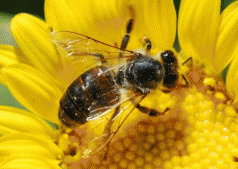
Disturbing evidence that honeybees are in terminal decline has emerged from the United States where, for the fourth year in a row, more than a third of colonies have failed to survive the winter.
The decline of the country’s estimated 2.4 million beehives began in 2006, when a phenomenon dubbed colony collapse disorder (CCD) led to the disappearance of hundreds of thousands of colonies. Since then more than three million colonies in the US and billions of honeybees worldwide have died and scientists are no nearer to knowing what is causing the catastrophic fall in numbers.
The number of managed honeybee colonies in the US fell by 33.8% last winter, according to the annual survey by the Apiary Inspectors of America and the US government’s Agricultural Research Service (ARS).
The collapse in the global honeybee population is a major threat to crops. It is estimated that a third of everything we eat depends upon honeybee pollination, which means that bees contribute some £26bn to the global economy.
Potential causes range from parasites, such as the bloodsucking varroa mite, to viral and bacterial infections, pesticides and poor nutrition stemming from intensive farming methods. The disappearance of so many colonies has also been dubbed “Mary Celeste syndrome” due to the absence of dead bees in many of the empty hives.
US scientists have found 121 different pesticides in samples of bees, wax and pollen, lending credence to the notion that pesticides are a key problem. “We believe that some subtle interactions between nutrition, pesticide exposure and other stressors are converging to kill colonies,” said Jeffery Pettis, of the ARS’s bee research laboratory.
A global review of honeybee deaths by the World Organisation for Animal Health (OIE) reported last week that there was no one single cause, but pointed the finger at the “irresponsible use” of pesticides that may damage bee health and make them more susceptible to diseases. Bernard Vallat, the OIE’s director-general, warned: “Bees contribute to global food security, and their extinction would represent a terrible biological disaster.”
WHY BEES MATTER
Flowering plants require insects for pollination. The most effective is the honeybee, which pollinates 90 commercial crops worldwide. As well as most fruits and vegetables – including apples, oranges, strawberries, onions and carrots – they pollinate nuts, sunflowers and oil-seed rape. Coffee, soya beans, clovers – like alfafa, which is used for cattle feed – and even cotton are all dependent on honeybee pollination to increase yields.
In the UK alone, honeybee pollination is valued at £200m. Mankind has been managing and transporting bees for centuries to pollinate food and produce honey, nature’s natural sweetener and antiseptic. Their extinction would mean not only a colourless, meatless diet of cereals and rice, and cottonless clothes, but a landscape without orchards, allotments and meadows of wildflowers – and the collapse of the food chain that sustains wild birds and animals.
Read the full article, with links in The Guardian, HERE
Malini Alexander:
It might come as a worrying surprise to readers, that there have been reports around the world of disappearing bees. Some countries including France, Germany, Denmark and the US, have experienced a 30% decline in bee populations in the last few years.
What’s responsible?
The usual suspects – pesticides, herbicides and fungicides.Forestry Tasmania acknowledges that ‘There is a risk associated with every pesticide operation that chemicals may be transported off-site, contaminate waterways and subsequently be toxic to aquatic or terrestrial organisms.’ (Trainer, Forestry Tasmania )
In Tasmania, the forestry, horticulture and agricultural industries use many of the chemicals that have been responsible for bees disappearing in other countries.