Environment
EU can afford to increase its climate ambition

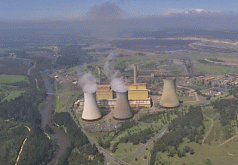

The EU is not doing enough to deliver meaningful cuts in its emissions, says Bryony Worthington. In this week’s Green Room, she says the economic recession has resulted in a sharp fall in emissions, meaning the 27-nation bloc can hit current targets with little effort and little investment in green technologies.
Recently released figures for the 27-nation bloc’s power and industry sector, which makes up half of all carbon dioxide emissions, showed a 11% decrease in just one year.
The previous year had already seen a 6% drop compared to the year before.
This dramatic drop in emissions is down to the impact of economic recession. As belts tightened, demand for energy fell and many factories saw production levels go into steep decline.
This is not good news for Europe, but there would be a silver lining for the environment if it led to the adoption of more ambitious climate targets.
The environment will not necessarily benefit unless tighter targets are introduced, because the EU climate policy is pegged to the Emissions Trading Scheme (EU ETS).
Since 2005, emission levels in the EU have been pre-determined with fixed numbers of emissions allowances being created and handed out to industry.
The problem is the caps on emissions were set before there was any sign of recession, and the number of allowances that have been issued exceed current emission levels.
As allowances can be banked indefinitely, pollution levels will be able to grow back up to the level set by the overall “cap”.
The caps are meant to create incentives to reduce emissions because allowances can be traded between participants.
The price someone is willing to pay to buy a permit creates an incentive for someone else to reduce emissions in order that they can sell the spare permits.
Like any market, this depends on the balance between supply and demand – too much supply and the prices will be low. An unanticipated drop of 17% over two years is, understandably, keeping prices low.
The current caps that were set back in 2006 were never very ambitious and a new round of caps for the period 2012-2020 will be decided in June of this year.
The current proposals are also far from ambitious. Caps are set to reduce emissions by only 1.74% per year, delivering a 21% reduction by 2020 from 2005 levels.
This is not in line with the contribution Europe is expected to make towards reducing global emissions, which should be in the range of 25-40% compared to 1990.
The recession has provided a very clear reason to increase these targets.
As large volumes of spare permits expected to be banked into the next phase of trading, the cost of meeting higher targets will be significantly reduced.
Many companies will hold huge surpluses of allowances, meaning that they will be insulated from having to make any emissions cuts for some time to come.
‘Piece of cake’
Our recent Carbon Fat Cats’ report illustrated just how much money the surpluses held by large multinational companies could be worth.
Many of the same companies and sectors that are amassing large surpluses are actively lobbying to hold targets where they are.
But decision makers need to look at the evidence and resist the arguments of those who are trying to protect the status quo.
The recession, coupled with the trading scheme, gives the EU an excellent opportunity to increase its ambition without unduly damaging its competitiveness.
This would help to ensure that there were strong incentives for our growth out of recession to be green, and would help to restore trust in international negotiations.
The outgoing head of the UN’s climate body, Yvo de Boer, recently stated that it would be a “piece of cake” for Europe to meet its current targets; and he is not wrong.
Huge cuts in emissions were made in the 1990’s as accession countries’ economies collapsed after the fall of the Soviet Union.
The “dash for gas” by energy providers in the 1990s saw the sector move away from coal, which is the most carbon intensive form of electricity generation. This also helped deliver big savings.
And in this decade, more huge cuts are being delivered that have nothing to do with dedicated climate policies.
What little there is left to deliver in the next decade could simply be met by using the generous “offsetting” provisions available to companies and countries.
This allows targets to be met through buying emissions reductions achieved in developing countries.
Many countries are looking to Europe to show how it is possible to achieve growth without increasing emissions.
Only when they see that this is possible will they be inclined to adopt absolute reduction targets of their own.
The argument that we need to keep our targets where they are in order to allow us to grow out of recession simply serves to strengthen developing countries’ concerns that we are not serious about being able to decouple emissions from economic growth.
When decision makers meet in June to decide the emissions targets for the EU in the next decade, the only logical thing to do is to increase them.
Then the silver lining of these recent falls in emissions will be genuine.
Investors in Europe will have a clear signal that growth in the EU will be through green investment; and our economy will be all the stronger for it, both in the short and the long term.
Bryony Worthington is a founding director of Sandbag, an environmental NGO that focuses on emissions trading
The Green Room is a series of opinion articles on environmental topics running weekly on the BBC News website