Article
Mine ‘directly contaminating town lands’

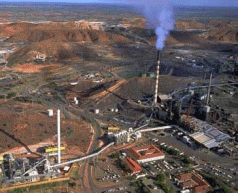

THE high levels of lead and other heavy metals in Queensland’s Mount Isa come directly from activities at nearby Xstrata Mount Isa Mines, according to a new analysis.
The findings by Macquarie University environmental scientist Mark Taylor and his colleagues contradict long-running claims by the mine that the lead, cadmium, copper and zinc contaminates are a result of natural mineralisation of the local geology.
“The game’s up: the lead is not naturally occurring,” Professor Taylor said.
“It’s an inescapable conclusion that the source of the metals is mining and smelting activities.”
According to Professor Taylor, better strategies must be established to reduce contamination of homes, parks, gardens and uncovered roads and slag heaps, as well as to stop “fugitive emissions” from the mine.
Several lawsuits have been lodged against Xstrata based on the findings of a 14-month Queensland Health screening program, reported in 2008, that 45 of 400 children tested in the Mount Isa area had blood lead levels exceeding the National Health & Medical Research Council’s “level of concern”, 10 micrograms per decilitre. One child had a reading of 31.5 mcg/dl.
Pediatric epidemiologist Bruce Lanphear said there was mounting evidence young children might suffer serious impairment when exposed to even low levels of lead.
He told The Australian last November: “New studies indicate that many Australian children are at risk for intellectual deficits, attention deficit hyperactivity disorder, school failure, delinquency and violent criminal behaviour.”
Queensland Health did not respond to Professor Taylor’s claim that it had “downplayed” the health risk to exposed youngsters.
In an upcoming paper in the journal Applied Geochemistry, Professor Taylor’s group reports that analysis of surface and at-depth soil samples, combined with atmospheric data, showed surface soils within 2km of the mine were significantly contaminated compared with those from more distant sites.
Xstrata Copper North Queensland’s chief operating officer, Steve de Kruijff, dismissed the report, claiming it didn’t show the lead was “bio-available”, or useable by the body.