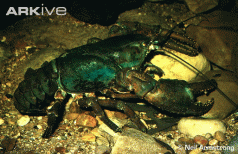
Upon my arrival in Tasmania in the early 70s, my interest in freshwater crayfish was revived when I discovered the streams in my local environment contained the largest freshwater crayfish, indeed, the largest freshwater invertebrate, in the world: Astacopsis gouldi, known locally as the Giant Freshwater Lobster. I also discovered the extra element of caution that is involved handling a crayfish capable of doing considerable damage if it manages to catch hold of you with a giant claw.
In the late1980s, A. gouldi was declared by noted Astacologists, Dr Pierre Horwitz, and Dr Premek Hamr, to be in trouble from over fishing and habitat destruction. Our fledgling field naturalists group, then called the Deloraine Field Naturalists Inc., decided to apply for and carry out a Commonwealth funded study to determine any impacts of habitat destruction on the giant crayfish.
This was an enormous commitment from the group, and involved around a dozen field nats doing weekend surveys over the summer season of 5 different streams in the Gog Range. These streams were graded from ‘Pristine’ to ‘Severely Impacted’ due to forestry operations. The published result was the Growns Report written by our supervisor in the field, Dr Ivor Growns, and it correlated the size of a stream’s crayfish populations to the impacts on the streams from forestry operations. This report was either denigrated or ignored by the Tasmanian State agencies, but led to Dr Horwitz successfully nominating A. gouldi on behalf of the Field Naturalists as a species Vulnerable to Extinction under the Commonwealth’s Threatened Species Act.
Around 20 years ago while Pierre Horwitz was staying with me to give a public lecture we had organised, he informed me that since I was so keen on crayfish he wanted to show me something REALLY interesting. He introduced me to a group of crayfish called Engaeus, which are a genus of burrowing crayfish. This was like a re-visit from my boyhood to once again encounter a burrowing crayfish, only this time it was in the enthusiastic company of the reigning expert, Pierre, who had carried out his PhD work on the genus Engaeus, and had named most of the species. He impressed upon me how there was a lifetime of work to be done just gathering and refining distribution information on this group, not to mention the possibilities of finding new species. He suggested that amateur enthusiasts like me were needed to carry out some of the work.
I was hooked.
How could I resist? It was like going back to something that had been waiting for me for many years since I had first encountered burrowing crayfish in the prairies of the US.
Some key anatomical features of the Engaeus group such as the tiny “exopodite of the third maxilliped”, which (once found!) took considerable patience with my cheap, dissecting microscope to determine whether it might be multi-articulate or not, otherwise, I couldn’t move any further along in keying out to a species.
When we managed to get the Giant Freshwater Crayfish listed as a threatened species, it was one of the first invertebrates to be put on the list. Given that invertebrates make up most of the life on earth, it did open up a can of worms (sorry), and it almost goes without saying that invertebrates along with fungi don’t exactly get equal billing with vertebrates or plants. There was certainly opposition to the listing of the crayfish. We often encountered the statement that “the problem with endangered species is there are too many of them”. Well, .. yes! These same people tend to then call for a “balanced approach”, which turns out to apparently mean we should ignore threatened species concerns wherever possible.
Working with endangered crayfish over the years has certainly had its challenges. For instance, our field nats contributed over eight years of voluntary work on the Astacopsis Recovery Plan once the species was listed, and in the end a bureaucrat in the lead agency simply watered down the plan according to what that department needed to do in order to not upset forestry interests.
This past year, I saw a news piece on the TV about how Astacopsis gouldi had now been “saved”. It is true that since the halt of fishing due to its threatened listing, the species has recovered somewhat in places in the NW of Tasmania where there is still reasonable habitat. However, in the NE of Tassie (where hardly any work has been done), I believe the species teeters increasingly towards eventual extinction. The real threat is the relentless trashing of habitat, especially in the headwater streams which are important nursery areas for the species. A REAL Recovery Plan remains something needed to address the needs of the species to survive wherever it currently occurs.
With the some of the threatened Engaeus burrowing crayfish, things are also bleak. I was commissioned a few years ago by the Engaeus Recovery Team to do the distribution work for a Central North species, Engaeus granulatus, which led to the species being listed as Endangered. Since that listing, a number of colonies have been severely impacted or extinguished by developments, and there appears to be no effective planning mechanism in place that works on behalf of the crayfish rather than the developer. I have wasted many countless hours doing report writing for the Commonwealth concerning protection measures for various colonies of E. granulatus, only to then see my work simply ignored. If I could write a pop song, it would be about betrayal of my midnight toil.
In the NE there is a listed Endangered Engaeus species, E. spinicaudatus, which mainly occurs in a few buttongrass areas near the Forester River. There is a current proposal to dam the river, which would destroy much of this species’ habitat. Given the current regime and policies in Canberra, I wouldn’t bet on the crayfish winning that battle.
Our rock star credentialed Federal Minister for the Environment has also decided that Recovery Teams are no longer needed, and that we perhaps need to stop worrying about individual species. His record thus far should qualify him as an “endangering process” for species of concern.
Tasmania has one of the richest if not THE richest freshwater crayfish faunas in the world that includes five unique genera of mostly endemics. This includes the world’s largest (Astacopsis), and arguably the world’s most highly evolved (Engaeus). Observing and learning about many of these species has provided me with a great deal of pleasure over the years, while my growing awareness and admiration of their long history of evolution and adaptation has spurred a sense of purpose to work on their behalf.
Trying to make a difference for them has proved to be an ever increasing challenge. In trying to meet that challenge, I was once confronted with the question: “But what GOOD are they?” Increasingly, that becomes a question difficult for me to answer for our own species.
References:
Horwitz, Pierre The Systematics and Zoogeography of the Freshwater Crayfish Genus Engaeus, Phd Thesis, University of Tasmania, Hobart 1986
Hamr, Premek (2005) Giant Freshwater Crayfish Recovery Plan Review for the DPIWE, Hobart Tasmania.
Nelson, J. (2003). Unpublished Report to the Burrowing Crayfish Recovery Team on Engaeus granulatus survey work as of July 2003. Threatened Species Unit, Tasmanian DPIWE
“Ray Fox” Raising Kane, The Fox Chronicles, The Kindred Spirits Press 1999
http://chicagowildernessmag.org/issues/spring2002/fox.html
www.foxenviro.com.au/