The use of toxic chemicals in the manufacture of pulp for paper has long been an issue of concern for informed and concerned people.
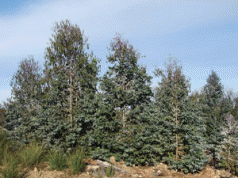
Another extremely serious danger to the health of people is now being shown to be present in the use of pesticides to maintain monoculture plantations of trees bred and designated for the manufacture of pulp for paper.
The material posted on Tasmanian Times by Dr Alison Bleaney HERE) contains important information.
Dr Bleaney drew attention to the effects of pesticides:
“Whether or not they are placing their work in this longer-view context, scientists are drawing more and more links between pesticide use and certain clusters of wildlife die-offs.
“For decades,” Sonia Shah reports in Yale’s Environment 360, “toxicologists have accrued a range of evidence showing that low-level pesticide exposure impairs immune function in wildlife, and have correlated this immune damage to outbreaks of disease.”
Amphibians were the first to start dying off – in 1998 scientists identified the cause as a type of fungus called Batrachochytrium dendrobatidis. Carlos Davidson, a biologist at San Francisco State University, has studied insecticide use in the San Joaquin Valley that shows a strong correlation between pesticides drifting into the Sierra Nevada Mountains and declining amphibian populations.
A few years later America’s honeybees started dying – 35% of their population has been decimated since 2006. Many scientists have begun drawing links between the dramatic bee die-offs, labeled Colony Collapse Disorder, and a group of pesticides known as neonicotinoids.”
Dr Bleaney’s cited comment to the effect that “ Pesticides are immune system changers, and must be implicated in the general decline in health.” raises futher concerns. I am reminded of the following very pertinent paragraph from a paper delivered by Dr Pete Hay to a ‘Search Round Table’ in Hobart on April 12 2008. Relating conversations with people who live in an areas being clear felled and replanted Dr. Hay said:
“Much of the antagonism expressed towards current forest practices is directed towards its effect upon water quality, particularly in the catchments, where massive hydrological changes are seen to be taking place. Some people are scornful of industry and government scientists, who are thought to turn up to do their studies and take their measurements at precisely the times when they can be sure of not finding anything in breach of the Forest Practices Code. ‘There are people up here can’t read and write’, said one person, ‘and none of us are scientists, but we’re here all the time, and we see things – dead wombats in the creeks and that, the creeks foaming like anything – stuff that the bloody scientists never see because they aren’t here when it’s there in front of you’.”
The plantations issue is much more than a “management” problem.
Monoculture plantations represent many dangers to the environment, wildlife and people.
What we need is “common ground” with those who are victims of current forest practices; and these victims and potential victims include ex forest based industry workers and current forest based industry workers whose work futures and health are under threat from current forestry practices.
Health, Human futures and genuine environmental protection are more important, even in realistic economic terms, than $ returns on deeply faulted, environmentally damaging investments in monoculture plantations.