

It seems that many people who are opposed to clear-felling of native forests, and to the use of old growth and other native forests for woodchips, see timber plantations as a way to keep up
employment in the timber industry while operating the industry on a sustainable basis.
This ignores some fundamental points, including the negative effects plantations have on the water and land available for agriculture, and on existing agricultural communities as well as on existing ecological systems.
First, the important question to ask is: what are the best uses, economically and ecologically, to which our forests, our land and our water can be put, now and in the future?
It is clearly not the production of paper and cardboard from woodchipped Tasmanian trees, wherever those trees have been grown. Economic common sense says that the more value that is added to the raw material, the better. A pulp mill will add more value than woodchips, but not a lot more, and the only proposal for a pulp mill in Tasmania is for one which is planned to process additional chips, not to replace those currently exported. The plan is for the current tonnage of woodchips exported to be maintained whether the mill is built or not, therefore the rate of tree harvesting would increase because of the mill.
Woodchips and pulp are used for products that have a short life: paper and cardboard that ends up in disposable items such as packaging and toilet tissue, and is soon either burnt or allowed to rot, either way releasing its stored carbon into the environment and adding to the problem of climate change. Furthermore, only a fraction of the carbon gets even as far as the woodchip mill. The rest is burnt or rots on the forest floor.
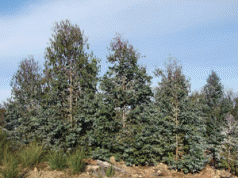
Eucalyptus nitens has been specially bred for the production of woodchips. It is of little value for construction or craft timber. For long-lasting and therefore more carbon retentive timber products, native forests must be selectively logged. This was the way in the Tasmanian timber industry for decades, up until the 1970s when the introduction of wood chipping, together with advanced technology involving a huge increase in invested capital, moved the industry into a qualitatively different sphere.
Work or employment in forestry, and in the industries utilising the products harvested from our forests, changed in character, and overall numbers of people employed fell dramatically. The beginning of the reduction in employment in forest based industries coincided with the advent of export of woodchips. The negative changes in employment opportunities were influenced partly by the radical change in use of most of the timber now harvested and partly by the use of technological innovations used to increase profits by reducing labour costs.
In historical terms the large scale use of environmentally damaging chemicals to pulp wood for the manufacture of paper is a relatively recent development. In Tasmania in the 1930s, the argument for this use of timber was that it would use up the limbs and heads of trees which at that time were often left to rot. It was portrayed as having a minor effect on overall use of our forest products. As we all know that is not how it developed. Woodchips for pulp now swallow most of the harvested timber and the ‘waste’ is burned, along with some valuable minor species wood, while many of us cop lung damaging smoke from the irresponsible burning practices of our forestry controllers.
There are other, more ecologically sustainable ways to manufacture paper, including from hemp and from banana waste. The argument for the retention or increase of E nitens plantation acreage rests on the assumption that trees are the only possible source of suitable fibre. Economically, the introduction and retention of the MIS (Managed Investment Scheme) to provide tax incentives for these plantations indicates that they would not be viable otherwise.
Even so, a number of plantation investment companies have gone under in recent years. Formerly productive dairying and mixed cropping land has been turned over to plantations with a consequent loss not only of population in rural areas but even of whole communities.
Although Australia does not yet have a carbon tax or any emissions trading scheme, there is little doubt that it will have within a matter of a very few years, or even months. Provided there is a realistic price put on carbon, Tasmania’s trees, especially in the old growth forests, will be worth much more as repositories of carbon than they would as hewn timber, and much, much more than as woodchips.
Plantations planted for the sole purpose of carbon retention might make sense under such a tax or scheme, but what would make even more sense would be to replace existing plantations, where the land is not suitable for farming, with mixed age and mixed species native forests.
As they stand at the moment, plantations compete for access to groundwater with farms and other users, increasing the need for expensive irrigation infrastructure. As there has never been an adequate audit of Tasmanian water, successive governments have proceeded ad hoc to distribute water where it has seemed politically expedient. In all of this, the impact of plantations has been ignored. Future generations will have to pay massively for this.
Among the environmental problems caused or exacerbated by plantations are reduction of biodiversity and the use of pesticides and herbicides. Despite a recent cessation of the use of 1080 by Forestry Tasmania, this poison is still being used on privately owned land. Other poisons, such as Atrazine, which are banned in many other parts of the world, are deemed essential for keeping plantations viable, and are sprayed, often with disastrous impacts on nearby properties, and always with detrimental effect on waterways.
The warning that Australia’s outstanding economist and public servant of the Twentieth Century, the late H. C.( Nugget) Coombs left us in his last book needs to be heeded. The title of Coombs’ book, The Return of Scarcity was suggesting, some two decades ago, what is now becoming evident to all but those who refuse to see, namely that our mindless plunder of our natural environment has clearly already threatened and is continuing to threaten food and other necessities for human existence.
As Coombs put it “… we are not inescapably dependent on this flood of commodities which our economic system is designed to produce. There are conceivable lifestyles more modest in their material demands, less destructive of the physical environment – lifestyles which are simpler, whose excitements are found primarily in the human relationships they provide scope for.”
Opinions aired, particularly in The Mercury Street Talk (Jan. 9-2010) and at a deeper level on Tasmanian Times indicate a quite wide recognition that plantations, encouraged by being a tax dodge, are not a solution.
The revealing article by Brenda Rosser on ‘Tasmanian Times’ (Dec 29-2009) HERE: Welcome to the Third World, Tasmania and the many complimentary comments on Brenda’s article suggest a quite wide appreciation of the danger the plantations we are here discussing represent to the human future.
We would add to this the following comment from a paper prepared by Tasmania’s outstanding expert on water issues – Dr David Leaman. Under the subheading ‘Plantations and Water’ Dr
Leaman, in a paper titled “Solving our Water Crises”, wrote “…If we have a forest in the catchment, average rainfall of 1,000 mm, then the run off is about 200mm. If it were a grassed catchment then the run off would be some 350mm. Thus if we clear the forest we release 150mm from the expenditure ledger for running the catchment. The land becomes wetter, reeds appear, and farming is easier. A new equilibrium may be reached in three to five years.”
It is what immediately follows these sentences that plantation supporters are either ignorant of or deliberately ignoring.
Dr Leaman continued: “If however we take a grassed catchment (or burn or clear a forest, then replant) we reverse the trend but there is now a large growth demand and for part of the growth cycle the water demand will exceed that of mature forest by up to 50%. Thus our newly treed land at 15 years may be drawing 900mm of the 1000mm of rainfall and only100mm of rainfall can run off. It may take many more decades before the runoff levels match those of a mature forest. These time functions mean that the forest industry demands in a catchment are far from simple but potentially very large”
The full text of this paper, courtesy of Dr. Leaman, is available on:
http://www.nwtptas.org.au/seminarwater.php
As indicated above there are several other problems created by plantations, but the above explained competition with agricultural and urban domestic usage of water is an additional reason to think again about plantations. Of course it is important to end the wanton destruction of our native forests, but simply to replace the reliance on them with an increased, or even a maintained level of reliance on plantations is not a recipe for a future that is sustainable, either economically or ecologically.
Max Bound and Tim Thorne
January 11 2010










