IN THE annals of Australian forest protest, the battle of Baker’s Creek should barely rate a mention. It was a small, grim affair in Tasmania’s Huon Valley that pitched old-time loggers against incoming settlers.
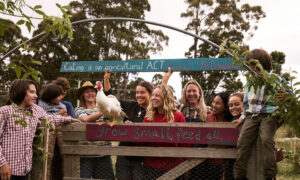
The loggers contracted to Gunns Limited wanted to cut native forest on surrounding hillsides at the hamlet of Lucaston. The greenies failed in their attempt to buy the land, and then set up a blockade. So badly organised were they that no one was manning the first blockade when police swooped early one morning to clear it. Over the next few months there were a few arrests, and eventually the loggers departed after cutting little.
Local though it was, the battle of Baker’s Creek in 2003 now has a standing unusual for such struggles. It’s all that’s left of the Gunns 20 case, the landmark civil action against environmental protest.
Baker’s Creek is also symbolic of a much greater problem for Gunns. This little protest poses an obstacle to the timber giant’s long-touted $2.2 billion pulp mill.
If it is to turn the stalled project into reality, Australia’s largest timber firm may have to undergo a radical makeover. It may need to show that instead of pursuing protesters, it has community support for what it does. And the same company will have to stop woodchipping old-growth forest.
Gunns began its case against 20 environmentalists, including the Greens leader Bob Brown, five years ago this week – just as it unveiled the pulp mill project. It sought $6.9 million in damages and alleged an over-arching conspiracy through a series of protests against its operations, both in the forests and in woodchip plants.
Many of the defendants said they faced the threat of financial ruin in the case, which was regarded by environmental lawyers as a watershed ”SLAPP” suit – Strategic Litigation Against Public Participation.
Gunns chairman John Gay firmly defended it. ”What we’re sick of is the malicious damage some people are doing to us,” he said. ”We will continue to chase that down to the nth degree.”
Over the years the conspiracy claim and others by Gunns were thrown out of the Victorian Supreme Court. Gradually the company settled with defendants or dropped them from the action. Now all that’s left of the original Gunns case is a claim for $184,000 against four people involved in the battle of Baker’s Creek.
For the remaining defendants, the financial and legal costs have been exhausting. In a moment of understatement one of them, grandmother Lu Geraghty, said yesterday: ”I’m just a bit frazzled.”
Gunns calculates its legal costs so far at $2.8 million. And the company continues to defend both dollar, and image costs. ”Of course we are concerned about it,” Gay told the company’s AGM recently. ”But we are also concerned about what (protest) does to the company, so it cuts both ways.”
Gunns showed its determination again earlier this year when it began another civil prosecution against 13 protesters who shut down one of its woodchip mills at Triabunna for several hours.
But global self-regulation in the forest industry increasingly means that chasing down a few greenies with the heavy hand of corporate-financed law is no longer acceptable. With financing still tight, Gunns is likely to require a partner to get the pulp mill up and running (it has already spent $200 million on the project) – but a partner brings new standards.
Gunns says it is talking to a number of parties about its project. Among names touted in the industry earlier this year was China’s Nine Dragons Paper Holdings, owned by the ”wastepaper queen” Cheung Yan, who made billions from importing America’s unwanted cardboard. It may be a good fit with the tough-minded Gunns board. But since the global financial crisis, her company’s value has plummeted and scrutiny of its sweatshop practices increased.
Now the only company publicly to say it is talking with Gunns about a joint venture for the divisive mill is Sodra of Sweden. And Sodra has set the tough European-based Forest Stewardship Council certification as one of its firm requirements for involvement.
Sodra is a collective of 50,000 plantation forest growers in Sweden. Its main European markets require FSC certification, and to keep this green tick the Swedes must make it the benchmark for any other project they get involved in.
”With FSC a company can’t be half-pregnant,” former Australian director, Frank Strie, says.
Sodra has required that Gunns use environmentally friendly, totally chlorine-free bleaching technology for the project – an obstacle that Gay said was being satisfied. But there seems to be little wriggle room for the community support demand in FSC.
”My understanding is that Gunns couldn’t continue a court action like this and expect to get FSC,” said Senator Brown of the Gunns 20 case. ”The two are inimical. They work against each other.”
Potentially as difficult for Gunns is FSC’s requirement for all company operations to move out of high conservation value forests. Already Gunns has said it won’t be feeding old-growth forest into the pulp mill – a claim disputed by environmentalists. But under the FSC it would have to cease old-growth logging totally.
Last year, 2110 hectares of Tasmania’s old-growth forest was logged, according to Forestry Tasmania figures. Most was exported by Gunns as woodchips. And despite political campaigns and continuing protests, there is no formal end to old-growth logging in sight.
”It would be a major breakthrough if Gunns were to agree to FSC certification,” Senator Brown said. ”And, of course, they should.”
Not everyone in Australia likes the FSC though. Even though it is a European standard, Forestry Tasmania’s general manager Hans Drielsma dismisses it as relying less on science and more on stakeholder opinion. He believes it is something that belongs in a Third World country where human rights might be at stake, and not in a developed democracy such as Australia.
Instead nationally there is strong pressure to adopt the Australian Forestry Standard, which is more relaxed about the logging of native forests. The Green Building Council of Australia recently switched from demanding exclusive FSC approval to include the AFS, under pressure from the forestry union and Federal Government.
Gunns currently prefers the AFS. But in the face of Sodra’s strict requirement, the company has met with FSC’s Australian office, and was reassuring about its chances of obtaining the tick at its recent annual general meeting.
”Our aim is to have FSC across our business into the future,” said Gunns’ sustainability manager Calton Frame. ”That’s not specifically tied to the pulp mill. We want to have all the third-party accreditation we can possible have.”
According to the FSC’s Australian chief executive Michael Spencer, one way Gunns may be able to gain certification is to do it in stages, over a five-year period. This is about the time that Frame said Gunns would need to move to a 100 per cent plantation base for the mill.
But clearly, community support for this project is yet to be gained.
The Battle of Baker’s Creek is due to go before the Supreme Court in Melbourne in February. At least two of the four defendants have decided to self-represent, a decision raising the spectre of the McLibel case, in which two impoverished Londoners fought for years against fast food giant McDonald’s, tying up costly legal resources in a PR disaster.
Then there is the other local community – in the Tamar Valley. During a bitter exchange at the AGM, Tamar resident Judith King claimed that 70 per cent of local people were against the mill and told Gay: ”This community is going to fight you to the end, if it takes 30 years.”
Gay snapped back: ”Well you’ll have about 25 years of the mill operating.”
Through the mill
• December 17, 2004: Gunns announces its pulp mill project, with building to start early in 2006 and the mill to be commissioned by mid-2008. Days before, it launches the Gunns 20 case against environmentalists.
&bull February 24, 2005: The company chooses the Tamar valley as the preferred site for a $1 billion mill producing up to 1.3 million tonnes of pulp each year.
&bull October 26, 2006: Gunns’ 7500-page pulp mill study is lodged, but found to contain errors and omissions. CEO John Gay is reported to say that unless it is approved within six months the project will be axed.
&bull November 17, 2006: Greens leaders Bob Brown and Peg Putt are dropped from the Gunns 20 case.
&bull March 14, 2007: Gunns pulls out of the assessment process for the now $1.4 billion mill, and premier Paul Lennon agrees to push enabling legislation through.
• October 4, 2007: Environment minister Malcolm Turnbull gives separate conditional federal approval. Gay says building will start by December.
• May 30, 2008: Under pressure from mill opponents, ANZ announces it will not be involved in the project.
• January 5, 2009: Now costing $2.2 billion, the mill’s conditions are mainly accepted by Environment Minister Peter Garrett, but water quality tests are set to continue through 2010.
• March 16, 2009: Gunns pays the Wilderness Society $350,000 to settle its part of the case, and the company is awarded $25,000.
• November 12, 2009: Sodra of Sweden confirms it is involved in discussions about a role it could play in the mill. Ground clearing works are under way.