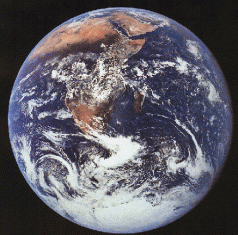
A document leaked from the UN secretariat suggests that, even if (and it’s a very big if) the various pledges made at Copenhagen are kept, the world will still warm by three degrees, a rise sufficient to send 50 per cent of animal species into extinction and threaten half a billion people with starvation.
Imagine if the CIA or another intelligence agency provided credible evidence of an al Qaeda plot to do that much damage to the planet! Under those circumstances, there’d be no quibbling about either the risks or the expense.
Dick Cheney famously codified this into his “one per cent doctrine”: if there was, he suggested, even a one per cent chance that al Qaeda has access to nuclear weapons, the US needs to respond as if it were a certainty, simply because the consequences of being wrong would be devastating.
In other words, if bin Laden seriously menaced half a billion people, there would be no limits placed on the efforts made to stop him. Remember, according to the Nobel Prize winning economist Joseph E Stiglitz, the war against Iraq – a nation that, as it happened, possessed no weapons of mass destruction – will ultimately cost America three trillion dollars, a sum far in excess of the price tag attached to transitioning to a carbon neutral economy.
Yet, in response to climate change, a threat both far more real and far more devastating than any number of terrorists, the US – and everyone else – seem paralysed. The environmental journalist George Monbiot makes the comparison with the diplomacy of the early modern period: The treaty-making system has scarcely changed in 130 years.
There’s a wider range of faces, fewer handlebar moustaches, frock coats or pickelhaubes, but otherwise, when the world’s governments try to decide how to carve up the atmosphere, they might have been attending the conference of Berlin in 1884.
In this case, most rich and rapidly-developing states have sought through these talks to seize as great a chunk of the atmosphere for themselves as they can – to grab bigger rights to pollute than their competitors.
Then as now our political system makes multinational responses to long-term threats almost impossible. It’s not simply that climate change happens over decades or centuries, whereas politicians think in electoral cycles of three or four years.
It’s that, as in 1914, there’s a fundamental conflict between a national perspective that rewards brinkmanship and an internationalist one that demands action. The White House can authorise billions upon military campaigns because that’s seen to strengthen the nation relative to its rivals but cuts in emissions promise only a weakening of national hegemony.
Furthermore, even within nation-states, there’s no unity about what needs to be done, since there’s powerful lobby-groups with an overwhelming interest in the status quo.
Again, this is not new. In the early 20th century, politicians in Germany, France and England were under pressure from the industrial magnates for whom military assertiveness created new markets – as Woodrow Wilson famously said, the Great War was a commercial and industrial conflict, not a political one.
Today, the fossil fuel industry and its derivatives wield tremendous power in every advanced economy, so much so that had Barack Obama promised anything more substantial in Copenhagen he would have returned home to find his political career in tatters.
In August 1914 Bertrand Russell wrote despairingly: “All this madness, all this rage, all this flaming death of our civilisation and our hopes, has been brought about because a set of official gentlemen, living luxurious lives, mostly stupid, and all without imagination or heart, have chosen that it should occur rather than any one of them should suffer some infinitesimal rebuff to his country’s pride”.
That wasn’t quite right then and it’s not quite right now, since politicians, for the most part, aren’t stupid nor necessarily given to luxury, and some of them do possess both imagination and heart. But Russell’s anguish captures the incompatibility between conventional politics and a challenge of this nature.
It’s often forgotten today but the First World War – that “flaming death of our civilisation” – came to an end not because of negotiations between statesmen but because ordinary people refused, eventually, to fight.
Siegfried Sassoon expressed the sentiments of many: “I have seen and endured the sufferings of the troops, and I can no longer be a party to prolong those sufferings for ends which I believe to be evil and unjust”. A revolution in Russia, mass mutinies in the French ranks, and then the Germans toppled their militarist leaders and sued for peace.
In retrospect, it seems obvious: the war was a catastrophe for humanity, and should have been stopped before it began. But it took popular protest, untrammelled by diplomatic niceties, to achieve what the political class palpably could not.
That’s where we’re at now. Copenhagen demonstrates that politics-as-usual will not prevent climate change, that there are formidable forces pushing to maintain the status quo and that hope, if there is to be any, depends upon pressure from below.
We need now a movement comparable to the civil rights struggle in the US, a campaign with its own Martin Luther Kings, prepared to subordinate national rivalries and commercial pressures to the requirements of humanity.
Full story at: http://www.abc.net.au/unleashed/stories/s2777113.htm
There was a sense at the Copenhagen climate conference that we were witnessing, not so much the making of history but, the ending of it.
In light of the fierce urgency to slash global emissions, the agreement – if it was that, for the final plenary only ‘noted’ the accord – postponed indefinitely that which can only be done now.
The scientists must be the final arbiters. Despite the genuflection to the two degree target in the accord document, the actions pledged by the major emitters mean that the world is now confirmed on the path to a four-degree world.
It is hard to convey in a few words what this means. It is a scenario so frightening that climate scientists have been reluctant to canvass it for fear of being dismissed as alarmist. It was the unspeakable scenario, until at a conference held in Oxford in October leading scientists began to say openly what they most feared. What they said is something you don’t want to tell your children about.
There is likely to be backsliding between now and the Mexico COP; indeed there is likely to be backsliding between now and the end of January when the parties are required to formally make their emission reduction pledges under the Copenhagen Accord.
Yet even in the absence of regression, the climate future embedded in the flimsy document to come out of Copenhagen means that adequate emission reductions from the big polluters are now off the table for several years.
By the time they are revisited, perhaps after the next IPCC report, it will be too late. To have any chance of limiting warming even to two degrees (itself a dangerous objective), global emissions have to peak within the next ten years then decline sharply. After Copenhagen that is now impossible. It was for this reason that the Copenhagen conference was seen to be the last chance.
The world was a better place before Copenhagen, because then a glimmer of hope survived. Carl Jung once wrote that the great events of history cast their shadows before they occur. In the case of global warming, the shadow of the future is long and dark.
Full story at: http://www.abc.net.au/unleashed/stories/s2777595.htm
The tectonic plates of global politics shifted in Copenhagen last week, and it was tiny Tuvalu that exposed the rift. For more than a decade, developing countries have maintained an uneasy united front at climate conferences, one resolved to force the big polluters of the West to cut their emissions and to defend the innocence of developing countries.
The rift that was exposed last Wednesday has profound geopolitical significance. Third World solidarity — indeed, the idea of the Third World itself — dates from the Bandung conference in 1955, a meeting of Asian and African nations aimed at resisting colonialism and neo-colonialism.
At every climate conference, the G77 — or more usually G77 plus China — has been the developing country bloc that faced up to the big powers of the United States, Europe and Japan. But is has always been an awkward alliance, combining nations mired in poverty with those industrialising rapidly, and nations rich in oil with those dependent on imports.
Frequently, the G77 was represented by oil-exporting nations, such as Saudi Arabia, bent not on defending the interests of the South but on protecting oil revenues by sabotaging any agreement to cut emissions.
On Wednesday, Tuvalu finally broke the veneer of solidarity. Speaking for the most vulnerable countries — the small island states and the mainly African least-developed countries — Tuvalu called for the creation of a contact group to discuss a Copenhagen Protocol, which would require large developing country emitters to take on legally binding emission reductions.
The move was blocked on the floor of the plenary by China, India and Saudi Arabia, the developing nations that would be most affected. But Tuvalu would not be cowed and, in a tactic that shocked the conference, moved that proceedings be suspended.
The intransigence of the big developing countries had come up against the desperation of the least-developed nations. The stridency of the vulnerable is new to international climate talks; they understand that Copenhagen really is the last chance to head off the unthinkable.
Morally, there is a world of difference between calls by the United States for China, India and the like to take on binding emission cuts and calls for the same from Tuvalu, the Maldives and Bangladesh. China is now caught in a pincer, but one of its own making, because with economic power comes responsibility. China was a significant player at Bandung, but in recent years it has begun to look more and more like a colonial power, especially in Africa with its huge investments in resources.
If Tuvalu, with the population of a small Australian suburb, is at the sharp point of the fracturing of one of the three blocs that defined post-war geo-politics, the man who has precipitated it is an unassuming Australian. Ian Fry has, for a decade, been Tuvalu’s lead negotiator. Previously a Greenpeace employee, he lives quietly in Queanbeyan when not travelling to climate conferences.
It was Fry who last Wednesday refused to bow to the Chinese juggernaut and called for the conference to be suspended. It was an act that required a deep knowledge of how these conferences work, a measure of courage and a steely determination not to let the moment pass. He put it very simply: “Tuvalu is one of the most vulnerable countries in the world to climate change, and our future rests on the outcome of this meeting.” It was an heroic act.
For 50 years, the Third World remained united in the face of a common threat, the influence of the United States and, to a lesser extent, the Soviet Union. But for least-developed countries a greater enemy has now emerged, the threat to their survival posed by global warming, and they are no longer willing to subsume their demand that all the world’s polluters curb their activities beneath the imperative of maintaining the appearance of G77 unity.
They know that the US and China are locked in a struggle in which one will not move without the other, a struggle that is an environmental version of the mutually assured destruction of the Cold War era.
If the Copenhagen conference has announced the end of the Third World, it has also exposed the unbridgeable divide within the First World. The US position, we can now see, was not an artifact of the Bush presidency and the ascendancy of the neo-cons in Washington, but is deeply embedded in the American political system.
The characterisation of global warming by conservatives as a left-wing scam is uniquely American (although it has been imported by those temporarily in charge of the Liberal Party in Australia). Indeed, even before Kyoto, American conservatives were just as likely to attack global warming as a European plot to achieve world governance. (In Australia, the earliest documents of the Lavoisier Group promote this bizarre notion.)
Full story at: http://www.crikey.com.au/2009/12/15/hamilton-the-end-of-the-third-world/