Adventure and Wilderness
The Dying Game

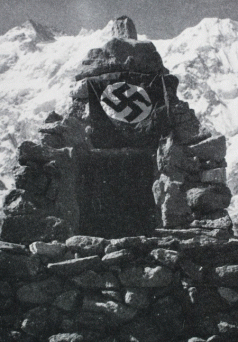

The stories of the repeated attempts to climb Nanga Parbat (8126 m) in the Kar-akoram, do not need to be continued very far for them to end in death. Nanga Parbat, means Naked Mountain in Sanskrit/Hindi. The Sherpas called it Maneater. Nanga Parbat was also called Murder Mountain and Killer Mountain. It also became known, through the claims of death, through the obligation to dead comrades and countrymen, the German Mountain.
The words “unimaginable tragedy” have been used to describe the outcome of the German expeditions of the 1930’s, and through these tragedies came the German claim on the Naked Mountain. Nanga Parbat, like some grinding battle, like the Battle of Verdun for instance, swallowed up levies of men, men as hard as nails, brilliantly talented men, the men of the new Germany. Swallowed up as well were the Sherpas. Let us not forget the Sherpas.
The comparison of the attempts to climb Nanga Parbat with battle is not a casual comparison. Both Verdun and Nanga Parbat were mincing machines. Only the numbers involved were different. Some may say that makes all the difference. Let them argue.
The claim of the dead over the living is an inexorable claim and exposes men to fatalism, to ignore consequences, because the luminosity in the sky far off where the ranks of the dead sing their high mournful songs, presages victory. The glow of the Silbersattel up high, suspended between the East Summit and the Southern Silberzacken, the moonlight that for Paul Bauer suffused the landscape and the glacier around Base Camp in 1937 after the corpses had been retrieved from the site of the avalanche at Camp 1V and buried, Bechtold’s farewell vision of the glittering crests of Nanga Parbat after the tragic conclusion of Merkl’s last assault in 1934, are, like the strange lights seen in the skies over the trenches of the Western Front during the First World War, an eerie presentiment of victory, and a compulsion to continue regardless of the sacrifice.
Here is the claim of the mountain expressed by Bechtold:
“Once more we looked up at the glittering crests of Nanga Parbat, a challenge to conquest, a memorial of sacrifice, an inspiration to young mountaineers.”
War, mountaineering and gambling have at least one thing in common – an obsession with winning that vaults over appalling defeats on the path towards the luminous spectre of victory. Loss, death and tragedy are but momentarily discouraging. How quickly defeat is transformed into the reason for continuing. How quickly defeat becomes the compulsion to continue. In gambling, mountaineering and war, the desire for victory is indistinguishable from the desire for vengeance.
Success
On July 3rd 1953, 35 days after Tenzing and Hillary stood on the summit of Everest, the Austrian climber, Hermann Buhl, whom we young climbers of the 1960’s admired so much, in one of the great episodes of human endurance with which all climbers were once familiar, trod the summit of Nanga Parbat alone. He had made the solo ascent without oxygen. To that date, 31 mountaineers had died on the mountain. Buhl had the good fortune to make his summit push on one of those rare, incredible days that some of us have experienced in the mountains, when one’s desire and the events one is caught up in, flow with the landscape in an enterprise from which there is no possibility of failure, from which failure is utterly excluded. There is much more that can be said about this phenomenon but this is not the place.
Hermann Buhl slipped through the barrier of Nanga Parbat that all the deaths of the 1930’s had made, climbed over the Silbersattel that looked so much like a gateway to the summit, passed the high point of 1934 below the Subsidiary Summit, and completed the ascent that fellow Austrians Aschenbrenner and Schneider could most likely have completed in 1934 had they not been compelled to turn back out of a sense of honour and fairness to the slower team members below on the Silbersattel.
The success of the 1953 expedition, the first post-war German expedition, of which the climbers had felt so privileged to be part, vindicated in their minds the tragedies of the past. Nanga Parbat had been climbed, so now “the dead in their vast and icy tombs may sleep.”
As Buhl was returning from his summit success, Walter Frauenberger was fixing a memorial plaque on the Moor’s Head, a 15m crag of black granite on the East ArÍte, in honour of Willy Merkl, Willo Welzenbach and Uli Wieland, who died on the upper reaches of the mountain in 1934. Merkl, in fact, died nearby with “his” faithful Sherpa Gaylay. Note the possessive pronoun.
The Moor’s Head is now a tombstone. How significant then, in the light of the German vindication of German deaths, is the surprising fact that the Sherpas who died in the same 1934 tragedy: Gaylay, Pintso Norbu, Nima Norbu, Dorje (who held the world altitude record of 27224’), Tashi and Dakshi, are not mentioned on the plaque? Often the Sherpas are not mentioned by name in books and articles on Nanga Parbat (and other mountains) and their deaths are often recorded en masse and anonymously as, for example, “six Sherpas perished”, rather like rubber that has been left too long in the sun. It often takes a bit of hunting around to gather together all the names.
How much of a German vindication of German deaths the successful 1953 expedition was, remained a matter of debate as the expedition organized by Dr. Herligkoffer, Willi Merkl’s half-brother, became embroiled in bitter public recrimination. That at least some of the sting had been drawn from the mountain by Buhl’s amazing, and by his own admission, barely conscious solo ascent and miraculous bivouac balanced on a tiny ledge on which only his feet could fit, is beyond doubt. The deaths had been avenged and what remained in the future was for Herligkoffer to vindicate his own ability as a leader, which he sought to do by obsessively returning to Nanga Parbat in 1961, 1962, 1963, 1964, 1968, 1970 and 1975. Herligkoffer, a relative latecomer to the mountain, had been sucked into the whirlpool as many before him. Merkl, Bauer, Bechtold and Aschenbrenner were among those also compelled to return. I am reminded of Wilfred Owen, the poet of the First World War, who, despite receiving injuries that rendered him unfit for combat, felt fatally compelled to return to the trenches and his men.
This story must pivot on the German Expedition of 1938, organized by Paul Bauer, because it is that expedition which is shown here in the photographs and it is with that expedition that I claim the most tenuous of connections.
The 1938 expedition was a circuit breaker. It was the fourth German expedition to the mountain in the 1930’s up until that date (there was another in 1939), or the fifth if one counts Bauer’s “rescue attempt” in 1937. It followed the tragic 1934 and almost totally annihilated 1937 expeditions, yet in itself it was not tragic.
Although the circuit of death was broken in 1938, death permeated the expedition all the same, not only the deaths of the previous years which haunted the slopes and made a grisly appearance up by the Moor’s Head, but world events were heading towards a cataclysm. It was August 1938, only 13 months before the German blitzkrieg on Poland and the spread of war across the globe. In saying this am I continuing the story too far?
The Tragedies
Putting the future aside for now, I must return to the earlier tragedies on the German Mountain, even though they have been recounted many times in many places, in order to comprehend the weight of the past which Bauer’s 1938 Expedition had to bear.
The German claim on Nanga Parbat began with the explorer Schlaginweit. In 1856 he travelled along the base of Nanga Parbat and stood under the huge Diamir Face, 17000’ from valley to summit in one unbroken sweep. He remained some time in the Rupal Valley. Later he went to Chinese Turkestan, which was in a state of unrest. He was captured and his execution ordered. He was stabbed and decapitated.
In 1895, English mountaineer A.F. Mummery sought to reduce Nanga Parbat to Alpine dimensions with an unsupported rush up the Diamir Face, but had to turn back at 20,000’ because of the illness of his companion, Ragobir. Mummery was confident the summit would have been reached after one more night in a higher camp. Those who had experience of the mountain have dismissed this claim. Later, while crossing into the Rakhiot Valley via the Diamir Ravine, Mummery and Gurkhas Ragobir and Goman Singh disappeared. The Naked Mountain had its first three victims.
In 1932 the German-American Expedition (one member, Herron, was American) led by Merkl, made a concerted effort on the Rakhiot side, much longer but considered to be a safer bet than the Diamir Face. The expedition was unable to take full advantage of the fine weather because of trouble with porters, or lack of them, and the mountain was abandoned after a height of 23,000’ was reached. This was Aschenbrenner’s first trip. He returned in 1934 and again in 1953. Death was added to the gloom of defeat, when the American Rand Herron, on his way back via Egypt, fell off the Kephren Pyramid while attempting to run down it.
1934 was Willy Merkl’s last assault. The other climbers involved were Aschenbrenner, Bechtold, Drexel, Mulritter, Schneider, Welzenbach and Wieland. Hieronimus was Base Camp overseer.
Tragedy hit straight away. Relatively low down on the mountain Alfred (Balbo) Drexel died of pneumonia. Bechtold reflected on his death as the body was being carried down the desolate icefalls:
“The mountains which he loved shone in the sun, shedding their glory over his last pilgrimage. Avalanches thundered a salute.”
To Willy Merkl, Drexel’s death was even more cause to go on:
“I was overwhelmed by grief at the loss of my friend. Tears welled up under my snow glasses, and I had to summon up all my powers of self-control. But the claims of the moment restored my equanimity, and an even greater determination was roused in me.”
A battle is not called off because someone dies.
“The attack would be continued,” said Bechtold. “Merkl made us feel we had buried a soldier and a hero”.
A grave was dug on the moraine above Camp 1, “a mountaineer’s grave among the eternal peaks”. Earth, flowers and sprigs of juniper were dropped into the grave and climbers sang “the song that mountaineers sing.” Later a stone was planted over Drexel’s grave.
Their solidarity in death cost 17 fine, valuable days. The inexorable chain of events had begun. Willy Merkl’s last assault had begun its agonising slide into annihilation.
It is strange that events should have occurred as they did. Merkl attacked on a broad front and stacked most of the expedition members into the high camps, with inadequate support lower down the mountain. No thought at all seemed to be given to the possibility of retreat.
The bulk of the expedition ran out of steam on the Silbersattel. Schneider and Aschenebrenner were well in the lead just up under the Subsidiary Summit. They could have made their dash to the actual summit but chose instead to wait for the rest, giving an attempt on the summit away in the end to turn back and help their comrades set up Camp V111 on the Silbersattel, after Schneider had first attempted to persuade them to make camp higher up. During the night a gale developed into a hurricane, knocking the big tent flat containing Merkl, Welzenbach and Wieland. “That night at Camp V111 will forever haunt my memory,” said Aschenbrenner. A second storm-bound night followed and when July 8 dawned, Schneider and Aschenbrenner with Pinto Norbu, Pasang and Dorje made a break down the mountain, expecting the others to follow shortly. Schneider, Aschenbrenner and Pasang made it.
The storm raged and during the following days only Kitar, Kikuli, Tsering, Thondup and Pasang, Schneider and Aschenbrenner (previously mentioned), of all the Sherpas and climbers who had been fighting for their lives on the descent from the Silbersattel via the East ArÍte, made it to the lower camps.
Nima Norbu died in the bivouac of July 11. Nima Dorje and Nima Tashi died on the Rakhiot ropes. Pintso Norbu died three paces from the tents at Camp V. Welzenbach died in Camp V11. Uli Wieland fell asleep from exhaustion coming down from the Silbersattel and died. Merkl, Gaylay and Ang Tsering made it to the Moor’s Head where they dug a cave. Ang Tsering was sent on down and he fought his way alone to Camp 1V, a whole week after the hurricane had hit on the Silbersattel, in one of the supreme feats of endurance in the history of mountaineering. He gave the last news of Merkl and Gaylay, “the last news,” said Bechtold, “to be received from the battle front.”
Merkl and Gaylay had attempted to leave their cave but were too weak to go more than a few paces. They returned to the cave to await rescue but all rescue attempts were defeated by storm and deep snow. Merkl and Gaylay died in their cave up by the Moor’s Head.
1934 was very nearly the end of German Himalayan expeditions, but after the initial shock, a heightened fervour grew. Out of this spirit came the 1937 expedition led by Karl Wien. The mountain had to be defeated. Wien wrote:
“Homage to the dead demanded that after 1934 Nanga Parbat should be the goal of the next German expedition to vindicate the tragic blow.”
Some of the Romantic fatalistic fervour that affected German mountaineering in the 1930’s is captured in Hans Hartmann’s diary. In it he quoted Nietzsche:
“There is a path in the world that nobody can take but you. Follow it and do not ask where it leads.”
From the start the expedition was beset by bad weather. On June 14th a combination of circumstances resulted in 16 people being in Camp 1V, including all the German climbers except Uli Luft. A freak avalanche off the Rakhiot Peak buried the campsite instantly killing all the climbers: Karl Wien, Hans Hartmann, Adi Gottner, Gunther Hepp, Pert Frankhauser, Martin Pfeffer, Peter Mulritter (who had been on the mountain in 1934) and a group of nine Sherpas. Anonymity surrounds the identity of the Sherpas. Only Pasang is mentioned in Bauer’s book, the same Pasang who survived 1934.
At Base Camp only Uli Luft was left of the German climbing team and Dawa Thondup, who had also been on the 1934 expedition, the only Sherpa survivor.
Uli climbed to Camp 1V and with porters attempted to dig out the bodies. He knew he was powerless. Yet the mountain still beckoned.
“The Silbersattel gleamed in the sun high above me, serene and withdrawn. The team was no more.”
Bauer flew out from Germany at the head of a small “rescue” expedition. Five German bodies were recovered and buried in a “communal heroes’ grave.” The bodies of the Sherpas were left untouched as requested. The German swastika flag was raised over the strange battlefield at Camp 1V. Crossed ice axes and a rope marked the grave.
1938 Expedition
Bauer returned the next year, 1938, accompanied by the 1937 survivor Uli Luft, Fritz Bechtold on his fourth trip to the mountain, Mathias Rebitsch, Rolf von Chlingensperg, Stefan Zuck, Ludwig Smaderer, Herbert Ruths, Bruno Balke and Alfred Ebermann. Also accompanying the expedition were Major Kenneth Hadow (British army?) and Captain Mackenna of the RAF.
The expedition was supplied by air, a Ju 52, stationed in Srinagar. The pilot was Alfred Thoenes. A member of the German Kangchenjunga team, Rudolf Mense, was wireless operator and Otto Spengler was the mechanic. The liaison officer on the Ju 52 was Flight Lieutenant Alan Bowman, a Tasmanian pilot serving with the RAF. He was not mentioned in Bauer’s book. Apparently Bowman became a close friend of the pilot Thoenes.
The climbers made slow progress in deep snow. Ruths and Shmaderer were unable to located Camp 1V in the correct place and pitched their tents temporarily on a terrace near Rakhiot Peak. Thoenes, mistaking this for Camp 1V, airdropped 12 loads, resulting in a spectacular muddle. The advantage of airdropped supplies was immense and meant the expedition did not have to rely on porters, a major weak link in any expedition. The use of the Ju 52 indicates the sort of insurance Bauer had taken out to guard against catastrophe.
Conditions were terrible that year. It hardly stopped snowing. All risks were avoided, especially the risk of overcrowding any one camp, the cause of much of the huge loss of life in 1934 and 1937. A grisly reminder of 1934 occurred on the Moor’s Head. Here is Bauer’s description of it.
“Nine days after leaving Base Camp four climbers and four porters stood on the ridge. This was my first experience of the overpowering view into the Rupal Valley and of the southern bastion of Nanga Parbat. Something arrested me on the Moor’s Head: two climbing boots half embedded in ice. I turned round. Sherpa Phutta was fortunately fifteen paces behind me. I called to Zuck to lead the two porters some distance away. Meanwhile Luft and Bechtold came up. The latter confirmed what I had suspected. The two bodies under a thin covering of ice were those of Merkl and Gaylay. We bared our heads in the presence of the dead. Then we removed the ice. Merkl’s face was perfectly intact, as if modelled in wax. In his pocket was a letter, Willo Welzenbach’s last call for help.”
Unable to reach even the Silbersattel because of bad weather, where airdrops could have provisioned them for a summit push, the expedition was called off. At least no one had died.
Thoenes later flew the expedition over Nanga Parbat where many photos were taken. He flew them over Base Camp, up and over the Silbersattel and the summit plateau. (The plane had been fitted with special high altitude engines.) Here is Bauer’s concluding description:
“Finally, beautifully handled by Thoenes, the machine dropped dizzily thousands of feet into the Rupal Valley. It took my breath away, it was so glorious. Even so, to climb the mountain and feel it beneath our feet was preferable to us, and inspired in us a more permanent feeling of affection for Nanga Parbat than flying over her.”
In 1938 it was even possible to speak of Nanga Parbat with affection.
Nanga Parbat, whose flanks had been laced with the tracks of so many abruptly terminated lives, was about to be pushed into the background. The whirlpool of the German Mountain was about to be replaced by a universal whirlpool triggered by the German invasion of Poland that would suck the bulk of humanity into its vortex.
Heinrich Harrer led the 1939 Expedition the following year. Along with Heckmair, Kasparek and Vorg he had completed the first ascent of the Eiger Nordwand the previous year. The story of the attempts on the North Face of the Eiger is recorded in Harrer’s classic, The White Spider.
Harrer failed on Nanga Parbat and the expeditioners were imprisoned in a British concentration camp in India at the outbreak of war. Harrer escaped to Tibet, an adventure recorded in another classic book, Seven Years in Tibet.
Harrer was a very lucky man. He had a good war because in large part oblivious to it. But what of all the other survivors of the German Nanga Parbat expeditions of the 1930’s and of the 1938 one in particular? What did Bauer, the expedition leader do during the war? What about Mense, the radio operator and Otto Spengler, the mechanic? Did they survive? Did the pilot Alfred Thoenes survive? How far does one continue this story for all to end in death? We know what happened to the Tasmanian liaison officer, Alan Bowman.
Alan Bowman
It is only right I continue the story of Alan Bowman, who took the photos shown here.
To say his story is typical of so many of his generation, is not to detract from him as an individual, but to indicate that events swamped people and bestowed upon millions a common destiny. Bowman’s career in the RAF was swashbuckling and short-lived, common enough characteristics of many young men of the RAF and Luftwaffe.
Along with a party of RAF officers Bowman was deported from Germany during the Berlin Olympics of 1936. I am not sure why but I think it was because of commendably ratbag behaviour. Bowman was an avid skier and did a lot of skiing in Europe as well as a little gentle climbing. He was chosen as liaison officer on Bauer’s Expedition because of his fluency in German.
He was intensely interested in the Ju52 flown by Thoenes and he paid especial attention to the gun mountings on the plane. He was not allowed to take photographs of the interior of the plane but did manage to take one of the control panels in the cockpit. So a certain tension did exist and Alan Bowman apparently had no doubt as to the direction the world was taking. As he flew past the mighty walls of Nanga Parbat I wonder if he appreciated the fine edge on which he was balanced, a witness to the desperate battles that had taken place on the mountain and a future participant in the battles just over a year off?
Scribbled across the top of a contemporary newspaper report in the Mercury (Hobart) of Bowman’s involvement with the 1938 Expedition as liaison officer aboard the Ju52 are the words: Good practise for a flight over Mother Germany. Such were the times.
Soon after the outbreak of war Bowman became Wing Commander, one of the youngest squadron leaders in the RAF and received a DFC and Bar for his bombing raids against Italian mustard gas dumps in Ethiopia and for the destruction of major ammunition and petrol dumps in the desert. He captured a Ju87 (Stuka) on the Libyan frontier and flew it back over British lines, dodging British fighter patrols and AA batteries, making three forced landings and eventually picking up, early in the morning near Tobruk, 10 gallons of fuel and a naval officer who was “enjoying quiet leave from Tobruk.”
The story has been continued far enough because for Alan Bowman it ends in death. On November 30th 1941, Wing Commander Bowman died in the crash of his Bristol Blenheim in the Western Desert.
Acknowledgements
I am deeply indebted to Jean McNeil (Alan Bowman’s sister) of Deloraine, Tasmania and husband John McNeil for kindly allowing me to make Alan Bowman’s photographs and story public. Jean McNeil (nee Bowman) served as a nurse in the Middle East and in other theatres of World War 2. A special thanks to Marion (Miff ) Fry for acting as a go-between her parents and me.
The Pictures
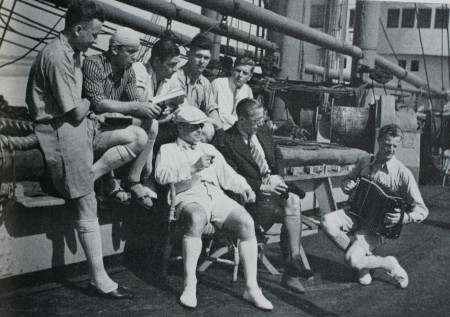
Members of the 1938 Expedition on board ship to India

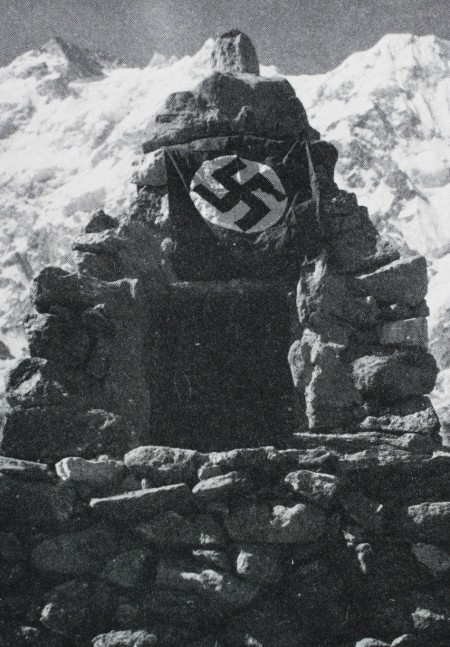
Memorial to the dead of the 1934 Expedition

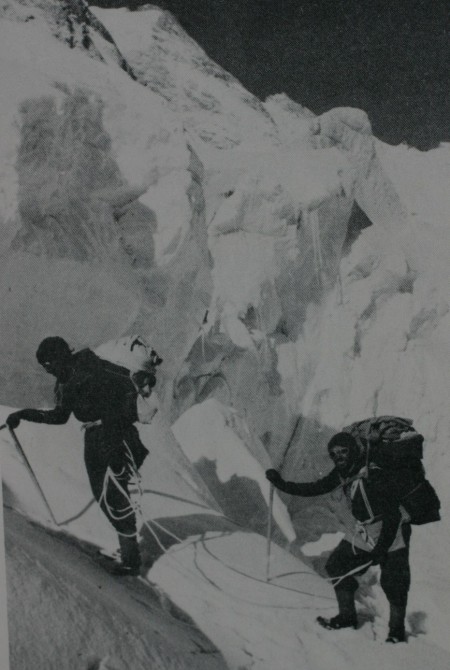
In the Rakhiot Ice Fall?

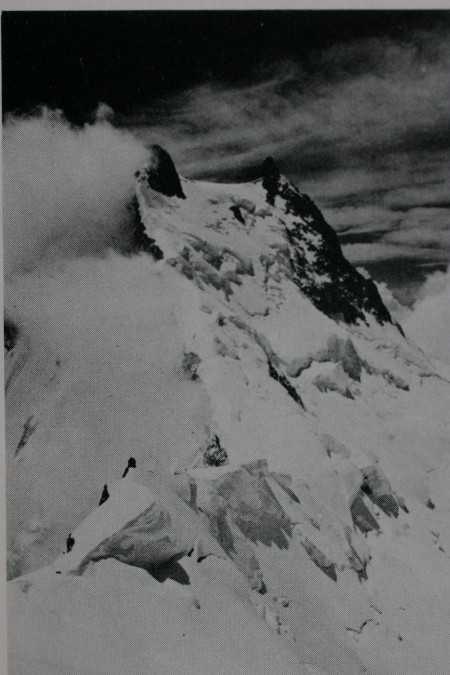
The East Arete photographed from near Rakhiot Peak. The Moor’s Head is visible on the ridge lower left. Ascent time up the ridge to the Silbersattel on skyline

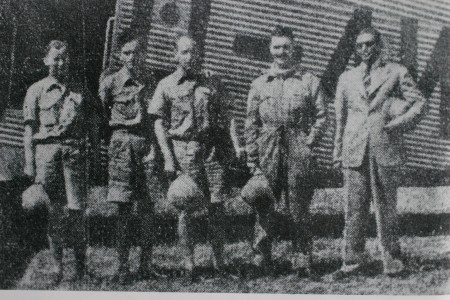
The crew of Junkers 52 Left to Right: Rudolf Mense, Otto Spengler, Alexander Thoenes, Alan Bowman, Mr Gadstar (pilot to the Maharajah of Jammu and Kashmir)

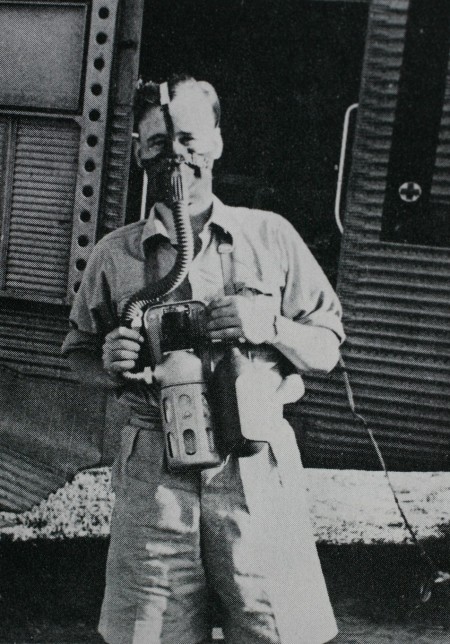
Alan Bowman with high altitude breathing apparatus


Junkers 52 at Srinagar

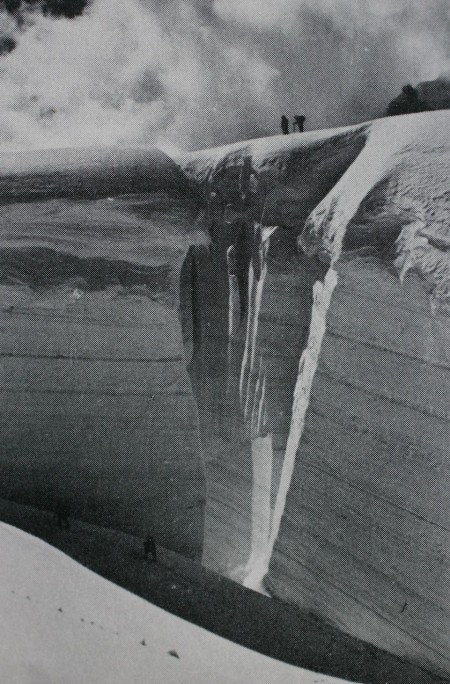
The Great Ice Barrier, one and a half kilometres long, proved to be a major obstacle between Camps 111 and 1V.

Robert McMahon is the author and co-author (with Gerry Narkowicz) of 7 books on climbing and adventure. He discovered and developed many of Tasmania’s rock climbing areas. His number of first ascents is unparalleled. He was listed by Rock magazine as one of the fifty greatest rock climbers in Australia of all time. He is the Tasmanian Times Adventure and Wilderness writer.