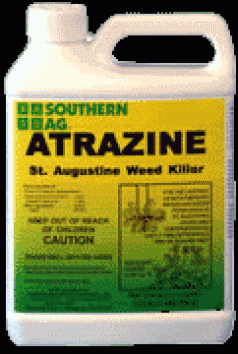
Triazines and EDCs and why they should be banned in Tasmania.
(Sent to Members of the Tasmanian House of Assembly this (Tuesday) morning.)
The Endocrine Society Statement (6/09)
clearly demonstrates the widespread adverse health effects from exposure to very low levels of endocrine disrupting chemicals (EDCs).
It states that there is no safe level of exposure to EDCs
Atrazine (and the triazines) feature in the list of known EDCs.
Quoting from the Statement:
‘The literature demonstrates a role of EDCs in the aetiology of complex diseases such as obesity, diabetes mellitus, and cardiovascular disease, yet these processes are still poorly understood. Although the evidence is limited, accumulating data are pointing to the potential role of endocrine disruptors either directly or indirectly in the pathogenesis of adipogenesis and diabetes, the major epidemics of the modern world. Taking into consideration the wide spectrum of industrial chemicals to which an average consumer might be exposed, a rational hypothesis is that the scientific community may inadvertently ignore the effect of several other compounds that might in turn constitute potential “obesogens” or promoters of glycemic disturbances.
Although more experiments are being performed to find the hows and whys, what should be done to protect humans? The key to minimizing morbidity is preventing the disorders in the first place. However, recommendations for prevention are difficult to make because exposure to one chemical at a given time rarely reflects the current exposure history or ongoing risks of humans during development or at other life stages, and we usually do not know what exposures an individual has had in utero or in other life stages. In the absence of direct information regarding cause and effect, the precautionary principle is critical to enhancing reproductive and endocrine health (49).
As endocrinologists, we suggest that The Endocrine Society actively engages in lobbying for regulation seeking to decrease human exposure to the many endocrine-disrupting agents. Scientific societies should also partner to pool their intellectual resources and to increase the ranks of experts with knowledge about EDCs who can communicate to other researchers, clinicians, community advocates, and politicians.’
Much has been learnt about the timing of an animal’s exposure to EDCs and the critical effect of this and subsequent exposures to other chemicals in the development of disease processes, be they faulty immune systems, cancer, autism, diabetes, Parkinson’s disease or allergies.
The timing of exposure in relation to the development of adverse effects in the foetus which translates into child and adult disease is being documented at present.
The role of the Endocrine Disruption Exchange is to assure the integrity of the science that supports the endocrine disruption movement
and ensure that information is made widely available to all parties including politicians.
An increasing awareness about the effects of chronic low level exposure to EDCs and discussions on how to minimise exposure to these EDCs is evident in the scientific literature. The article ‘Does the dose make the poison?’
articulates the problem with the current toxicology testing methodology with high levels of exposure, and the flawed assumptions regarding the safety of low level exposures.
How EDCs cause cancer (directly and/or indirectly) lead into theories of the origins of cancer and how best to investigate these theories, given the complexity of the problem.
The Collaborative on Health and the Environment have a large scientific database including “toxicant and disease” and the interactive site for atrazine (diseases grouped by strength of evidence) is at
Adding to the already complex regulatory problem is the issue of mixtures and how to assess this issue in the current toxicological risk assessment process which does not allow for ‘real life’ situations.
along with the reality of exposure to the ‘super-toxic cocktail’.
The broad trends in scientific findings about endocrine disruption have been stated as follows:
. Exposure is ubiquitous.
. Laboratory experiments show that exposures have impacts at levels
far lower than had been considered possible in traditional toxicology.
.
Here
Many more hormone systems, perhaps all chemically-mediated message systems, are now known to be vulnerable to endocrine disruptors.
. Here
Many more compounds are now known to be powerful endocrine disruptors.
. Human health effects of concern now include adult impacts of foetal exposure.
. Human epidemiology is biased toward false negatives in the search for health effects of endocrine disruption. It will be exceedingly difficult, if not impossible, to establish scientific certainty of causation of many health problems in humans, even though based on laboratory data it is likely that endocrine disruption is involved in a range of human diseases. Because the animal data demonstrate plausible, serious risks to human health, this bias toward false negatives (a statistical term that means finding no association when in fact there is one) requires the application of the precautionary principle, using animal data as the guide.
More recently, critical weaknesses in the system of regulation have again been articulated and now the main challenge is to design a new system of regulatory toxicology based on new testing technologies that allows for the testing not only of EDCs but also for chemicals which affect gene functioning (epigenetics). A recent paper on sourcewatch
explains the new approaches to chemical assessment and therefore regulatory reform.
However, despite the regulatory framework being unable to keep pace with the science, it is abundantly clear to all those who familiarise themselves with the relevant literature that the need to limit the exposure of the most vulnerable in our society (the about-to-be-pregnant mother and her partner, the foetus and the child, and the genetically and immunologically
susceptible) to EDCs is of the utmost importance.
(Env Health News – latest scientific papers on atrazine:
Here )
It can be argued that all chemicals that result in non-target exposure with consequent adverse health effects should be withdrawn from use. The financial, societal and economic costs outweigh the benefit from their continued use.
The need to limit exposure to the triazines cannot be overstated.
The triazines (widespread and persistent) continue to pollute Tasmania’s waterways and are not able to be used without producing water pollution, have no data to show that they are safe (and much data to show they are un-safe), and have science demonstrating the absolute need to minimise exposure to these EDCs; for these reasons the triazines must be banned now in Tasmania.
Dr Alison Bleaney OBE
Tasmania – some of the highest detected atrazine concentrations over the years.
From Anthony Amis FOE – Vic – (compilation as part of atrazine levels found in Australia).
Peter Davies studies etc have not been included despite a good proportion of very high readings of atrazine and simazine close to the coupes sprayed .
1. Tas 1989-1992 Forestry Atrazine 53000ug/L 1325xhealth value (HV)(ADWG)
2. Tas 1989-1992 Atrazine 700ug/L 17.5xHV
3. Tas1989-1992 Forestry Atrazine 58.1ug/L 1.45xHV
4. Tas 1989-1992 Big Creek Soak Atrazine 68ug/L 1.7xHV
5. Tas 1989-92 Big Creek Atrazine 22ug/L 55%adwg hv
6. Tas (6/8/93 Advocate) Lorinna Atrazine 12.6ug/L 31.5%adwg hv (Drinking Water supply)
7. Tas July 93 Lorrina* Atrazine 9.7ug/L 24.25%adwg hv (DWS)
8. Tas August 1994 Guide River Atrazine 0.1ug/L 0.25%adwg hv (DWS)
9. Tas Water Sampling Forestry Tasmania 93/03 Atrazine 41 samples over adwg 0.5ug/l
10. Tas 20/11/01 Chimney Saddle treated Atrazine 0.21ug/l 0.525%adwg hv (DWS)
11. Tas 28/9/06 Liffey Atrazine 7.42ug/l 18.55%adwg hv (DWS)
12. Tas2008 Macquarie River Ross Atrazine 1.35ug/L 3.375%adwg hv (DWS)
13. Tas March 04 (Carpenter’s Bore) Atrazine 0.72ug/L 1.8%adwg hv (DWS)
14. Tas Spring 1994 Rubicon River Atrazine 0.7ug/L 1.75%adwg hv
15. Tas 24/7/06 Jordon River Atrazine 0.14ug/L 0.35%adwg hv
16. Tas 21/7/05 Rubicon River Atrazine 0.14ug/L 0.35%adwg hv
17. Tas 27/9/06 Derwent River Atrazine 0.08ug/L 0.2%adwg hv (DWS)
18. Tas 18/1/06 Duck River Atrazine 0.06ug/L 0.15%adwg hv
19. Tas 10/10/08 Derwent River Atrazine 0.06ug/L 0.15%adwg hv (DWS)
20. Tas 18/1/07 Duck River Atrazine 0.05ug/L 0.125%adwg hv
21. Tas Groundwater Ross Atrazine 1.2 ug/L 3.1%adwg hv (DWS)
22. Tas Groundwater Ross DESA 1.31ug/L 3.3%adwg hv (DWS)
23. Tas Groundwater Port Arthur Atrazine 1.52 3.8%adwg hv(DWS)