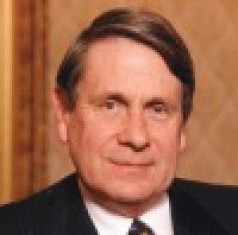
Former Lord Mayor John Freeman has been voted off the Hobart City Council. His seat has been taken by Damon Thomas in the only change, after Freeman’s preferences and a weaker than normal flow within the Greens ticket assisted Darlene Haigh to retain her seat, beating Greens #2 Corey Peterson by 115 votes.
Haigh started the cutup 248 votes behind Freeman after polling only 3% of the primary vote. However, Haigh did very well on Rob Valentine’s surplus, getting 17.2% of the Lord Mayor’s preferences compared to just 9.4% for Freeman. In 2005, Haigh had received 14.6% of Valentine’s surplus to Freeman’s 12.6%.
Haigh’s 100-vote lead after Valentine’s surplus immediately put Freeman in a more or less lost position since there was no real reason why he should gain on her based on the preferences that remained. Attention therefore turned to the battle between Haigh and Corey Peterson for the final seat.
After the exclusion of #3 Greens candidate Wendy Heatley, it was obvious that Peterson was struggling. Across the board the preferences from other Greens candidates had not flowed as strongly to Peterson as they had to Bill Harvey in 2007. In particular, in 2007 61% of Peterson’s preferences went to Bill Harvey, but in 2009 only 46% of Wendy Heatley’s went to Peterson. Furthermore, not only were Green votes not flowing strongly enough to Peterson, they were also “leaking” to Haigh, who got 15% of Heatley’s cutup. Thus, after the exclusion of Heatley, Peterson led Haigh by just 327 votes, which with the strength of expected flow from Freeman to Haigh never looked like it would be enough.
Peter Sexton had passed Zucco and Thomas on Valentine’s surplus, and moved well clear of them after getting 29% of Peter Brownscombe’s votes, far more than any other candidate. Sexton was also the leading beneficiary of Leo Foley’s votes and was elected third on Foley’s preferences.
Foley’s preferences had no real impact on the contest between Haigh and Peterson but they formally sealed the already obvious fate of Freeman, who had fallen further and further behind Haigh, and was eventually excluded by 256 votes (although I doubt he would have won on Haigh’s preferences had he been ahead of her anyway). Freeman’s preferences then flowed to Haigh over Peterson at a rate of around two to one. They also created small surpluses for Thomas and Zucco, who were not far from election after the cutup of Foley (Thomas was elected fourth 21 votes ahead of Zucco) and it was the first of these two surpluses that finally put Haigh ahead, after Freeman’s primaries and Freeman’s votes from Valentine’s surplus had closed nearly all of the gap.
In some senses, Haigh’s re-election is surprising. She was not very visible in the campaign, with relatively few signs, no print advertising that I saw, and only one media grab (and that concerning another candidate’s endorsements). I noted in my preview here that Haigh’s best hope was for “only one [outside candidate] succeeding but Freeman losing so badly that he goes out instead of her.” This is exactly how she did it, and it seems in retrospect that for all his efforts otherwise John Freeman lost his seat back in January when he announced his premature intention to not seek reelection. Further contributing factors to Freeman’s defeat included Zucco’s very strong vote as a result of his profile-building and his mayoral campaign, and Thomas’s success in gaining the endorsement of high-profile figures who are very influential within Freeman’s former support base. But this is not necessarily the end of the road for John Freeman – should any of Valentine, Sexton, Thomas, Zucco or Haigh not serve out their term, for whatever reason, he will be back on board on a recount.
So why did the Greens ticket not hold as well as in 2007? I’m not convinced that the Greens did all that much wrong, or different to 2007. My theory is that those voting for the minor Greens candidates in 2007 included some hardcore Greens supporters who, for whatever reason, preferred Peterson and/or Elizabeth Perey to lead candidates Cocker and Harvey, but kept their votes within the ticket. Those votes were very useful to Bill Harvey, as they went to him at full value. The same voters generally voted 1 for Burnet in 2009, and the minor Greens candidates were thus attracting more of a personal vote than a ticket vote for Greens supporters. Much the same thing happened when Burnet was on top of the Greens ticket in 2005; indeed, the preference flows to the #2 candidate from the minor Greens candidates that year were weaker than in 2009. Burnet polled 82% of the Green ticket vote in 2009 but Cocker polled just 70% of it in 2007. It is a little paradox of Hare-Clark that having your lead candidate do too well compared to the rest of your team can sometimes hurt you a bit because of leakage from the surplus – this is something I have seen many times in state elections.
Another problem is one I mentioned in my preview – it is more difficult for the Greens to get two up in a Valentine year because the votes of those who vote 1 Valentine then down the Greens ticket get reduced in value. A third may be that a very small number of Greens supporters perceived Peterson as more radical, compared to Harvey whose moderate voting record on council has been consistent with his sopping up of preferences in 2007. Certainly, I had to wonder if this was the case when I saw one voter had voted 1 Burnet 2 Heatley 3 Rowallan and 4 Freeman!
What impact Freeman’s defeat will have on Council meeting voting patterns remains to be revealed. New alderman Damon Thomas campaigned as a politically eclectic candidate and, while capturing many “blue” endorsements, strenuously denied that he would be in it just to serve the forces of commerce. In two years I will be able to assess where his voting record puts him in the spectrum. Perhaps a bigger impact of Freeman’s defeat (assuming he stays off Council for most or all of this term) could be the removal of Freeman’s impact on the personal dynamics of the Council. Without that impact, some aldermen may move towards more moderate positions. At the same time, Thomas clearly isn’t in it to just make up the numbers, so his influence on the new Council beyond just his voting record will be another factor to be watched.
In the washup from the 2005 elections, I observed that the voters had put veterans Freeman, Haigh and Zucco on notice and correctly predicted that one way or the other we would not see all the same faces returned in 2009. Zucco is well and truly removed from danger watch after a strong aldermanic result that shows that if he is active enough and keeping his media profile high enough (by whatever means) then he doesn’t have too much to worry about and will keep getting re-elected. Haigh’s primary vote continues to decline and she had a lot go her way in narrowly retaining her seat this time, but her very strong performance on preferences shows that she still commands a lot of community regard and therefore can’t be written off if she does have another go in 2013. Also, a candidate I saw as a direct threat to Haigh’s seat (Leo Foley) hasn’t built on his previous results enough to become a more serious challenger – indeed compared to his first tilt in this side of the field, he has gone backwards about as much as Haigh has, meaning that it will now be difficult for him to ever get elected to council except perhaps on a recount.
There are plenty of big questions about the 2009-13 term. Where will Thomas position himself and will he build greatly on an already strong support base? How will the “blues” deal with a Green being Deputy Mayor (something that, by the way, would have been avoided had Sexton run a more vigorous campaign)? How long will Rob Valentine want to go on for? One way or the other I suspect that the electoral landscape in four years time will be very different to 2005 and 2009.