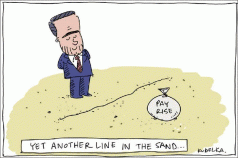
This was David Bartlett’s statement ending, or so we thought, support for the Gunns pulp mill in June last year: “The government has drawn a line in the sand regarding any future government involvement in this project.”
And in July last year: “The Tasmanian people have a right to say ‘enough is enough’ … The Tasmanian government will no longer be involved in this project.”
Little wonder, then, that Tasmanians were bemused to learn this week that Bartlett’s Treasurer Michael Aird was in Europe with Gunns chairman John Gay to help sell the $2billion mill to potential financiers.
Last week, it emerged that Bartlett had sent a letter to Gay for him to share with prospective financiers and joint venture partners in the project. Written in May, it suggests that enough is not nearly enough after all. Bartlett’s letter reads: “The Tasmanian government views the Bell Bay pulp mill project as a critical downstream processing initiative. We are fully supportive of the project proceeding. I am happy to meet with or provide further information to any interested party that may be associated with your proposed financing structure.”
So has Bartlett’s line shifted and if so why? Certainly the Premier had never said he didn’t support the mill. In fact, he has repeatedly pointed out that he voted for former premier Paul Lennon’s much despised fast-track approvals process for the mill.
And Bartlett insists there is no change to his position that there will be no further financial support for the mill. Aird’s European trip will cost $50,000, but he insists speaking to Gunns’ potential financiers is not the main reason for the journey. Aird won’t reveal the chief reason, but it is thought to be helping to secure a mining and processing plant proposed for Tasmania’s northwest coast, potentially employing hundreds.
Even so, the implicit admission that meeting Gunns’ financiers, thought to include Nordea Bank, is part of the reason for the trip logically means that part of the cost can be attributed to it. However small, this is a breach of the Premier’s pledge.
More significantly, there has undoubtedly been a 180-degree change in rhetoric on the project, matching recent glowing references for the mill from federal ministers.
Until recently the Premier’s line was that the Labor government had done enough to advance the project. Time and again, he insisted the project was entirely in Gunns’ hands and would live or die solely on whether the company could raise finance.
Apparently, flying halfway across the world to join the company chairman in reassuring bankers is not involvement with the project.
So what’s changed? For a start, manufacturing is shedding jobs, with more expected, including potentially 500 at existing pulp and paper mills in northwest Tasmania. Bartlett does not want to alienate the forestry union and timber lobby, which have shown they can mobilise with devastating political consequences (just ask Mark Latham).
More to the point, Bartlett does not want to lose traditional blue-collar Labor voters and others who, even if they don’t support the mill, may look at the job losses in manufacturing and conclude it is a necessary evil.
Labor is also keen to create a narrative at the March election that says it is the pro-jobs party, while the Greens are anti-jobs. If the project does finally die, after five long years of division and dirty deeds, the Premier clearly does not want to be blamed for tipping it over the edge by withholding a show of support.
Having backed the project and voted for its fast-track, there is an argument Bartlett could hardly turn around and refuse a Gunns request to at least explain his government’s position to financiers.
However, the cost of being seen to back-flip right back into bed with Gunns will be high.
The fast-track of the mill to sidestep a planning authority that had found the project to be critically non-compliant was rightly seen by most Tasmanians as a corruption of proper process. Many will never support the Gunns mill because of this alone, leaving aside legitimate concerns about air and water pollution in the Bass Strait and the Tamar Valley. Bartlett’s squiggle in the sand may have washed away, but he continues to walk a fine line politically.
Kudelka in Mercury: Here
Earlier: Airdy spruiks trip