Robert Vincent RAIA ICOMOS Cultural Heritage Consultant.
To bring us forward to the beginning of colonial history, Knopwood’s grant is comparable to the first Government House site in Sydney. But are we treating the values and place with the same respect? HCC auctioned the Montpelier Retreat block in 2005, for 3.5 million dollars. They did not do so in ignorance of the heritage value of the location. After the Bicentenary, several written histories were commissioned. Amy Rowntree, R.J. Solomon, and Scripps and Hudspeth all wrote of the area. At the time of the auction, there was public outcry about its impact on the historical and heritage values. HCC responded by including a condition of Sale: ‘that purchasers should undertake their own due diligence’ and so wiped their own hands of their statutory responsibility for due diligence. The current developer, Sultan Holdings, dealt with their due diligence issues by engaging a Sydney Heritage Consultant, who reported that, despite the obvious importance of the site, he established criteria for the Design without having the knowledge that could be revealed by the Archaeology. He also fails to take account of Knopwood’s larger Grant.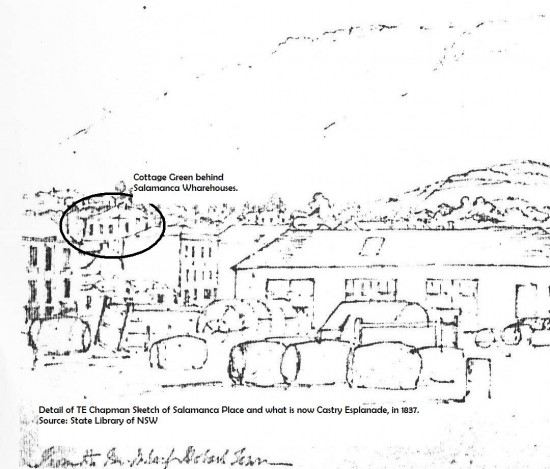
LIKE Sullivan’s Cove and Salamanca Place, Montpelier Retreat is a vital part of our history. This history did not end with the passing of the 19th century. Living memories still link us to our past, back through the history of two world wars and generations of the families that lived near the docks and supplied their labour.
What tales will we have to tell our children and grandchildren?
Just now, we risk civic amnesia. We even struggle to find the library shelves where our stories might be found.
The map of Sullivan’s Cove and its surrounds portrays vital chapters of our living history. It is held right now in the hands of developers, the HCC and the State Government. How do they balance concerns about the past, present and future?
Montpelier Retreat and the dockworkers
Amanda Lohrey has written vivid and detailed accounts of growing up in Montpelier Retreat. She brings back to life the close-knit working class community whose land and lives revolved around the Port, getting work where when they could, going further away when seasonal work might be better.
The Montpelier Retreat homes were identified by the HCC’s Cook Plan of 1946 as ‘old and decadent’ (slum housing) and so they were earmarked for destruction.
The HCC displaced these families by acquiring properties in Montpelier Retreat in the 1950s, for car parking. The impact of the displacement of these people was a key reason for the Review of the Battery Point Planning Scheme from 1972-79.
This history helps explain why we have Battery Point as it is today. There were proposals by the HCC in 1950s to widen a number of roads in Battery Point by demolishing one of the street frontages. These proposals were queried, and finally altered, as a result the effects of wholesale demolition of Montpelier Retreat.
Other issues date back further
The Reverend Robert Knopwood was granted the land for his home, Cottage Green, in 1805. He built on the ridge between Gladstone Street and Montpelier Retreat. He cultivated an extensive garden adjacent to St David’s Burial Ground and the original Church. Some of the original garden wall can still be seen on the edge of the currently proposed development, and there are other visible remains as well.
The most famous group of buildings remaining on the Grant are the Salamanca Warehouses.
In 1805, Knopwood wrote in his diary of an Aboriginal woman and her child camping at the bottom of his garden. Thus begins the chronicle of a much longer tale of displacement. Concerns about sites of cultural significance are yet to be resolved. A location adjacent to the Wursthaus is of critical importance in terms of recognition of the traditional owners and the reconciliation issue. Unfinished business remains, concerning on this and other sites in Sullivans Cove, and along the shores of the Derwent.
To bring us forward to the beginning of colonial history, Knopwood’s grant is comparable to the first Government House site in Sydney. But are we treating the values and place with the same respect?
HCC auctioned the Montpelier Retreat block in 2005, for 3.5 million dollars
They did not do so in ignorance of the heritage value of the location. After the Bicentenary, several written histories were commissioned. Amy Rowntree, R.J. Solomon, and Scripps and Hudspeth all wrote of the area. At the time of the auction, there was public outcry about its impact on the historical and heritage values.
HCC responded by including a condition of Sale:
‘that purchasers should undertake their own due diligence’ and so wiped their own hands of their statutory responsibility for due diligence.
The current developer, Sultan Holdings, dealt with their due diligence issues by engaging a Sydney Heritage Consultant, who reported that, despite the obvious importance of the site, he established criteria for the Design without having the knowledge that could be revealed by the Archaeology. He also fails to take account of Knopwood’s larger Grant.
The entirely predictable consequence of this approach is that the development is being taken to the RMPAT, for appeal.
Plainly, there is a popular understanding in Hobart that some places are documents in their own right, and need to be read and understood and preserved. The history of Montpelier Place needs to be integrated into a growing culture rather than buried under new concrete and glass.
Currently, development of Montpelier Place is slated to proceed while we are applying for its World Heritage listing for other convict heritage places. Clearly Hobart is a crucial colonial and convict origins as the centre of trade and early commercial activity and government.
Cottage Green has been listed on the Tasmanian Heritage Register as a result of my nomination, and data and references that were provided prior to the Auction.
The dispute we see here arises from casual disregard in a number of quarters, for our history and the cultural fabric woven from it.
Such issues as the current Montpelier Place development go time and again to RMPAT for resolution, when the answers lie in a process faithful the to the history and culture of the place in question.
Montpelier Retreat: A recent history:
The HCC put the site up for Auction through L J Hooker on the 6th October 2005.
The initial condition of sale had no references to any historical aspects or archaeological investigation.
The work on history of the area was done back in 1993 as part of a Review of Battery Point’s Heritage.
In 2002-3 the Sullivans Cove Waterfront Authority had undertaken a study to identify potential archaeologically sensitive places.
Sultan Developments in conjunction with the HCC proposed a new car park development Argyle St. To gain access to this car park entrances is via the existing Argyle St car park. The development was given generous concessions (discretions) outside of the Planning Scheme provisions.
The Myer’s fire presumably means this development is currently on hold though it has approval to proceed.