Neil Smith
Leunig’s example ( Do not forgive … ) was not the blackened clearfell but the jet airliner flying above the (non-flying) caged bird. What neater indictment of the mainstream attitude that says it’s OK to take over the skies for the momentary pleasures of a few, whilst simultaneously keeping the traditional owners of the air downtrodden – or even on captive display, again just for our casual pleasure. By extension, what applies to the sky applies to the rest of the biosphere.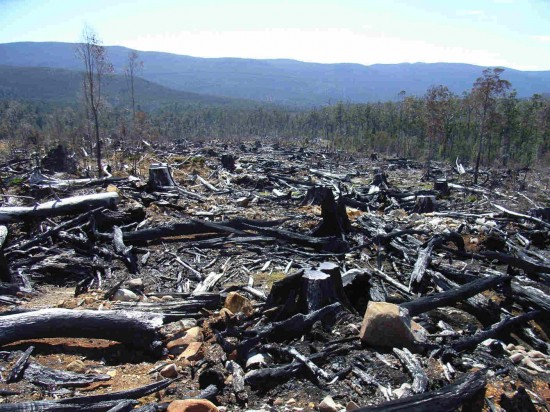
But to the matter of the blackened coupe. If a critic wants to be ridiculously pedantic and reductionalist, it is true that the perpetrators of this sort of thing don’t know “precisely” how many individuals of a given species were on site at the time of felling and burning, and they don’t know “precisely” the effect on the probability that such species might become extinct in the next 50 years. Nor do they know “precisely” how many of grams of carbon dioxide were released into the atmosphere during the burn, or how many further grams will be released when the the non-durable products of the clearing (the vast majority) shortly degrade.
That is not the point. In their more reflective thumb-twiddling moments when the day-to-day demands of running their grubby empires recede a little further back in their brains, they are perfectly (“precisely” – a good poetic emphasising word) aware of the body of well-tested scientific opinion which says the effects are anything but good, and are getting worse.
On wildlife, one quick example from long ago (RFA Background Report Part C, volume III (1996) – Dusky antechinus (Antichinus swainsonii).
Fire: Population may be obliterated, even by fire of low intensity – ranking 3 (Suckling and Macfarlane 1985, Statham 1984). Regimes: A clearfell and regeneration burn excludes the species from the site, still absent 15 years after the disturbance – ranking 3 (Green 1977).
Ranking 3 means “process is a major threat, which if not checked poses a significant risk to the viability of the species in Tasmania”.
And the wild ideas of those who would deny climate change are (or, rather, should be – off the planet). We have the report of over 2000 scientists who point us to a number of easily-understood positive feedback effects which are going to bite in a few years, or at most, a few decades. The melting of the northern hemisphere tundra (already well underway after just a small rise in global temperatures) will release enormous amounts of methane, the most powerful greenhouse gas. A tiny increase in ocean surface temperature releases CO2 simply because it is less soluble at higher temperatures. The part of the ocean cool enough to sustain CO2-absorbing phytoplankton will shrink further towards the poles, a vast reduction in area. Hitherto unheard-of summer meltwater in Greenland is now crashing down crevasses and lubricating the ice/rock contact, accelerating the sliding of the icecap into the sea. Etcetera.
It is of course true that some of the carbon dioxide released in clearfell-and-burn will be reabsorbed by any regrowth on the site. If it were the right sort of regrowth (i.e. the original species mix) it might ALL be reabsorbed. But this will take not decades, but hundreds of years. If the “regrowth” is a plantation of Eucalyptus nitens, it won’t ever be reabsorbed. Those trees just don’t get that massive.
And when logged on the next rotation, any slight offset will all be undone.
We don’t have hundreds of years. We don’t even have decades. We have maybe a few years, and right from day 1 (today) we need to be seriously creative in tackling the CO2 menace. Even planting trees on cleared land now isn’t fast enough to solve anything, despite being a nice thing to do as added insurance in the far future (if you are an optimist). And provided you don’t intend to cut them down. But any action which involves tearing down and replacing existing trees is just ridiculous.
If we are going to have any chance whatever of stopping those feedbacks coming into play, we need to greatly cut back on our power station and transport CO2 emissions – which at least have the redeeming feature of providing useful energy and mobility to large numbers of people. What we most definitely DO NOT need on top of all this is the deliberate and irresponsible release of thousands of tonnes of CO2 every autumn, a process which will bring the judgement day that much closer. And neither can we afford to put up with the instant removal of the CO2-absorbing photosynthesis factory which is each coupe. Whilst in the short term benefiting no one but Gunns’ shareholders and those of the companies which buy their chips or their pulp.
But the poets and cartoonists put it much better.
Dr Neil I Smith
South Hobart