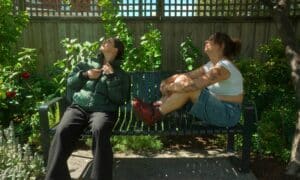
Jo Flanagan
But the image of the Weld Angel is also disturbing. In the Biblical tradition, angels are messengers, often warning of looming disaster. Observing the political and social developments in pre-World War Two Germany, the Jewish intellectual Walter Benjamin described the Angel of History thus:
“His face is turned toward the past. Where we perceive a chain of events, he sees one single catastrophe which keeps piling wreckage upon wreckage and hurls it in front of his feet. The angel would like to stay, awaken the dead, and make whole what has been smashed. But a storm is blowing from Paradise; it has got caught in his wings with such violence that the angel can no longer close them. This storm irresistibly propels him into the future to which his back is turned, while the pile of debris before him grows skyward. This storm is what we call progress.”
Lindsay Tuffin
Americans declare the Pursuit of Happiness to be a primary aim of human existence.
What rubbish!
Joy is far more authentic …
And that’s the state of being charged by reading Pete Hay’s words:
The wind weighs its touch
to the mauve-edged scimitar
of its taken shape.
The curve of this leaf is a
wind-formed, windform child of breath.At one with the clouds, the wind.
The great swirl of the elements.
It is a plane of vantage not only
enjoyed by the eye …
This is joy … but The Forests is primarily about the obverse … as the wonderful Jo Flanagan will tell you. Jo is Manager of the Social Action and Research Centre, Anglicare. She is a hero. She spends her life for the poor and dispossessed.
Jo …
I AM SO proud to be asked to speak here today; proud to be associated in any way with Matt and Pete’s work. I want to try to find the words to describe this book but it’s a hard job and I am at a loss because it is a wild lament of a book.
The story it tells is the story of the forests. Its words and images take us from the protests on the streets of the cities of Tasmania into the forestry exclusion zones, where people and media are no longer allowed. The book exposes events of the last four years and it shows us a war zone – ‘forests torn down and remembered only in dreams’, wounds running through rainforest, an ancient tree fern standing alone on smoking, razed land. It bears witness to the destruction and (to use an old word for a howl of mourning) it is a keen, for Tasmania and for us.
Matt describes his work as documentary photography but I would humbly suggest that these images are transcendent and have moved across that nether world between documentary photography and art. Matt’s photograph of the Weld Angel has become as important to us as Peter Dombrovskis’ photo of Rock Island Bend, the photograph attributed with saving the Franklin River. Like Rock Island Bend it is a symbol of so much more than a campaign – these are images we can look on to try to understand wonder and love and spirit. They are iconic and Matt has quite rightly been nominated for Australian journalism’s most prestigious award, the Walkley Award for Excellence, for this and other photographs from this book.
But the image of the Weld Angel is also disturbing. In the Biblical tradition, angels are messengers, often warning of looming disaster. Observing the political and social developments in pre-World War Two Germany, the Jewish intellectual Walter Benjamin described the Angel of History thus:
“His face is turned toward the past. Where we perceive a chain of events, he sees one single catastrophe which keeps piling wreckage upon wreckage and hurls it in front of his feet. The angel would like to stay, awaken the dead, and make whole what has been smashed. But a storm is blowing from Paradise; it has got caught in his wings with such violence that the angel can no longer close them. This storm irresistibly propels him into the future to which his back is turned, while the pile of debris before him grows skyward. This storm is what we call progress.”
Let us hope the Weld Angel is not a messenger of more wreckage or of more loss because we’ve had so many losses. We’ve lost hallowed places and at times we’ve lost each other – men greedy for money have manipulated us, exploited our poverty and our fear of unemployment and pulled our communities and our families apart.
But the hope in this book is wonderful and it centres on the activists. Matt’s portraits of the forest activists are direct and forceful, but so tender. I would ask you to look at the beautiful youth of them, with their earnestness and their mad hair. Look at the pictures of the young girls in handcuffs sitting quietly, being arrested by large-bodied police officers. You can’t help but wonder, were the girls’ legs trembling? Were their hands shaking? Because working on campaigns can bring an exhilarating sense of autonomy and community but it also takes courage. It takes physical courage and it takes moral courage. In a Tasmania where disagreement about forestry policy equals treason, where you risk your pitifully small savings, your employment and your good name, it takes great courage. In a Tasmania where the media is denied access, the conflict is reduced to basics. These young Tasmanians are doing the last thing that can be done, they are placing their bodies between the machinery and the forests in a place where no-one is watching. This is courage indeed.
Now look at Matt’s photographs of the police officers raiding the activists’ camps. These men look like what they are, our uncles and our neighbours and our friends – Tasmanians being sent to do the company’s dirty work.
And look at the faces of the forestry workers and read Pete’s words: ‘Set a Tasmanian against a Tasmanian. Construct fear and loathing where none need be. Win yourself an election.’ These words read like the whisper of a malignant advisor into the ear of a weak, powerful man. Pete’s power as a poet has expressed the bitterness of our betrayal. He has given me words where I had none.
In the world in which I work – that of community service organisations working with marginalised people – we face a rising tide of poverty and dispossession, desperate people with no options and public services bled white. I am grateful for the reminder this book gave me, of the power we have to assert ourselves, to ‘insist upon good and right behaviour’, to be ‘free to pitch with good cheer for the last and best chance’. Because environmental justice is also about social justice and here, now, in Tasmania, it is about a protest for our right to a democracy. It is about our right to an uncompromised Parliament, our right to an independent regulatory framework to business development, our right to engage in civil society without being sent a bill for the wear and tear on the policeman’s truncheon. This book reminds us that we have a democratic right to protest and a moral duty to do so.
Thank you Matt and Pete for creating something so moving. Thank you Julia Dineen who did the beautiful design work of this book out of love. The book you three have created is the story of this time.
This book is a work of art, it is a poem; it keens for the lost, and it bears witness to the storm blowing in from Paradise. It is inspired by grief and by anger and by love. It burns from within and I know it will light another phase of the fight as we step forward into the unknown.
Thank you.