Paul Sandery Press Release
STUDIES carried out for Gunns are not entirely adequate to predict the potential long-term impacts on the Tamar Estuary and Bass Strait of the proposed pulp mill, according to an oceanographer at Flinders University.
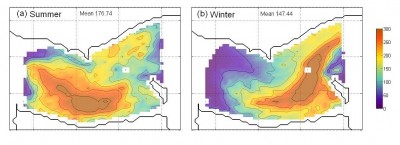
Paul Sandery is an oceanographer carrying out post-graduate studies at the Department of Chemistry, Physics and Earth Sciences at Flinders University. He is an expert in the modelling of large-scale water movements in Bass Strait and has published studies that relate to the nature of the flushing of its waters. A recently submitted study shows the flushing also has significant seasonal variation.
Mr Sandery says in a report released today that Gunns’ Integrated Impact Statement (IIS) does not resolve uncertainty about the pulp mill’s long-term environmental impacts on the marine environment with respect to:
1. Accumulation of pollutants, particularly dioxins and furans, in sediments and the food chain in the Tamar Estuary and Bass Strait;
2. Potential long-term impacts on fisheries and marine eco-systems in Bass Strait, and estuarine nurseries in the Tamar estuary.
He says that the IIS has not taken into account the complex nature of the circulation of the waters of Bass Strait. The area in which Gunns proposes to introduce pollution is relatively stagnant. He has called for longer-term studies and more accurate simulations of the discharge to be carried out.
In addition, he says that the studies carried out by Gunns’ in relation to the proposal to build a huge new wharf at the pulp-mill site, show that the development will significantly slow down the flow at the site in the Tamar estuary and create a stagnation area.
Mr Sandery says that a recently published study shows that some parts of the waters of Bass Strait have relatively long flushing times. He displayed charts that show the area where the outfall is proposed has a mean flushing timescale of around six months.
“A serious concern is not really knowing what the levels of pollutants and contaminants will be in Bass Strait over the lifetime of the pulp mill” Mr Sandery said.
“The flushing of Bass Strait as a whole is not accounted for in Gunns’ IIS. Recent studies suggest the flushing is seasonal, and that some of the water not flushed out during winter remains through the summer. Therefore pollutants can remain in the system for longer periods than expected.”
Highly toxic
Mr Sandery says that the IIS’s finding that highly toxic organochlorines will potentially exceed water-quality objectives for 5% of the time, in the vicinity of the outfall, is a concern because this means that over a period of around 30 years there will be around 550 days where water quality objectives will be exceeded.
Mr Sandery is concerned about the following issues and unanswered questions in the modeling studies which relate to water movements in Bass Strait and the Tamar estuary:
1. Simplistic assumptions have been made about the mixing of pollutants in the receiving waters of Bass Strait and sensitivity studies of mixing in the model have not been presented;
2. It is not clear from the studies that adequate dilution of pollutants will be achieved over longer periods in the ‘low flushing’ part of Bass Strait;
3. The studies in the IIS do not appropriately use the available scientific literature regarding the circulation of water.
4. The use of a depth-averaged model for the larger region of the Strait is not applicable for around half of the year when stratification occurs.
5. There are claims about mixing of the waters in Bass Strait that have been drawn from a small set of observations.
6. Further studies involving modelling the flushing of the Tamar Estuary is required.
7. Emphasis should be placed on studying long-term exposure of marine ecosystems to pollutants and contaminants, rather than short-term.