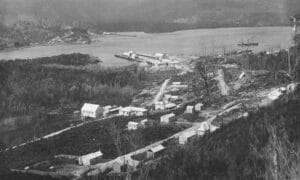
ONE of the least known and seldom visited wilderness areas of the state is Southern Tasmania’s Weld River Valley.
Up unto recently, there were no roads into this isolated and unpopulated region apart from a few logging roads entering from the Huon Valley via Judbury and Lonnavale. There was little intrusion west of the Huon River until recently constructed logging roads rudely intruded into this precious, untouched region.
Last year I was shocked to discover incursion had occurred from the Mueller Road to the west adjoining the already desecrated Florentine Valley and its heir apparent, the Styx. A hard slog that had previously taken several days to accomplish through dense bush and thick under-story was now possible in a matter of minutes by motor vehicle.
Similarly, from the other side of the Weld, bulldozers have ploughed through roads into this precious and irreplaceable piece of our natural heritage ready for the clearfell madness they call progress.
Why is the Weld River Valley so special? I asked well known veteran bushman the late Deny King that question many years ago, and his answer filled me with curiosity and wonderment for an area that I then knew very little about.
Deny was a legend in his own time, a true blue gentleman who was passionate about the natural history of our island. His wisdom and appreciation of the bush was second to none, and in his own, quiet back-county drawl, he held me spellbound for some time as he shared his tales of the mysterious Weld Valley.
He told me of his early life in the Huon Valley, and especially of the family property, Sunset Ranch near Lonnavale. He spoke of the big bushfires that ravaged southern Tasmania in 1934, and the effect those fires had on his small community. He told of the explorations carried out by he and his father Charles, into the largely unknown backblocks of the Weld River Valley.
Deny revealed his father’s hopes of finding gold in the Weld and of his secret forays into the hinterland, much to the curiosity of the locals. Charles King’s success was invariably gauged by his payment with gold for the family’s grocery bill at the local store. It was in fact his father’s lust for gold that first drew the pair to the wilds of Port Davey in 1930 and eventually into the tin mining business for which they were later to become so well known.
Very limits of endurance
Deny loved exploring, and the Weld was his classroom with much of his bush prowess and skills learned there. To him it was a vast untouched wilderness that begged exploring. He expressed his distaste of snaring, a sore point between him and his father, much as it had been between my father and I, for Deny like myself, would rather sit and quietly observe the forest animals and birds than catch them in cruel traps and snares.
Beyond his boyhood intrusions into the lower reaches of the Weld, his hunger to investigate its beauties and dangers were at last to come to fruition. He and his father entered the region at the request of the Huonville Council in 1927 to seek out an alternate route to the old South Gordon Track. In doing so they would attempt to open up the way from the Huon through to the recently discovered osmiridium diggings along the Adams River to the north-west.
It was a daunting task and one that Charles King had deep reservations about. They plunged into the vast unknown on a harrowing journey that was to tax both men to the very limits of their endurance. Deny was then only 17 and his father 50, and should they come to grief, there would be no help or assistance forthcoming. They were completely on their own in that wild and untamed wilderness of the Weld.
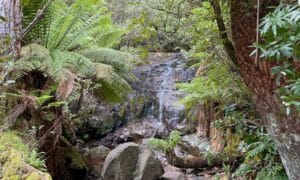
Deny told me of dense stands of the dreaded horizontal, of deep and dangerous sinkholes with swift torrents of water pouring into their unseen depths, of vast river caves, of splendid waterfalls racing off the escarpment after rain and of huge cliffs adjoining the Weld River’s erratic course.
He spoke of their locating a thylacine nest in a shallow crevice amongst the rocks, and of their suspicions that the nest had only recently been occupied by a mother tiger and her brood. This was an animal that frequented the Weld in reasonable numbers at the time, and Deny confided that they may still have been there, as up to that time, much of the region remained untouched by logging and like disturbances.
As they traversed the western side of the Jubilee Range as it sweeps down to join the Weld River, the inherent danger was obvious as one wrong move could have spelt disaster. They had a one chain tape and a compass to keep them on course, and within that short distance, they would often lose sight of each other, so dense was the undergrowth.
On another expedition into the Weld, Deny spoke of giant landslips with whole hillsides swept clean of trees, the aftermath of many thousands of tons of earth and rock crashing to the river far below. He described it as being like another world back in there, and both men felt honoured at the privilege of laying eyes on this vast untouched, pristine wilderness, that few had ever seen before. Little did he realise he was whetting my appetite for the Weld, so much so that I could hardly wait to get in there.
First humans to pass through
No doubt there have been many who have walked into the Weld in recent years, and many of them would have felt that they were the first humans to pass through certain areas, so utterly pristine is the landscape. It is a breathtaking experience; the natural history is superlative; the mesmerising marsupial lawn and moss patches, the brilliant diversity of flora and fauna, the pure mountain water, an air tinged with a glorious array of scents and fragrances — this is a special place of beauty and reverence, the likes of which are fast disappearing in our island state.
It is reputed that there was a notice tacked to a tree on the South Gordon Track still readable in 1939 that said “Huon via Weld” but by then the Kings’ track had long disappeared under the fast encroaching bush. Various tracks had previously been cut into the area by early surveyors and explorers by way of Mt Anne, but none had previously sprung from Lonnavale and traversed a route through to the South Gordon Track.
My early forays into the valley were cautious and restrictive, for there were few worn trails or walking tracks to follow. My reasons were obvious to anyone who knew me. For me it was like discovering a new country, an uninhabited land that was utterly fascinating every step of the way.
At first I entered from various sections along the Mueller Road between the Styx Valley and the Scott’s Peak Road and the old Port Davey Track. In doing so I discovered many previously lost sections of the early trail, first blazed by Marsden in 1898. Much has now returned to bush, with large sections badly overgrown with horizontal.
I sat alongside the remains of the old “Damper Inn” an historic hut first constructed by Marsden’s party and in later years refurbished to provide shelter for walkers traversing the track. Sadly, it is now derelict and on the ground, the roof having caved in and taken the rotting walls with it.
As I sat in the quiet and serenity of the surrounding myrtle forest, I reminisced, thinking back to the old days when this was the only track into the south-west; when walkers on their way to the majestic Lake Pedder would spend the night safe from the elements within its humble slab walls. And of the couple I once interviewed who spent the first night of their bushwalking honeymoon there. They assured me it was a night to remember. If only those walls could talk!
And of that well organised tiger hunting party who back in the late 1950s set up their base camp in the hut as they scoured the surrounding countryside for their elusive quarry following several sightings in the area.
Perhaps my most productive time was east of Mt Bowes when I left the old track and blazed my way through to the Weld River as it makes its way towards the Huon. Tracing its journey past the Snake River as it winds its path past the Jubilee Range, I got some idea of what Denny King was talking about. Here the scenery was magnificent and untouched, in much its primeval glory. It would surely have been a massive undertaking for them to have trekked through the area from Lonnavale back in 1927.
I found evidence of tigers
Although I refuse to say whether I actually saw a thylacine, I certainly found evidence that they were traversing the area, for there are suitable hunting grounds and an ample food supply along the valley. Denny had advised me where to centre my search, and he wasn’t far wrong. I have little doubt the tiger, in its wide-ranging transient ramblings moves through these vast wilderness areas still.
Of course I expect many to scoff and snigger at my claim, but what would they know. To believe the animal still exists, it is imperative that one ventures into these areas and to see for oneself. For to see first hand the nature of this wilderness, is to believe implicitly that the thylacine could still survive.
I don’t mean to fly over it in a helicopter and pass a judgement based on that alone. Or to sit in one’s ivory tower in the city and with a wave of the hand over a map declare it impossible for the animal to still exist. Or to read a book or two on the subject and be led astray by what others may have foolishly declared. To do that is sheer ignorance.
It would appear that the future of the Weld River Valley, like so many other tracts of pure wilderness in Tasmania, is caught up in that much maligned culture of ‘if it grows, chop it down’ expediency, and it seems nothing we can do or say will change the Tasmanian Government’s attitude. The inherent danger lies in the fact that both major parties share much the same agenda on this pivotal issue.
The State Government’s on-going crusade to appease the pro-logging fraternity is winning it few friends. Meanwhile, the multi-national barons are having a field day at the expense of a most precious legacy that we can never, ever hope to replace.
While we are forced to stand and watch as our natural heritage leaves our shores on ships bound for Asia, the leading protagonists of this rape and burn culture assure us that it is all for the good of our state. The on-going profits they tell us far outweigh the loss of a few scrappy bits of bush — perhaps in the same category as that ‘leach-ridden ditch’, the tag a previous Tasmanian Premier used to denigrate the majestic and now much exalted Gordon River.
Or maybe it is scarcely different to that insignificant little lake that lay, as its critics claimed, sandwiched between a toilet paper ridden stretch of low sand hills deep in the south west — and a now belatedly flaunted as one of World Heritage proportions. Such an ecological tragedy, many declared would never be allowed to happen again — but it has happened and will continue to happen infinitum unless the powers that be see logic in preserving our precious natural heritage.
Not true, you may be heard to say —‘ the Weld River Valley is nowhere in the same category as the fore-mentioned gems.’
Well to you I say, get out of your place of convenience, don some walking boots and a pack, and get in there and see for yourself what I am talking about, and I am sure you will soon change your mind.
But you had better do it fast for tomorrow may be too late, because the ‘beavers’ are already in there chipping away at it!
Col Bailey is an author and thylacine researcher.
Earlier: Tiger photos – the real story
.