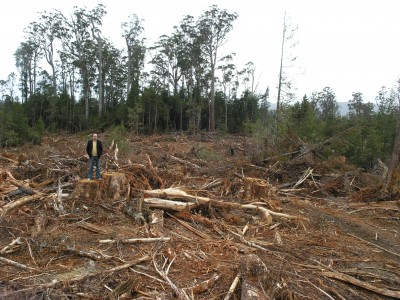
British MP Norman Baker in a Styx, aggregated retention clearfell
HEADLINES and commentators keep saying it. The state government is promoting it. The federal government supports it.
‘The phase-out of clearfelling.’
Observers could be forgiven for believing that vistas of stumps, flattened vegetation and clouds of smoke will soon be a thing of the past.
But, like so much promised by the state and federal governments on the forest-conservation front, it’s a sham. 95% of clearfelling and burning will continue unabated. In 5% of cases, clearfelling will be modified so that clumps of intact trees are left standing amongst the blackened stumps.
That 5% — the so-called ‘aggregated retention’ logging — will occur in areas that should never be logged at all. The forest immediately adjacent to Timbs Track in the Upper Florentine, for example, will be subjected to the clearfell-with-clumps treatment. This is an area with documented World Heritage values, an area that the Prime Minister himself promised to protect. Instead, taxpayers’ funds are being used to drive new logging roads into these pristine forests and more taxpayers’ funds used to subject the forest to modified clearfelling. The same thing has already occurred in the Styx.
So how is it that both governments can justify bankrolling such blatant destruction of oldgrowth forests?
The fact is that the governments’ promise to phase out clearfelling has been rendered meaningless by devious use of statistics, definitions and spin.
The stated commitment is to reduce clearfelling to 20% of the total area of oldgrowth forest logged on public land by 2010. However, Forestry Tasmania’s definition of ‘oldgrowth’ is so narrow, and its definition of ‘regrowth’ is so broad, that few forests will qualify for the reduction in clearfelling. The attached Table demonstrates this.
Effect of Forestry Tasmania’s definitions on Government’s clearfell policy

Sources: Averages from figures in Forest Practices Board Annual Reports from 1999-2000 to 2004-2005
* Oldgrowth figures are taken from Forestry Tasmania’s Sustainable Forest Management Report 2003-04.
These are the latest oldgrowth logging figures available. The figures said that in 2003-04, 2820 ha of oldgrowth forest on public land were logged of which 1300 ha were clearfelled. If clearfelling is ‘reduced’ to 20% of 2800 ha, then 560 ha will still be clearfelled according to Forestry Tasmania’s definition, while another 740 ha of clearfells will have clumps left.
Basically, on private land, the clearfell-phase-out policy will not apply. It will be business as usual. Clearfelling and burning in large areas will go on.
On public land, in forests not mapped as oldgrowth by Forestry Tasmania, the clearfell-phase-out policy will not apply. It will be business as usual. Clearfelling and burning in large areas will go on.
Yet the vast majority of these forests contain trees that are old. Recent Three Year Plans produced by Forestry Tasmania show that more than 60% of woodchip logs come from old trees. They come from forests that have been selectively logged 20-40 years ago. Or they come from forests subjected to natural wildfires up to 100 years ago. Some of these forests may never have seen an axe. They contain big old trees. But because they also contain younger trees, they have been mapped as ‘regrowth’ or ‘other’. And they can be clearfelled.
No change in strategy
And then there are the forests that Forestry Tasmania has mapped as ‘oldgrowth’. 20% of such forests scheduled for logging can still be clearfelled under the ‘phase-out’ policy. Many of these are forests that occur on steep slopes. They can be logged only by using cable-logging, a technique that usually necessitates clearfelling. So the assault on Tasmania’s character as an island of forested mountains will go on.
The other 80% of mapped oldgrowth scheduled for logging will be subjected to various forms of ‘selective logging’. These include the soothingly-named ‘shelterwood harvesting’, in which about two thirds of the trees are cut down. The remainder will be felled in the future. This has been the dominant form of logging in higher-altitude forests for nearly two decades, anyway. The clearfell-phase-out policy will therefore bring about no change in the management of these forests. The penetration of new logging roads into high-altitude pristine forests on Ben Lomond, in the North-East Highlands and in the Great Western Tiers will continue.
And then there is the already-mentioned ‘aggregated retention’. Forestry Tasmania has adopted a definition of ‘clearfelling’ that is so narrow that this form of logging — clearfelling leaving small clumps — is defined as ‘selective harvesting’. These isolated clumps are said by Forestry Tasmania to help protect the forest’s biodiversity. However, the clumps will suffer damage from burns, wind, disease and drying out. There are already cases where retained clumps have been incinerated by ‘low-intensity’ burns that went badly wrong.
The truth is that the retained vegetation in the areas subjected to ‘alternatives to clearfelling’ will serve almost no ecological function.
In other words, the Tasmanian and Australian Governments are spending millions of taxpayers’ dollars to replace one form of clearfelling with another. The policy will generate no appreciable change to the appalling treatment of the vast majority of Tasmania’s native forests.
Geoff Law
Tasmanian Campaign Coordinator
The Wilderness Society
Earlier, Pulp mill fury: in Argentina