Article
On the ground in Dili (3)

TUESDAY 30 MAY, 5pm. Yesterday was a ‘down’ day for me here in Dili.


It started with some optimism and slid into more feelings of hopelessness. But at least the meeting of the Council of State began — in the President’s ‘Palace of Ashes’ right opposite where I sit.
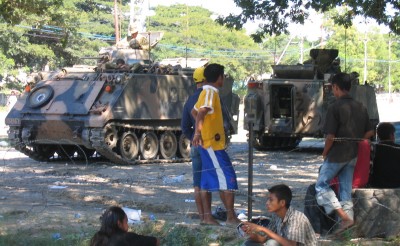
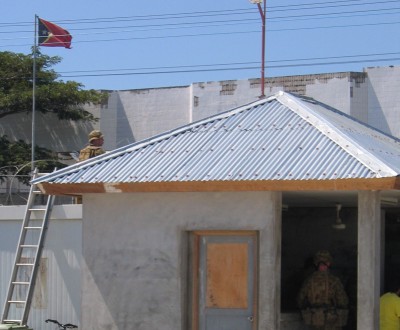
Lots of Australian troops on hand. And a large gathering of Timorese protesting in support of Alkitiri’s removal as Prime Minister. My friend Joao rang me from the midst of the demonstration, and was then to return to his family at the camp at the
airport.
I’d ventured out earlier in the morning to buy food (great sign: two or three shops opening cautiously, though not stocked with fresh vegetables or water). Then drove home to cook for the guards, who’d gone, unsurprisingly, and to drop some sacks of rice and oil off at the nuns’ house next door (reputedly 2500 women and children living in there now, and it’s a small property).
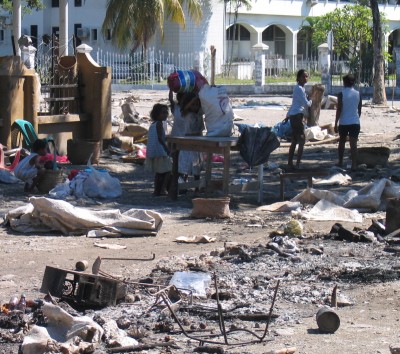
I drove past one of the warehouses, overflowing with thousands of people milling around, and many walking off with their sack of rice. Depressingly, the open-air market I’d regarded as a barometer — with the women still coming out each day to spread their fruits and vegetables and clothing for sale — was now a smouldering waste, with girls picking through the remnants for anything still useful.
In the afternoon, during the demonstration outside Xanana’s office, I drove a Timorese family home, which was a glimmer of confidence in the situation. Early evening, we got clearance to drive home, but ran straight into a blockade by Australian soldiers outside the abandoned military police compound, and had to take a different route (last night was very dark). We were woken around 2am by army tanks rumbling past our house, and learnt this morning of 11 houses burnt nearby (in Bidau).
Still, more signs of both better and worse today. More people moving around the streets. Drove again past the warehouse, and there were still thousands of people but patiently queued (although goodness knows for how long in the increasingly blazing sun). But more outbreaks of violence, especially in Comoro, with a friend ringing me to say that he’d had to make a
break for it through fighting crowds and had arrived safely at the airport for his flight out to join his UN wife and baby in Darwin.
I spent some time in the camp of several thousand people right opposite the UN Barracks. Visited a woman who’d given birth in the camp 3 days ago (one of three babies born there since last Thursday). And, whilst there, I ran into a Timorese colleague living there, and the personal connections increase the frustration and sense of waste. This is one of the competent people employed in the Timorese Government; evidence of the foundations which have been laid for building the Timorese state.
And her first question was to ask what would happen about a child rights media campaign she’d been working on with UNICEF!
She’s ‘west’, her husband’s ‘east’ so had gone to Baucau for safety, and she doesn’t know his fate or that of their house in Dili.
I’ve been trying to keep these musings free of ‘heavier’ stuff (which is not to say I’m not engaged in thinking — or even writing — about it). So I’ll simply add that I couldn’t agree more with the APHEDA posting on this site, especially concerning ‘failed state’ stuff and the success of the Alkitiri Administration (despite my conviction that he has to go) in tackling core development issues, such as health services, the education system and (yes) a national police force.
But, as APHEDA notes, there’s a lot of people still missing out on the benefits of improvements in the social and economic systems. Most notably former resistance fighters living in poverty and unemployed urban young people: clearly a volatile combination.
For now, I wait to find out if the Council of State has made any decisions, and to see what Wednesday brings.
Robert Johnson
Dili, East Timor