Why we want to save it:
History of the North East Highlands National Park
and 7-day bushwalking track
1996 – 2006
DURING the Regional Forest Agreement submission period (1996-97) a group of concerned local north east residents commissioned and assisted the Tasmanian Conservation Trust with the preparation of the document: A new National Park for Tasmania’s Northeast Highlands.
In the document Professor Jamie Kirkpatrick notes … the northeast has suffered more from human impact in the last 200 years than most of Tasmania and has many areas of outstanding significance for their natural values that are yet to gain secure reservation.
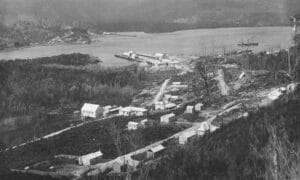
The RFA should have provided protection for a landscape with both a richness of natural significance and a fascinating cultural heritage from the Aboriginal inhabitants many thousands of years ago to the tin mining days of the late 1880’s.
A new National Park for Tasmania’s Northeast Highlands was submitted to the RPDC for its Inquiry into aspects of the RFA. The document assesses the conservation needs and opportunities of the area connecting and including Mt. Victoria and the Blue Tier in northeast Tasmania.
It was as part of this submission that the concept of a multi day walk through the area was first mooted.
Protection of a approximately 3,500 hectares of State Forest is required to form a continuous tract of land through the northeast — from Mount Victoria to the Blue Tier — linking the existing Mt. Victoria, Frome and Blue Tier Reserves. To the east this area covers the entire catchment and headwaters of the George River, to the west it would protect a large percentage of the Ringarooma River catchment.
The recent Community Forest Agreement failed to protect the area surrounding the proposed trail, despite the community again lobbying for this area to be included in the new reserve system.
State wide the Community Forest Agreement added almost 11,000 hectares to Formal Reserves — none of this in the Bass district. The agreement also added 47,000 hectares to Forest Reserves — of this the northeast gained a pitiful 1,700 hectares.
The northeast has lost out
The community forest agreement was supposed to end the dispute over forest management in Tasmania yet, with over a quarter of a million hectares of state forest still available to the timber industry, the northeast has lost out, the people’s concerns appear to have been ignored and the existing reserves throughout the area remain fragmented. The Bass Forests make up a huge chunk of the state’s forested land, roughly a quarter of the state, yet received a mere 3% of the amount of new reserves state-wide.
Given that the Break O’Day municipality has more unprotected State Forest (public land) — approx. 156,000 ha — than any other municipality in Tasmania the protection of the Star of Peace, Emu Flat (the link between the Frome and Blue Tier reserves) and the Groom River Valley would have to be seen as a reasonable compromise. This would require protection of (maximum) a further 3,500 ha (less than 2.5%) of the municipalities unprotected State Forest, which includes some areas that would be unviable for logging due to requirements of the Forest Practices Authority (eg: steepness, scenic values, streamside reserves etc).
Protection of a continuous tract of land from Mt. Victoria to Blue Tier would safeguard the water catchments, protect the rare and endangered ecosystems, protect the native wildlife and their habitat, conserve the valuable historical and culturally significant sites and save something for future generations to enjoy — promoting health by providing nature based activities such as walking and riding.
Upgrading of picnic areas, wheelchair access walks, short walks and a multi-day track that can be walked in sections, or as a 7-day walk, would bring economic benefits to the community — supporting local businesses: eg: Cheese Factory, Local Pubs and Shops as well as Tourist Accommodation and Tour Operators and would provide work for guides, transport operators and catering/food outlets.
Bushwalking promotes health and fitness, also providing an educational opportunity for walkers due to the diversity of the forest types and plants seen on the walk. Native wildlife habitat is highlighted with rotting logs and old growth trees with hollows abundant — allowing walkers to gain a knowledge and understanding of the importance to protect habitat. Also emphasised is the need to protect the headwaters and catchments of our rivers and streams. These fragile watercourses need the full protection of intact ground cover, understorey and canopy to maintain and regulate flow and temperature so that the minute aquatic life that keeps water clean can thrive.
Fantastic array of forest types
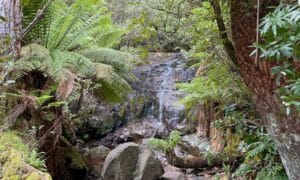
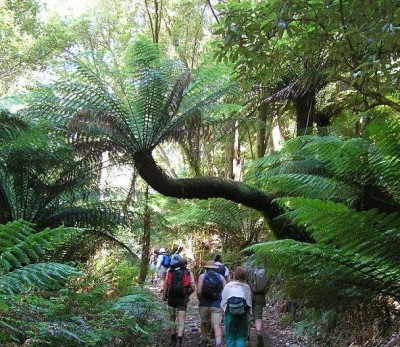
The benefits of a multi-day walking track through Tasmania’s Northeast Highlands are many … the track links numerous existing walks and can be walked as a series of day walks opening the way for a vehicle assisted multi day walk or a wilderness experience for the self sufficient! The track offers walkers a fantastic array of forest types, visits stunning waterfalls, crosses pristine streams, contains many interesting relics from the past mining era, offers sensational views, unusual rock formations and petroglyphs, towering tree ferns, Gondwana forests, glacial refugia, mosses, lichens etc. and is habitat for a great many species of native wildlife
The proposed track was first walked by a group of local women in January 2001 — having mapped and planned the walk for years it was exciting to find that it was not just possible, but had great potential. Countless hours have since been spent re-walking sections, mapping and writing track notes.
In 2002 OUTDOOR Australia magazine Editor and Photographer walked the trail — the cover-story article claimed, “the trail reveals wonders right to the end, offering remarkable variety and a different experience from other Tasmanian trails I have walked. It surpassed all expectations and has the potential to be a truly world-class multi-day walk”. (Carl Roe – Outdoor Magazine Club Editor).
In January 2003 Forestry Tasmania announced plans to investigate the feasibility of the walk. Bass District Forestry Manager Steve Mansson claimed (Examiner Jan 24th 2003) “we’re trying to fit the walking track into existing reserves as well as considering our harvesting plans for the rest of the State Forest”.
Region North (now Northern Regional Development) assumed a lead role in coordinating the involvement of interested parties and a series of meetings were held in Feb. 2004. Again Forestry Tasmania’s Steve Mansson claimed, “Compromises re both the trail alignment and harvesting would be required”.
Feasibility study
In October 2005 the report and feasibility study were released. The Northeast Walking Trail Field Survey was compiled by Peter Ashton for Forestry Tasmania. Using local draft track notes the area was surveyed by Peter Ashton — for every daily section of the track the report states: budgetary constraints meant that I had insufficient time to survey this area. With no disrespect to Peter Ashton this would have to be considered an incomplete survey. Despite this, Peter Ashton’s report states a very real potential exists for a multi-day track from Mt. Victoria to the Blue Tier.
Jo Field, Community Liaison Officer with Forestry Tasmania, prepared the Report on the Northeast Walking Trail Feasibility Survey. The report found the walk “unviable”, failing to acknowledge that the Consultant did indeed support Option 2 of his survey: to go with the through trail idea, but not out to the coast.
It was unanimously agreed at the October meeting in Scottsdale that the proposed section between Blue Tier and Bay of Fires be abandoned due to extensive forestry operations in the area and concerns raised by Parks and Wildlife — allowing the walk to descend into the stunning Groom River Valley — ending at Halls Falls.
The Trail Survey reveals no evidence at all that Forestry have compromised or reconsidered their harvesting plans. Over the past ten years almost the entire Mutual Valley/Weld Hill area has been clearfelled and converted to plantation. Forests surrounding the Frome Reserve have also been heavily targeted, as are the Blue Tier foothills.
In Summary, the Report on the North East Walking Trail Feasibility Survey states:
The consultant’s GPS and flagged routes do not hold enough scenic values and interest to sustain a multi-day walk or individual day-walks, with exception to the Blue Tier where a series of walks have already been developed that include natural and cultural heritage and scenic values.
Having now walked the track in its entirety on 3 separate occasions I find this highly disputable — not only did the Outdoor Magazine crew find that the walk surpassed all expectations, a group of experienced and young walkers recently completed the 7-day track and were overwhelmed by its diversity, breathtaking beauty and accessibility.
Volunteers
History Room Volunteers and Friends of the Blue Tier have for many years, maintained the walks on the Blue Tier.
The report also finds that for many sections of the walk there is little to no scenic value. The photos above will help people decide for themselves — I don’t believe that the report conveys the common view.
With 20 short walks on offer the area is regularly visited by Walking Clubs, Locals, Visitors and Tour Operators. Horse and Mountain bike riders continue to use many of the old tracks as well.
The northeast is unique in that it offers something for everyone. The walks begin with a 15 minute disabled access forest walk, walks under 1 hour, 2 – 4 hour walks, half and full day walks/rides.
Early in 2005 the fantastic but unauthorised walking tracks to the Blue Tier Giant (fattest tree in Tassie), Crystal Hill and the Groom River Trail were closed by Forestry Tasmania. The Anchor Stamper track has also been closed for repairs for over a year.
The proposed National Park area is State Forest and is currently under the control of Forestry Tasmania, the Tasmanian Governments forestry agency.
The mountainous forests have been providing timber to local communities for over one hundred years. Until relatively recent times, this has involved selective logging of the occasional tree with minimal impact on the landscape. More recently large sections have been clearfelled for woodchipping and plantation establishment. Continued industrial scale logging will drastically alter the landscape, destroy biodiversity and cultural values, place at risk the value of the area for recreation and tourism and severely damage the water quality and quantity. By protecting the area we will have a sustainable future, which will also benefit the whole of the region and Tasmania.
Tourism and sustainable agriculture are the only industries for the area, which are sustainable. They are also industries that can be developed and controlled locally, relatively free from international factors over which Tasmania can exert no influence. They are industries that can adapt quickly to accommodate changes in demand. Plantation forestry is entirely dependant upon world markets and influences.
Tourism and sustainable agriculture bring people back into the region because they are labour intensive, bringing services with them. Plantations make little contribution to the local community.
The choice is clear … in fifty years time what is going to benefit local communities and Tasmania most? A sea of plantation (or stumps), water and soil contaminated by chemicals associated with plantation establishment and growth, or a mixture of wet and dry eucalypt and rainforest, a plentiful supply of clean water, clean soil and pure air?
Lesley Nicklason has been campaigning for the preservation of the Blue Tier, near where she lives at Pyengana, for years.
[email protected]