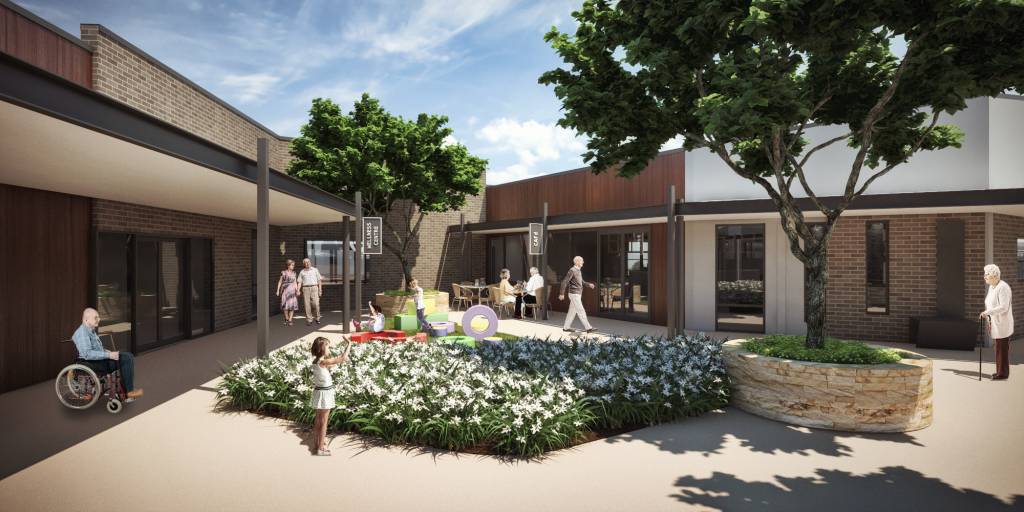
Final plans for a cutting edge Australian first suburban village designed to recreate real life experiences for people living with dementia were unveiled today.
Funded through a social impact investment with industry super fund HESTA, managed by Social Ventures Australia (SVA), and to be built with some assistance from the Commonwealth Government, Korongee’s village structure will be based on a typical Tasmanian streetscape.
Glenview CEO Lucy O’Flaherty said the timing of this project highlights the need to change how we provide care for people who are living with dementia who are no longer able to live in their own home.
“Korongee returns to the simple home truths of ‘it takes a village’, pushing the boundaries in terms of doing something innovative and different in aged care,” she said.
Ms O’Flaherty explained that one of the key elements of the village design is the small house model, which forms the basis of the design of Korongee.
“It highlights the significance of living in small houses with people whose values you share and have something in common with. In large buildings, the sense of institution is unavoidably present when you walk through the front door and any well-meaning ideology can easily be lost. With a village like Korongee, you walk into small homes, all with dementia design principals throughout, and a sense of the everyday is much easier to maintain.”
Ms O’Flaherty said that Korongee’s design will make it possible for residents living with dementia to walk around the village and participate in everyday life decisions which are presently not always available to those in traditional residential based dementia care – activities such as going to the café to buy a coffee or simply heading to the supermarket to buy groceries for dinner.
“In addition to the commercial hub, Korongee will consist of 12 houses, each with eight bedrooms which will be staffed by care professionals who will help reinforce the authentic home like environment,” she said.
Glenview commissioned The University of Tasmania to undertake work in creating a tool based on evidence to enable a matching of individuals and the type of house they move into. This is based on values, demography and a range of other factors.
“Creating an authentic environment is the key to this cutting edge model, with residents within each house to be matched by their similar backgrounds, experiences, interests and skills,” said Ms O’Flaherty.
“The Korongee village concept draws on a range of national and international best practice models, while contextualising this into a uniquely Tasmanian experience.”
HESTA CEO Debby Blakey said the unveiling of final plans and breaking of ground at the Korongee site represents a significant milestone for aged care in Australia.
“HESTA is incredibly proud to partner with Glenview on this project and support innovation in dementia care. Korongee is a huge step forward for dementia care in this country and puts Australia and Tasmania at the forefront of a global push to improve the quality of life of those living with dementia,” Ms Blakey said.
HESTA has invested $19 million towards financing the construction of the facility through its Social Impact Investment Trust. Social Ventures Australia manages the $70 million trust and aims to invest in opportunities that deliver both an appropriate market-based financial return and a measurable social impact.
“Our impact investing program is part of a much bigger focus at HESTA on how we make a real difference to the financial future of every member, and in the process, have a positive impact on the world they will retire into,” Ms Blakey said.
“Through social impact investments like this we’re aiming to encourage other large investors to also invest in addressing big social challenges like dementia care. Even relatively small allocations to impact investing from funds in Australia’s $2.7 trillion superannuation industry can make a huge difference.”
SVA Executive Director, Impact Investing Michael Lynch added:
“Our partnership with HESTA and Glenview in the Korongee project is an example of an opportunity to deploy institutional capital at scale towards social sector projects by funding a new, innovative solution in the growing aged care market.”
Forging a strong connection with the community will be of upmost importance to the success of the project, said Ms O’Flaherty.
“We embrace the immense value to be found in working with local people and embedding Korongee within the community. The significance of social engagement, job creation and education opportunities linked with the community cannot be underestimated.
“Once complete, people will be encouraged to visit the village to enjoy the gardens, visit the beauty salon or have a coffee in the café.”
Director of the Wicking Dementia and Research Centre and Glenview board member James Vickers said with dementia emerging as the most important health issue of the century, the rapidly rising prevalence of this condition would have tremendous impacts across our society.
“It is vitally important to reconfigure our approach to care in order to meet the needs, as well as support the dignity and autonomy, of people living with dementia now and into the future,” he said.
“The built environment and the way we provide support and care have significant effects on personal wellbeing, as well as the progression of dementia, and so the Korongee model is a vital development and will be an internationally leading beacon for innovation in aged and dementia care.”