
Protesting 1080 through Wellington’s streets
Isn’t it just incredible that the people of New Zealand are threatened with deadly poison in their water supplies, on their walking tracks, within the school holidays, and repeatedly over the years close to rural communities, and that this is affecting their ability to gather food from the Public Land?
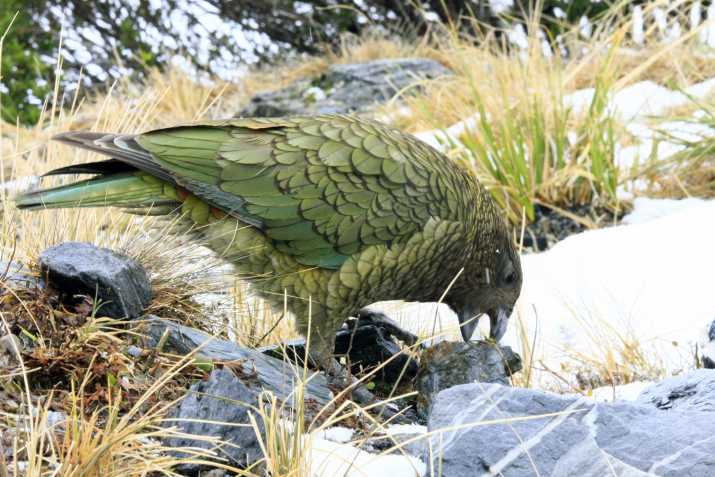
Not the Department of Conservation’s land or “Docland” (as we are accustomed to saying), but New Zealand – public land – our land. Our wild resources. The West Coast of the South Island, habitat of the world’s only alpine parrot, the kea, has undergone repeated aerial-1080 drops for too long now. Isn’t it just amazing that this community, which has suffered great financial hardship and setbacks, is also being pounded by poison?
The Department of Conservation is proud of its poisoning. It joins with other involved government agencies in protecting its right to poison. Meanwhile, the rights of the public to protest and illuminate the impacts of the aerial poisoning are damaged in a publicity storm. Deliberately it seems. DoC wishes to play the victim here and intend to gain the ‘moral high ground’ in a bid to win hearts, at least, if not minds.
Many of those authorities we would traditionally rely upon to safeguard us are ignoring or dismissing the fact that the risks to the environment and the public are real. There goes that elephant in the room again! The devastation to all species in our ecosystems is real, the “Kea Problem” is easily pinpointed, the animal welfare issue is no joke. DoC is not keeping it real. It is playing a game. It’s like chess with lives. Too many lives.
Many of those affected are ordinary people who don’t want their communities impacted by poison dropped from the sky. Is it so surprising? After all, across NZ more than two thirds of the public are against this form of wildlife management (according to a DoC survey released in June 2016). I guess people aren’t seeing the benefits that DoC claims. Hell, even many of the DoC workers aren’t seeing the benefits …
But it’s all about the authorities controlling the dialogue; forcefully if need be. Our battle against ecosystem poisons is being fought via an information war. The pesticide 1080 (sodium monofluoroacetate) is a broad-spectrum poison. Yet it is marketed as ‘targeted’ at so-called ‘pests’ – namely possums, rats and stoats.
Possums need only consume 0.4 % of their daily food ration in 1080-poisoned food, whilst a smaller tomtit-sized bird with normal to high tolerance need only consume 0.6 to 1.2 % of its daily food intake to reach a lethal dose. A larger kea-sized bird would require only 6 to 12.5% of their daily food ration in 1080-poisoned food to reach a lethal dose. (Pietak, 2011) Clearly, 1080-poisoned food, as used in New Zealand’s aerial poison drops, has the capacity to easily kill both mammals and birds if it is ingested in quantities that are small, relative to the normal eating habits of these creatures. Worse still 1080 is an insecticide, depleting and intoxicating many of the food sources of our wildlife.
The term ‘soluble in water’ is sold to the public as if 1080 poison just disappears, when it fact it is stable and highly mobile in water. It takes microbial action to break it down, and warmth. Aerobic bacteria are killed by the presence of 1080 poison potentially leaving behind facultative anaerobic species such as E. Coli, Staphylococcus, Streptococcus and Listeria.
The spreading of mis-information and dishonesty that has been demonstrated by the agencies using 1080 poison needs to end. The fact is, where 1080 poison isn’t used, the forests and its birdlife is healthy compared to where there has been regular use of aerial-1080.
Unfortunately, many people are now so brainwashed about the “terrible pests” they can’t see or hear the truth. It’s a shame, but also a deliberate ploy by the poisoning agencies. Their jobs are now safe until at least 2050. It’s a shame too about the native species that will become extinct through their toxic legacy and mis-management.
What we need is an internationally-independent investigation undertaken into the whole pest industry/predator-free scam, because that’s what it is – an organised fraud with government backing.
There’s every reason under the sun that DoC and the government should be listening to common sense now. And that common sense would say aerial-1080 is not working. It causes rat plagues. It kills across the board of oxygen-using species and is not increasing populations of native species. So-called ‘nesting success’ does not equate to net gain. The kea has been disappearing since 1080 drops escalated in the 1990s. The poisoning programme is making DoC and the government incredibly unpopular; it is inhumane and puts people and domestic animals at risk. The science is patchy and there are evident vested interests.
The time is ripe for the government to help the Department of Conservation come up with a good reason to save face, back down and end the poison drops.
*Michelle Terry lives in sunny Hawkes Bay, on the East Coast of the North Island with her three children. Michelle is an independent writer & researcher. Born in New Zealand, she has lived in Australia, the UK and France. She ‘came home’ to NZ in 2006. Michelle’s career background is in pharmaceutical PR and advertising.

NZ, Brown Teal … Comment 14